If you are looking for the best hosting for website in 2026, start by choosing a host that matches your website and budget. One hosting company is not the best for everyone, so the right choice depends on what you want to build.
Before you buy, think about your traffic, website type, and future growth. This simple step helps you save money today and avoid moving your website later.
| Your Need | Best Choice | Why You Should Choose It |
|---|---|---|
| Overall | Hostinger | Great value, fast servers, AI tools, and beginner-friendly dashboard. |
| WordPress | SiteGround | Excellent WordPress speed, daily backups, and reliable support. |
| Beginners | Bluehost | Easy setup, simple dashboard, and WordPress-friendly tools. |
| Cheapest | Namecheap | Low starting price for personal websites and small blogs. |
| Business | Cloudways | Managed cloud hosting with high performance and easy scaling. |
| Ecommerce | Cloudways | Handles growing online stores with flexible cloud resources. |
| Premium | Kinsta | Premium managed WordPress hosting with strong security and speed. |
| Enterprise | Liquid Web | Built for large websites that need advanced resources and support. |
Editor’s Pick
Hostinger is our Editor’s Pick because it offers the best balance of speed, features, ease of use, and price. Independent reviews in 2026 continue to rank it among the top choices for beginners, bloggers, and small businesses.
Budget Pick
Namecheap is a smart choice if your main goal is to spend as little as possible. It works well for personal blogs, portfolio websites, and small projects that receive low traffic.
Performance Pick
Cloudways is the better option if your website needs faster loading, higher uptime, and room to grow. It is a practical choice for business websites, WooCommerce stores, and websites that expect higher traffic.
Quick takeaway: Choose Hostinger for the best overall value, SiteGround for WordPress, Bluehost if you are just starting, Namecheap for the lowest budget, Cloudways for performance, Kinsta for premium WordPress, and Liquid Web for enterprise websites. This simple guide helps you choose the best hosting for website without paying for features you do not need.
How to Choose the Best Hosting for Your Website
Choosing the best hosting for your website becomes easy when you first understand what your website needs. Instead of buying the most expensive plan, match your hosting with your budget, traffic, and future growth. Google also recommends choosing reliable hosting because page speed, uptime, and server response affect user experience and search performance.
Use This Simple Decision Checklist
Before you buy web hosting, ask yourself these questions:
- Budget: How much can you spend each year?
- Website traffic: Will you get under or over 20,000 visitors each month?
- Business size: Personal, small business, or growing company?
- Website type: Blog, online store, portfolio, agency, news, tutorial, or personal website?
- Growth plan: Will your website need more resources next year?
Choose Hosting Based on Your Website
| Website Type | Best Hosting Choice |
|---|---|
| Personal website | Shared Hosting |
| Learning website | Shared Hosting |
| WordPress blog | Shared Hosting |
| Portfolio | Shared Hosting |
| Small business | Managed WordPress or Cloud Hosting |
| Ecommerce store | Cloud Hosting |
| Agency website | Cloud or VPS Hosting |
| News website | Cloud Hosting |
| Tutorial website | Shared or Cloud Hosting |
When You Do Not Need Expensive Hosting
You can safely start with shared hosting if your website is still small. It saves money and gives enough performance for many new websites.
Choose a basic hosting plan if you have:
- Less than 20,000 monthly visitors
- A simple WordPress blog
- A personal website
- A learning or practice website
- A small portfolio
Upgrade Only When Your Website Grows
Move to VPS or cloud hosting after your website starts getting more visitors or needs more power. Common signs include slow loading, higher traffic, online payments, or running several websites together.
Key Takeaway
The best hosting for your website is not always the most expensive option. Choose a hosting plan that fits your website today, and upgrade only when your traffic, business, or website goals grow.
Types of Website Hosting Explained
Choosing the best hosting for website becomes much easier when you understand how each hosting type works. Each option fits a different budget, traffic level, and technical skill, so picking the right one now can save you money and future headaches.
Shared Hosting
Shared hosting lets many websites use the same server and share its resources. Therefore, it costs the least and works well for new websites with low traffic.
Best for:
- Personal websites
- Blogs
- Portfolios
- Small business websites
- Beginners
Pros
- Lowest price
- Easy to use
- No server management
- Free SSL on most plans
- One-click WordPress installation
Cons
- Slower during heavy traffic
- Limited resources
- Less control
VPS Hosting
A Virtual Private Server (VPS) gives your website its own part of a physical server. As a result, you get better speed, stronger security, and more control than shared hosting.
Best for:
- Growing businesses
- Medium-traffic websites
- Developers
- WooCommerce stores
Pros
- Faster performance
- Dedicated resources
- Better security
- Easy to upgrade
Cons
- Higher price
- Basic server knowledge helps
Cloud Hosting
Cloud hosting runs your website across multiple connected servers instead of just one. Because of this, your website stays online even if one server has a problem, and you can increase resources as traffic grows.
Best for:
- High-traffic websites
- Online stores
- SaaS platforms
- Fast-growing businesses
Pros
- Excellent uptime
- High scalability
- Fast loading speed
- Pay for the resources you use
Cons
- Monthly costs can change
- Some platforms are more technical
Dedicated Hosting
Dedicated hosting gives you one complete physical server for your website only. Therefore, you receive maximum performance, security, and full server control.
Best for:
- Large companies
- Enterprise websites
- Government websites
- Very high-traffic platforms
Pros
- Maximum speed
- Full control
- Highest security
- Handles millions of monthly visitors
Cons
- Highest cost
- Requires server management skills
Managed WordPress Hosting
Managed WordPress hosting is built only for WordPress websites. The hosting company handles updates, backups, security, caching, and performance, so you can focus on creating content instead.
Best for:
- WordPress blogs
- Business websites
- WooCommerce stores
- Agencies
Pros
- Automatic updates
- Daily backups
- Better security
- Optimized WordPress speed
- Expert WordPress support
Cons
- Costs more than shared hosting
- Usually supports only WordPress websites
Website Hosting Comparison
| Hosting Type | Best For | Starting Price* | Skill Level | Performance | Scalability |
|---|---|---|---|---|---|
| Shared Hosting | Beginners, blogs, portfolios | $2–$10/month | Beginner | Good | Low |
| VPS Hosting | Growing websites | $5–$100/month | Intermediate | Very Good | Medium |
| Cloud Hosting | Business and high-traffic websites | $10–$200/month | Intermediate | Excellent | Excellent |
| Dedicated Hosting | Enterprise websites | $80–$500+/month | Advanced | Outstanding | Very High |
| Managed WordPress Hosting | WordPress websites | $3–$25+/month | Beginner | Excellent | High |
*Typical 2026 introductory pricing varies by provider and plan. Renewal prices are usually higher than promotional prices.
Key Takeaways
- Choose Shared Hosting if you are starting your first website.
- Choose VPS Hosting when your traffic grows and you need more power.
- Choose Cloud Hosting if your website receives changing or high traffic.
- Choose Dedicated Hosting only when you need maximum performance and complete control.
- Choose Managed WordPress Hosting if you run a WordPress website and want the hosting company to handle updates, security, and backups.
Now you know how each hosting type works, choosing the best hosting for website becomes much simpler. Start with the hosting that matches your current needs, and upgrade later as your website grows.
Best Hosting Providers Compared
Choosing the best hosting for website depends on your budget, website size, and future plans. Instead of picking the most popular company, choose the one that matches your needs today and lets you upgrade easily later.
Hostinger: Best for Beginners
If you are building your first website, Hostinger gives you almost everything in one place. It combines affordable pricing, an easy control panel, LiteSpeed servers, AI tools, free SSL, and a free domain on eligible plans, making it one of the best choices for beginners.
Key features
- LiteSpeed Web Server for faster loading
- Free SSL certificate
- Free domain for the first year on eligible plans
- Weekly or daily backups, depending on the plan
- AI Website Builder and AI tools
- One-click WordPress installation
- 24/7 live chat support
Pros
- Very beginner-friendly dashboard
- Excellent value for money
- Fast website performance
- Good security features
- Easy WordPress setup
Cons
- Renewal price is higher than the first-term price
- Advanced VPS management still needs technical knowledge
Starting price: Around ₹159/month or about $2.99/month for long-term plans in 2026.
Who should buy
- First-time website owners
- Bloggers
- Students
- Small businesses
- Portfolio websites
Who should avoid
- Large enterprise websites
- Websites with very high traffic that need dedicated infrastructure
Bluehost: Best for WordPress Beginners
Bluehost keeps everything simple from the first login. Its clean dashboard and guided WordPress setup help you launch a website even if you have never used hosting before.
Pros
- Easy dashboard
- Beginner-friendly WordPress setup
- Free domain on eligible plans
- Good learning resources
- Affordable starting price
Cons
- Performance can slow during heavy traffic
- Higher renewal pricing
Best for: Personal blogs, WordPress websites, freelancers, and small business sites.
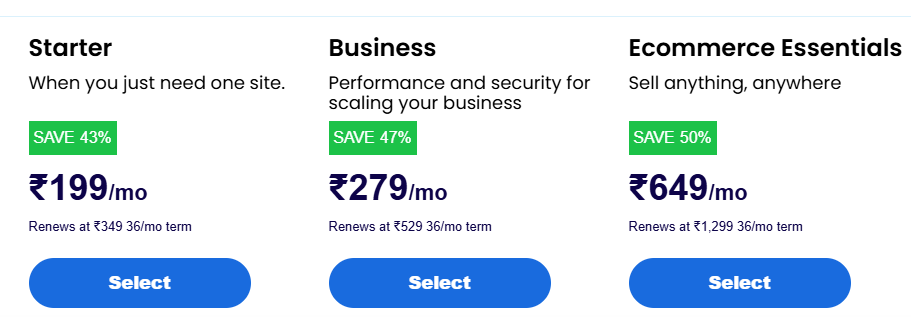
SiteGround: Best Performance and Customer Support
SiteGround runs its platform on Google Cloud infrastructure, which improves speed and reliability. It also has one of the strongest support teams, making it a great choice when you expect your website to grow.
Pros
- Google Cloud infrastructure
- Excellent customer support
- Daily backups
- Strong WordPress tools
- Fast caching technology
Cons
- Higher renewal price
- Limited storage on entry plans
Best for: Growing blogs, business websites, agencies, and WooCommerce stores.
Cloudways: Best Cloud Hosting
Cloudways gives you managed cloud hosting without making server management difficult. You can launch servers on DigitalOcean, AWS, Vultr, Google Cloud, or Linode from one dashboard.
Pros
- High website speed
- Flexible cloud providers
- Easy server scaling
- Managed backups
- Strong performance for busy websites
Cons
- No free domain
- Costs more than shared hosting
- Slight learning curve for beginners
Best for: Ecommerce stores, agencies, SaaS products, and websites with growing traffic.
Namecheap: Best Cheap Hosting
If your budget is very small, Namecheap offers one of the lowest entry prices in the market. You also get a free website builder, email service, and simple cPanel management.
Pros
- Very affordable
- Easy to manage
- Free website builder
- Free SSL
- Good value for personal websites
Cons
- Slower performance than premium hosts
- Fewer advanced features
Best for: Personal websites, small blogs, hobby projects, and students.
Kinsta: Best Managed WordPress Hosting
Kinsta focuses only on managed WordPress hosting, so you do not need to manage servers yourself. It provides premium performance, automatic security, Cloudflare integration, and developer-friendly tools.
Pros
- Excellent WordPress speed
- Automatic scaling
- Advanced security
- Daily backups
- Premium customer support
Cons
- Premium pricing
- Only for WordPress websites
Best for: Professional bloggers, agencies, online businesses, and high-traffic WordPress websites.
Liquid Web: Best Enterprise Hosting
Liquid Web targets businesses that need maximum reliability and dedicated resources. It offers managed VPS, dedicated servers, cloud hosting, and enterprise-level support. ([Website Planet][7])
Pros
- Powerful infrastructure
- Managed enterprise hosting
- Excellent technical support
- High uptime
- Strong security
Cons
- Expensive
- Not suitable for beginners
Best for: Large companies, enterprise applications, mission-critical websites, and high-traffic ecommerce stores.
Quick Hosting Comparison
| Hosting | Speed | Support | Entry Price* | Free SSL | Free Domain | Best For |
|---|---|---|---|---|---|---|
| Hostinger | ⭐⭐⭐⭐⭐ | ⭐⭐⭐⭐☆ | Low | Yes | Yes | Beginners |
| Bluehost | ⭐⭐⭐⭐☆ | ⭐⭐⭐⭐☆ | Low | Yes | Yes | WordPress beginners |
| SiteGround | ⭐⭐⭐⭐⭐ | ⭐⭐⭐⭐⭐ | Medium | Yes | Yes (eligible plans) | Business websites |
| Cloudways | ⭐⭐⭐⭐⭐ | ⭐⭐⭐⭐☆ | Medium | Yes | No | Cloud hosting |
| Namecheap | ⭐⭐⭐☆☆ | ⭐⭐⭐⭐☆ | Very Low | Yes | Limited offers | Budget websites |
| Kinsta | ⭐⭐⭐⭐⭐ | ⭐⭐⭐⭐⭐ | High | Yes | No | Managed WordPress |
| Liquid Web | ⭐⭐⭐⭐⭐ | ⭐⭐⭐⭐⭐ | High | Yes | No | Enterprise websites |
*Entry prices are introductory promotional prices available in 2026 and may change during renewal.
If you still cannot decide on the best hosting for website, keep this simple rule in mind: choose Hostinger if you are starting your first website, Bluehost for an easy WordPress setup, SiteGround for long-term growth, Cloudways for cloud performance, Namecheap if your budget is tight, Kinsta for premium WordPress hosting, and Liquid Web if your business needs enterprise-level performance.
Which Hosting Is Best for Your Website Type?
Choosing the best hosting for your website becomes easy when you match the hosting with your website goals. So, think about what you want to build first, and then pick the hosting that fits your needs.
You do not need the most expensive plan to get started. Instead, choose a hosting plan that gives enough speed, security, and room to grow as your website gets more visitors.
| Website Type | Recommended Hosting | Why It Fits |
|---|---|---|
| Personal Blog | Hostinger | Low cost, fast speed, free SSL, and simple setup. |
| WordPress Website | SiteGround | Strong WordPress tools, daily backups, and excellent support. |
| Small Business Website | SiteGround | Reliable uptime, good security, and easy website management. |
| Portfolio Website | Hostinger | Affordable hosting with fast loading for images and projects. |
| Ecommerce Website | Cloudways | Cloud servers handle more visitors and online orders smoothly. |
| Affiliate Website | Hostinger | Fast pages help improve user experience and SEO. |
| Agency Website | Cloudways | Easy to manage multiple websites and scale resources anytime. |
| News Website | Cloudways | Handles traffic spikes better with cloud infrastructure. |
| Tutorial Website | Hostinger | Good value, fast loading, and enough resources for growing content. |
Quick Tips Before You Buy
Use these simple points to choose the right hosting:
- Start a blog: Pick Hostinger if you want the lowest cost with good performance.
- Build a WordPress website: Choose SiteGround for strong WordPress features and expert support.
- Run a small business: Choose SiteGround for better security and stable uptime.
- Open an online store: Choose Cloudways because cloud hosting grows with your business.
- Manage client websites: Choose Cloudways for flexible cloud servers and easy scaling.
- Publish daily news: Cloud hosting helps your website stay fast during traffic spikes.
- Create tutorials or online guides: Hostinger gives excellent value for content-heavy websites.
Key Takeaway
The best hosting for your website depends on what you build today and how much you expect your website to grow tomorrow. Therefore, choose a hosting provider that matches your budget, website type, and future plans instead of simply buying the most expensive option.
Does Hosting Affect SEO?
Yes, hosting affects SEO because it changes how fast, secure, and reliable your website feels to both visitors and Google. Good hosting cannot make poor content rank first, but it can help strong content perform better when competing with similar pages.
Website Speed Matters
A fast server helps your pages open quickly, so visitors stay longer and enjoy a better experience. Likewise, Google recommends improving Core Web Vitals, and your hosting plays a big part in reaching those goals.
Uptime Keeps Your Website Available
Your website should stay online all day, every day, because Google cannot crawl pages that are often unavailable. Therefore, choose a hosting provider with at least 99.9% uptime to reduce downtime and crawling problems.
Core Web Vitals Start with Good Hosting
Good hosting helps your website pass Google’s three Core Web Vitals more easily. These scores measure how real people experience your website.
| Core Web Vital | Good Target | Why It Matters |
|---|---|---|
| LCP (Largest Contentful Paint) | 2.5 seconds or less | Your main content loads quickly. |
| INP (Interaction to Next Paint) | Less than 200 ms | Your buttons and links respond quickly. |
| CLS (Cumulative Layout Shift) | 0.1 or less | Your page stays stable while loading. |
Google recommends these thresholds because they improve both user experience and search performance.
A CDN Makes Your Website Faster
A Content Delivery Network (CDN) stores copies of your website in many countries. As a result, visitors load your pages from the nearest server instead of one far away.
Server Location Can Reduce Delay
Your server location should be close to your main audience whenever possible. For example, if most visitors come from India, choose an Indian or nearby Asian data center for lower loading time.
HTTPS Builds Trust
Always use HTTPS because it encrypts data between your website and visitors. Most quality hosting providers include a free SSL certificate, so you can secure your site from the first day.
Better Crawlability Helps Google
Google needs a fast and stable server to crawl your pages regularly. However, slow servers, repeated errors, or frequent downtime can reduce crawling and delay indexing.
Key Takeaways
- Fast hosting improves page speed.
- High uptime keeps your website online.
- Better hosting supports LCP, INP, and CLS.
- A CDN reduces loading time worldwide.
- A nearby server improves response time.
- HTTPS protects your visitors.
- Stable hosting helps Google crawl your pages.
Choose your hosting carefully because hosting affects SEO through speed, uptime, Core Web Vitals, security, and crawlability. When your hosting performs well, you give both your visitors and Google a stronger reason to trust your website.
Hosting Costs Explained
Choosing the best hosting for website starts with knowing the real cost. A low starting price looks good, but your total cost depends on several things.
Many hosting companies offer an introductory price for the first billing term. After that, the renewal price is usually much higher, so always check both prices before you buy.
What Is Included in Your Hosting Cost?
A good hosting plan often includes these features at no extra cost:
- Web hosting
- Free domain for the first year
- Free SSL certificate
- Business email
- Website backups
- Free website migration
- CDN for faster loading
- Security tools
However, some providers charge extra for daily backups, premium email, advanced security, or website migration. Therefore, compare the full package instead of only the monthly price.
Introductory Price vs Renewal Price
The first-year discount helps you start with a small budget. However, the renewal price becomes your regular yearly cost, so it matters more in the long run.
For example, an entry-level hosting plan may start at around $2–$5 per month. After renewal, the same plan can cost $8–$15 per month depending on the provider and features.
Hidden Costs You Should Check
Before placing your order, check these items carefully:
- Domain renewal after the first year
- Premium SSL certificate, if required
- Professional email service
- Daily or on-demand backups
- CDN upgrades
- Paid website migration
- Malware removal or advanced security
Paying attention to these costs now helps you avoid unexpected bills later.
Expected Yearly Website Hosting Cost
| Website Need | Estimated Yearly Cost* |
|---|---|
| Basic shared hosting | $30–$120 |
| Managed WordPress hosting | $120–$500 |
| VPS hosting | $100–$600 |
| Cloud hosting | $120–$1,000+ |
| Domain name renewal | $10–$25 |
| SSL certificate | Free–$100+ (many hosts include a free SSL) |
*Prices are typical 2026 market ranges and vary by hosting provider, billing period, and included features.
Key Takeaway
The best hosting for website is not always the cheapest one. Instead, choose a plan with fair renewal pricing, free SSL, backups, migration, and good support because it usually gives you better value over several years.
Common Hosting Mistakes Beginners Make
When you choose the best hosting for website, one wrong decision can waste your money and time. So, learn these common mistakes before you buy your first hosting plan.
Buy Only the Hosting You Need
Many beginners buy VPS or cloud hosting on the first day. However, a simple blog or small business website usually runs well on shared hosting until your traffic grows.
Check the Renewal Price
A low first-year price looks great at first. Still, many hosting companies increase the renewal price by about 20% to 40%, so always check the long-term cost before you pay.
Never Skip Automatic Backups
A website can break after an update or a mistake. Therefore, choose a hosting provider that offers automatic daily backups and one-click restore to recover your site quickly.
Do Not Ignore Uptime
Every minute your website stays offline can cost you visitors and sales. So, look for at least a 99.9% uptime guarantee, and read the Service Level Agreement instead of trusting big marketing claims.
Do Not Trust Advertisements Alone
Every company says it offers the fastest hosting. Instead, read real customer reviews, expert testing, and performance reports before making your final decision.
Test Customer Support First
Good support saves hours when something goes wrong. So, contact the support team before buying and check how quickly they answer your questions.
Do Not Buy Only Because It Is Cheap
The cheapest hosting plan is not always the best value. Instead, compare speed, security, backups, support, and renewal price before you decide.
Check the Data Center Location
Choose a server close to your visitors because a nearby data center helps your pages load faster. For example, if most of your visitors are in India, pick a hosting provider with an Indian data center whenever possible.
Key Takeaways
- Buy hosting that matches your current website size.
- Compare the renewal price, not only the first-year offer.
- Choose automatic daily backups.
- Look for at least 99.9% uptime.
- Read independent reviews before buying.
- Test customer support before payment.
- Never choose hosting only because it is cheap.
- Select a data center near your target audience.
By avoiding these mistakes, you can confidently choose the best hosting for website that fits your budget today and supports your website as it grows.
Frequently Asked Questions
If you are looking for the best hosting for website, these quick answers will help you choose the right hosting with confidence. Moreover, they cover the most common questions that beginners and business owners ask before buying.
What hosting is best?
There is no single hosting that fits everyone. Instead, the best choice depends on your website, budget, and future plans.
For most beginners in 2026, these are safe choices:
| Your Need | Recommended Hosting |
|---|---|
| Best overall value | Hostinger |
| WordPress beginners | Bluehost |
| Small business | SiteGround |
| Cloud hosting | Cloudways |
| Managed WordPress | Kinsta |
| Enterprise website | Liquid Web |
Always compare speed, uptime, support, backups, and renewal price before you buy.
Is Hostinger good?
Yes. Hostinger is one of the best hosting providers for beginners, bloggers, freelancers, and small businesses because it offers fast LiteSpeed servers, free SSL, a free domain on many plans, and an easy control panel at a budget-friendly price. Independent 2026 reviews also praise its value and beginner-friendly features, though you should still check renewal pricing before choosing a long-term plan.
Which hosting is fastest?
Fast hosting depends on the server, not only the company name. Therefore, look for modern features instead of marketing claims.
Choose hosting that includes:
- LiteSpeed or NGINX servers
- NVMe SSD storage
- Built-in CDN
- Server caching
- Data center near your visitors
These features usually improve loading speed and visitor experience.
Can I change hosting?
Yes. You can move your website to another hosting provider whenever you want.
Many hosting companies offer free website migration. Therefore, your website, files, database, and emails can usually move with very little downtime.
What hosting does WordPress recommend?
The official WordPress.org hosting page recommends Bluehost as a long-standing recommended hosting provider for WordPress users. However, many users also choose providers like Hostinger, SiteGround, and Cloudways based on their budget, performance needs, and features.
Do I need cloud hosting?
Not always. In fact, most new websites do not need cloud hosting on the first day.
Use shared hosting if you have:
- A new blog
- A portfolio website
- A local business website
- Less than 20,000 monthly visitors
Choose cloud hosting if you expect:
- High traffic
- WooCommerce stores
- Multiple websites
- Fast growth
- Better scalability
Can hosting improve SEO?
Hosting cannot improve SEO by itself. However, good hosting supports better SEO because it helps your website load faster and stay online.
Good hosting helps by providing:
- Better uptime
- Faster loading speed
- Better Core Web Vitals
- Free SSL certificate
- Reliable server response
Google also recommends focusing on page experience and Core Web Vitals because they improve how users experience your website. Faster and more reliable hosting can support those goals.
Is free hosting worth it?
Free hosting is useful only for learning, testing, or small personal projects. However, it usually comes with storage, bandwidth, performance, and support limits.
If you want to build a real blog, business website, or online store, paid hosting is a much safer choice because it offers better speed, security, and reliability.
Shared vs VPS: Which should you choose?
Choose the option that matches your current needs instead of buying more than you need.
| Hosting Type | Best For |
|---|---|
| Shared Hosting | Beginners, blogs, portfolios, small business websites |
| VPS Hosting | Growing websites, developers, medium traffic, more control |
Start with shared hosting if you are new. Then, upgrade to VPS when your traffic and resource needs increase.
How much hosting do I need?
Most new websites need only a basic shared hosting plan. Therefore, you do not need expensive hosting while you are just starting.
Use this simple guide:
- Personal blog: Basic shared hosting
- Portfolio website: Basic shared hosting
- Small business website: Premium shared hosting
- WooCommerce store: Cloud hosting
- High-traffic website: VPS or cloud hosting
- Enterprise website: Dedicated or managed cloud hosting
Start with the hosting that fits your current website, not your future dreams. As your visitors grow, you can always upgrade to a better plan without rebuilding your website, making it easier to keep using the best hosting for website that matches your needs.
Final Recommendation
If you want the best hosting for website needs in 2026, choose a hosting plan that matches your budget and website goals. This saves money today and makes upgrades easier as your website grows.
Choose the Right Hosting for Your Needs
| Your Need | Best Choice | Why It Fits You |
|---|---|---|
| Budget under $50/year | Hostinger | Low starting price, free SSL, fast LiteSpeed servers, and simple dashboard. |
| First website or beginner | Bluehost | Easy setup, beginner-friendly tools, and strong WordPress support. |
| Small business website | SiteGround | Fast Google Cloud servers, daily backups, and reliable customer support. |
| WooCommerce store | Cloudways | Better speed, flexible cloud resources, and easy scaling for growing stores. |
| Premium WordPress website | Kinsta | High performance, managed security, automatic backups, and expert WordPress support. |
| Large business or enterprise | Liquid Web | Powerful managed hosting with advanced security and dedicated resources. |
Do not buy the biggest hosting plan on your first day. Instead, start with a plan that fits your current traffic and budget.
For example: a new blog or portfolio website usually works well on shared hosting. However, an online store or busy business website often needs cloud hosting for better speed and stability.
Also, look beyond the starting price. Check the renewal cost, uptime guarantee, free backups, security features, server location, and customer support before you buy.
Independent 2026 hosting reviews continue to recommend Hostinger as one of the best overall choices for beginners because it offers strong value, while SiteGround, Cloudways, Kinsta, and Liquid Web remain excellent options for business, cloud, managed WordPress, and enterprise websites.
Quick Decision Guide
- Want the lowest cost: Choose Hostinger.
- Want the easiest setup: Choose Bluehost.
- Want the best business hosting: Choose SiteGround.
- Want fast WooCommerce hosting: Choose Cloudways.
- Want premium managed WordPress: Choose Kinsta.
- Want enterprise-level performance: Choose Liquid Web.
The best hosting for website success is the one that matches your current needs instead of the biggest plan. You can always upgrade later as your website grows.




Leave a Reply