You may want to improve content writing skills, yet writing a useful 2,000-word post can feel hard. You must research facts, answer the reader’s questions, add examples, and follow basic SEO rules.
You also compete with writers and AI tools that can publish content in minutes. Still, faster writing does not always give readers clear, correct, or useful answers.
Think about two writers: one opens a blank page and searches for facts while writing. The other starts with one reader problem, trusted evidence, and a clear outline; that writer works faster because fewer choices remain.
In 2025, bloggers spent about 3 hours and 25 minutes creating one article on average. Google also advises creators to publish original, helpful, people-first content instead of mass-produced pages with little value.
Your real advantage is simple: add sound judgment, direct experience, proof, and useful details. A clear research, drafting, and editing system will help you improve content writing skills and write stronger posts faster.
What Are Content-Writing Skills?
Content writing skills help you turn an idea into useful content for a clear group of readers. You use these skills to understand people, find facts, explain ideas, and guide readers toward the next step.
Good writing starts before you type the first line. First, you must know what your reader wants, what problem they face, and what answer they need.
The main skills required for content writing include:
- Understanding your target audience
- Finding and checking facts
- Organizing ideas in a clear order
- Explaining hard topics in simple words
- Keeping readers interested
- Using basic SEO writing skills
- Editing weak or confusing sentences
- Adding a clear next action
Grammar matters, but grammar alone cannot make a blog post useful. A perfect sentence still fails when it answers the wrong question, repeats common advice, or gives no real example.
A good blog writer helps readers learn, decide, or act. In simple terms, strong content writing skills combine research, clear thinking, useful storytelling, SEO, and careful editing.
Diagnose What Is Weakening Your Writing First
Before you try new writing tips, complete a quick content-writing assessment. You must find the weak part first, or you may waste time fixing the wrong problem.
Rate each skill from 1 to 5: 1 means you struggle with it, while 5 means you can do it with ease.
Seven-Part Writing-Skills Checklist
| Writing skill | Ask yourself |
|---|---|
| Research | Can you find trusted facts, expert views, and useful examples? |
| Reader intent | Do you know what the reader wants to learn or solve? |
| Structure | Does each heading answer one clear question? |
| Clarity | Can a reader understand each sentence on the first read? |
| Voice | Do your views, examples, and experience appear in the article? |
| Editing | Can you remove weak claims, repeated ideas, and extra words? |
| Speed | Can you finish one task without checking tools or changing tabs? |
Now check your lowest score: that is the first skill you should improve. Do not try to fix all your blog-writing mistakes at the same time.
- Low research score: save trusted sources and take short notes.
- Low intent score: study the search query before writing.
- Low structure score: give each section one clear job.
- Low clarity score: shorten and rewrite hard sentences.
- Low voice score: add real views, tests, mistakes, and examples.
- Low editing score: use a separate editing checklist.
- Low speed score: research, draft, and edit in separate sessions.
For example, a boring article may not have a grammar problem; it may lack a clear opinion or real example. Repeat this content-writing assessment after five articles, then compare your scores.
Build Subject Knowledge Before Trying to Write Faster
Research before writing if you want to work faster. When you know the topic well, you stop pausing to find facts, examples, and simple answers.
Start with the reader’s problem—not just the keyword. Ask what they need to know, choose, avoid, or do after reading your post.
Create a Short Content Brief
Your content brief should fit on one page. Add only the facts that support your planned sections:
- The reader’s main problem.
- Key questions that need answers.
- One trusted fact or statistic.
- One or two clear examples.
- A useful process or action plan.
- One risk, limit, or warning.
Keep extra ideas in a file called “Not for This Article.” This simple step stops the post from growing beyond its main goal.
More browser tabs do not mean better blog-post research. Stop when each key question has one credible answer and one useful example.
Practical Example
Suppose you write about email marketing for restaurants. First, note the owner’s main problem, one trusted statistic, two campaign examples, tool needs, one limit, and the steps to send the first email.
Now, build your outline from these notes instead of guessing while you write. Writers in freelance communities also report that research and outlining before drafting can reduce stops and help the first draft move faster.
Google also advises creators to publish helpful and reliable content for people—not pages made only to gain search traffic.
In short: research before writing, limit your sources, and draft from a clear content brief. You will write faster because the hard thinking is already done.
Use a Five-Source Research Stack
Good content research sources help you write with facts, real problems, and fresh ideas. Use these five source types before you start your draft.
1. Study Search Results and Competing Pages
Read the top pages to learn the search intent, common topics, key terms, and reader questions. Also, note weak answers, old facts, and useful points that competitors missed.
Do not copy their headings or writing style. Build a better structure based on what the reader still needs.
2. Find Primary and Trusted Sources
Use government data, academic studies, official documents, and first-party reports. Check the date, author, method, sample size, and country before using any claim.
For example, a company survey may sound strong but may only cover its own customers. Google also advises writers to create reliable content with clear sources, expert knowledge, and real experience.
3. Read Real-User Conversations
Search Reddit, forums, YouTube comments, reviews, and public Q&A pages. These places reveal the words people use, the problems they face, and the questions normal keyword tools may miss.
However, treat each comment as audience research—not proof. Social and video platforms now play a growing role in how people find information, but this creates a mixed and fragmented information space.
4. Learn From Subject Experts
Study expert interviews, podcasts, talks, speeches, newsletters, and live demonstrations. Focus on clear methods, tested advice, warnings, and real results.
5. Add Your Own Evidence
Run a small test, share a screenshot, or show a before-and-after result. You can also add a template, local example, mistake, or short case study.
For example, test two blog outlines and record which one saves more drafting time. This final step turns common content research sources into original insights that readers can trust and apply.
Turn Search Intent Into an Information-Dense Outline
An SEO content outline helps you turn messy research notes into a clear blog post. Start by asking one simple question: what does your reader need from each section?
Give every H2 one reader question and one clear outcome. This keeps your blog-post structure focused and stops you from adding facts that do not help.
Use This Simple Outline Formula
For each H2, write down:
- Reader question: What does the reader want to know?
- Short answer: What is your direct answer?
- Evidence: Which fact, study or expert supports it?
- Example: How can the reader see it in real life?
- Limit: When may this advice not work?
- Action: What should the reader do next?
For example, a heading called “Write Faster” is too broad. Use “How can you write a 2,000-word post faster?” and give the reader a clear method.
Remove Sections That Add No Value
Delete or merge a section when it:
- Repeats an earlier idea.
- Exists only for a keyword.
- Gives no example or action.
- Does not support the title’s promise.
Keywords should guide your headings, but they should not control them. Google recommends using search terms in useful places while creating content mainly for people.
Use this order: problem, principle, method, example, limit and next step. A 2024–2025 writing study found that an adjustable plan–draft–revise workflow improved content coverage and writer satisfaction.
Before drafting, check your search-intent outline once more. Every section should answer a real question and move your reader closer to a useful result.
Draft Faster by Separating Writing From Editing
You can write faster when you stop editing each line as you type. Writing and editing need different kinds of focus, so mixing them often breaks your flow.
Many writers spend 20 minutes fixing the first paragraph. Then, they feel tired before they reach the main part of the post.
Pass 1: Gather Proof and Build an Outline
First, decide what each section must explain, prove, or help the reader do. Add your facts, key points, examples, and trusted sources under the right headings.
Pass 2: Write a Rough Draft
Write one section at a time, and do not chase perfect words. Use notes such as [SOURCE], [EXAMPLE], or [SCREENSHOT] when something is missing.
Start with the easiest section when the introduction feels hard. You can write the opening after you understand the full article.
Pass 3: Fix the Structure
Now, read the whole draft and check the order of your ideas. Move weak sections, fill logic gaps, and remove repeated points.
Revision is more than fixing grammar: it means checking the purpose, proof, order, and meaning of the draft. The UNC Writing Center also treats revision as a wider process of reviewing evidence and reorganising ideas.
Pass 4: Edit Each Sentence
Next, shorten long lines and replace vague words with clear ones. Fix grammar, improve sentence flow, and read difficult parts aloud.
Pass 5: Complete the SEO Review
Add your title, meta description, internal links, images, alt text, and final sources. Then, check every fact before you publish.
Editing while drafting may work for a short topic you know very well. However, most new bloggers write faster when they draft first and edit after writing.
How to Write a 2,000-Word Blog Post Efficiently
You can write a 2,000-word blog post faster when you plan each stage before you begin. Your speed comes from fewer pauses, not faster typing.
A 2025 Orbit Media survey found that bloggers spend about 3 hours and 25 minutes on one article. So, taking three or four hours does not mean you are a slow writer.
Follow This Two-to-Four-Hour Workflow
| Stage | Time | What you produce |
|---|---|---|
| Search intent review | 15–25 minutes | Reader questions and content gaps |
| Focused research | 35–60 minutes | Facts, sources and examples |
| Article outline | 15–20 minutes | Clear section plan |
| First draft | 60–90 minutes | Full rough draft |
| Editing and SEO | 30–45 minutes | Publishable article |
Start by finding the main question your reader wants answered. Then collect only the facts, examples and expert sources needed for that answer.
Next, split 2,000 words into eight sections of about 250 words each. This small target feels easier than facing one long blank page.
Write the first draft without fixing every weak sentence. Use notes such as [add source] or [check fact], and keep moving.
Can You Write 2,000 Words in Two Hours?
Yes, but only when you know the topic well and finish the research first. A proven template, a clear outline and few approval steps also save time.
Do not use two hours as a fixed rule for every article. Medical, legal, financial and product-testing topics need more research, fact-checking and expert review.
Choose the Right Writing Method
- Fastest: Write about a familiar topic with a reusable template.
- Beginner-friendly: Use a four-hour writing plan.
- Safest: Check every fact before publishing.
- Expert-level: Research and outline several related posts together.
- Highest quality: Review the final draft after a long break or the next day.
Finally, read the post once for people and once for search engines. When you write a 2,000-word blog post, clear research and a strong outline will save more time than rushing.
Improve Clarity Before Trying to Sound Creative
To improve writing clarity, first make each idea easy to understand. Creative words have little value when your reader must read a sentence twice.
Clear writing does not mean dull writing. It means your reader understands your point fast and remembers it later.
Use Direct Words and Strong Verbs
Replace abstract phrases with simple actions. For example, write “review the draft” instead of “carry out a review of the draft.”
Use active voice when the person doing the action matters. Write “You should check every source” instead of “Every source should be checked.”
Give the Main Answer First
Do not begin with long background details. State the key point first; then add the reason, example, or warning.
Replace vague claims with exact details. Instead of saying “short sentences work better,” explain that a 15-word sentence is often easier to scan than a 40-word sentence.
Remove Words That Add No Value
Cut words such as “very,” “really,” “actually,” and “in order to” when they do not change the meaning. Also, remove repeated ideas, weak introductions, and unnecessary adjectives.
Read your article aloud after editing. Text-to-speech also helps you hear broken sentence flow, repeated words, and unnatural pauses.
Before and After
Weak: “Content optimization is an important consideration that should be implemented by bloggers.”
Clear: “Bloggers should optimize each article around the reader’s main question.”
Simple writing is not basic writing; it is skilled writing. When you improve writing clarity, your content becomes faster to read, easier to trust, and more useful.
Develop a Genuine Voice That AI Cannot Manufacture for You
A unique writing voice comes from your real views, choices, tests, and mistakes. It does not come from bad grammar, forced slang, or personal stories that add no value.
Say What You Truly Think
Do not hide behind safe lines that any writer could use. Share your honest view, explain why you hold it, and mention when your advice may not work.
For example, I do not believe every blog post needs a long introduction. When a reader searches for a quick fix, a direct answer often works better than a 200-word story.
Add Details Only You Know
Use small facts from your own work: what you tested, where you failed, how long it took, and what changed. These details make authentic blog writing useful because readers can see the lesson in action.
A Hyderabad food blogger may explain how summer heat changes recipe photos, while a freelance writer may show why client edits doubled after skipping the outline. Local details like these make your content harder to copy.
Turn a Generic Paragraph Into Your Own
Start with a plain line such as: “Research improves blog quality.” Then add these four parts:
- One clear example.
- One strong opinion.
- One honest limit.
- One sentence based on your experience.
Your improved version may read: “When I research while drafting, I lose my main point. A 30-minute research pass saves me time, but it may not be enough for medical, legal, or finance topics.”
Use Experience With Purpose
Do not add a personal story only to sound human. Add it when it proves a point, warns the reader, or helps them make a better choice.
Google also advises writers to create helpful, expert-led, non-commodity content that gives readers value beyond common information. Therefore, your unique writing voice should always combine original insights with clear and useful advice.
Make Blog Content Engaging Without Adding Fluff
To create engaging blog content, start with a real problem your reader knows. Then give a clear answer without a long opening.
Use a Simple Flow
Follow this order: problem → reason → example → result → action. This flow keeps the reader interested because each line leads to the next step.
For example, you may spend 20 minutes trying to name one section. Instead, turn the reader’s search query into a useful heading.
Do not write a weak heading like “Research.” Write: “How Much Research Does a Blog Post Need?”
The new heading tells readers what they will learn. It also helps you write the section faster.
Add Value to Every Section
Use these methods to improve reader engagement:
- Start with a pain point.
- Support each claim with a real example.
- Use short stories or mini cases.
- Add a table only when it makes facts easier to compare.
- Use a checklist when readers need to take action.
- Link one idea to the next with words such as “but,” “so,” and “for example.”
- End each section with one clear task.
Avoid open loops that hide the answer for too long. Readers came for help, not suspense.
Here is a useful rule: if a sentence adds no fact, example, warning, or action, remove it. This is the easiest way to avoid content fluff while keeping your blog clear, useful, and engaging.
Practise Writing With Deliberate Exercises
To improve your content-writing skills, do not just “write every day.” Give each writing session one clear goal, so you know what skill you are training.
1. Explain One Hard Idea in 100 Words
Choose a hard topic and explain it in only 100 words. Keep the main meaning, remove jargon, and use a simple example.
This exercise trains you to write clearly. It also shows which parts of the topic you do not yet understand.
2. Write for Three Different Readers
Write one paragraph for a beginner, a professional, and a 10-year-old child. Change the words, examples, and level of detail for each reader.
This teaches you an important lesson: good writing depends on who will read it. One writing style cannot serve every audience.
3. Reverse-Outline a Strong Article
Read a useful article and write one short sentence beside each paragraph. State what that paragraph does: explains, proves, compares, warns, or gives an example.
You will soon see how skilled writers move readers from one idea to the next. Do not copy their words; study their structure.
4. Compress Your Draft
Take a 250-word section and cut it to 150 words. Remove repeated ideas, weak openings, long phrases, and examples that add no value.
Do not remove facts that help the reader act. The goal is not shorter writing; it is denser writing.
5. Upgrade Weak Claims
Find five claims in your draft that lack proof. Add a source, real example, clear reason, or honest limit to each one.
For example, change “short posts rank better” to a careful statement that explains when shorter content may work. Strong content separates evidence from opinion.
6. Transform Your Voice
Take generic advice and add your own view, example, and warning. This makes your writing sound useful rather than copied.
Instead of writing “create an outline,” explain what goes wrong when you skip one. Then show the exact outline format you recommend.
7. Practise Ten Honest Headlines
Write 10 headlines for one topic without using clickbait. Each headline should promise a clear result that the article can truly deliver.
Daily writing practice works only when you measure one skill at a time. Use these deliberate writing exercises for bloggers, track your errors, and repeat the exercise that solves your weakest writing habit.
Use AI as an Assistant, Not as the Author of Your Experience
AI-assisted writing can save you time, but it cannot live your life. Use AI to organize your work; keep facts, opinions, stories, and final choices in your hands.
What AI Can Help You Do
AI works best as a thinking partner. It can help you:
- Find questions your readers may ask.
- Group messy research notes.
- Spot missing points in your outline.
- Suggest clear headlines.
- Flag hard-to-read sentences.
- Check whether your tone changes.
- Show the other side of an argument.
- Build a final editing checklist.
Still, you must check each suggestion. AI may give you a smooth answer that sounds right but contains a weak example or false fact.
What You Must Control
You should choose and verify every source. You must also control:
- Factual claims and statistics.
- Expert advice.
- Personal stories.
- Strong opinions.
- Safety or legal risks.
- Your brand voice.
- The final published draft.
For example, AI can suggest a story about a blogger missing a deadline. Only you can replace it with a real event, such as the day poor research forced you to rewrite half an article.
Follow This Human–AI Workflow
- Define your reader and the result they need.
- Gather facts from trusted sources.
- Ask AI to sort your notes.
- Write or approve the main argument.
- Ask AI to find gaps and unclear lines.
- Rewrite, verify, edit, and publish it yourself.
Try this test: remove your name from the draft. If any blogger could publish the same article, add your own proof, local examples, screenshots, results, mistakes, and clear opinions.
Does AI Content Rank on Google?
Google does not promise better rankings because a person wrote every word. It asks creators to publish helpful, reliable, original content made mainly for people; it also warns against producing many AI pages without adding value.
A Semrush study published on April 1, 2026, found that at least 65% of respondents use AI for research, editing, or on-page SEO. Your real advantage is not avoiding AI; it is using human editing to add experience, judgment, proof, and a voice readers can trust.

Apply SEO Without Damaging Readability
Good SEO content writing starts with the reader, not the keyword. First, understand the problem behind the search, and then give the clearest answer you can.
Match Search Intent Before Adding Keywords
Ask what the reader wants to learn, compare, fix, or buy. For example, a person searching “how to write faster” needs a practical writing process, not a long history of content writing.
I use one simple test: can the reader act after reading the page? If the answer is no, adding more keywords will not save it.
Place Your Main Keyword Naturally
Google advises you to use words people search for in clear places, such as the title, main heading, alt text, and link text. However, each use must help the reader understand the page.
Place your focus keyphrase in:
- SEO title and H1.
- First paragraph.
- One useful H2.
- URL and meta description.
- Image alt text, when it describes the image.
There is no perfect keyword count. Use the phrase when it fits, but never force it into every paragraph.
Answer Related Questions Naturally
Build headings around the reader’s next questions: costs, risks, mistakes, comparisons, steps, and results. This method covers related keyphrases without keyword stuffing.
Give the answer first, and then add proof, an example, or a warning. Clear headings, short definitions, and small tables also help search engines and AI tools understand your content.
Check Your On-Page SEO
Before publishing, confirm that you have:
- One clear H1.
- A logical H2 and H3 order.
- Helpful internal and external links.
- Accurate image alt text.
- A clear SEO title and description.
- A new date only after a real update.
Your final rule is simple: SEO content writing should make your answer easier to find and read. It should never make a human reader work harder.
Edit Your Blog Post in Five Focused Passes
A clear blog-post editing process helps you find errors without reading the same lines again and again. Use these five passes before you publish your article.
Pass 1: Check the Search Intent
First, check whether your article gives the result promised in the title. Place the main answer near the start, and cover every key choice the reader must make.
Pass 2: Fix the Structure
Read only the headings to see whether the article follows a clear order. Remove repeated sections, group related ideas, and move misplaced points to the right place.
Pass 3: Check Facts and Evidence
Verify every fact, date, quote, and number with a trusted source. Also, make sure each citation proves the exact claim beside it, and label forum comments as personal opinions.
Pass 4: Improve Clarity and Voice
Read each sentence once: if you must read it twice, rewrite it. Use direct verbs, short examples, and your own judgment so the article does not sound flat or copied.
Pass 5: Complete the SEO Editing
Use this short content-quality checklist:
- Write a clear title and meta description.
- Check the URL and heading order.
- Add useful internal and external links.
- Add images with accurate alt text.
- Improve spacing and mobile formatting.
- End with one clear call to action.
Google advises writers to use descriptive titles, useful links, and alt text that explains an image’s role on the page.
Do not accept every change suggested by grammar or editing tools. Your final blog-post editing pass should protect your meaning, natural rhythm, niche terms, and personal writing voice.

Common Content-Writing Mistakes That Slow Your Improvement
Content-writing mistakes often begin before you type the first line. When you do not know the reader’s real problem, your post may look useful but fail to give a clear answer.
Starting Without a Clear Plan
Do not research every small point you find online. Set a simple stopping rule: collect enough facts, examples, questions, and trusted sources to answer each heading.
Never copy the full structure of one competing post. Study three or four pages, find what they missed, and build a better outline around your reader’s needs.
Editing Too Early
Do not edit every sentence while writing your first draft. Finish the main idea first; then improve the flow, facts, grammar, and style in separate rounds.
Adding the same keyword every few lines makes your content sound forced. Use related words only when they help you explain the topic.
Trusting Tools Too Much
Always trace a statistic back to its original study or report. A number repeated across many blogs can still be wrong, old, or taken out of context.
Grammar tools can spot errors, but they cannot fully judge meaning, facts, tone, or reader needs. In the same way, publishing raw AI output often creates robotic writing, weak examples, and repeated advice.
Measuring the Wrong Things
Clear writing beats clever writing. Use simple words, and remove personal stories that do not teach, prove, or explain anything.
Do not measure progress only by daily word count. Track reader feedback, editing time, factual errors, search results, and whether your content solves the reader’s problem; fixing these content-writing mistakes will improve your work faster.
Choose the Right Improvement Method for Your Situation
To improve your content writing skills, first find the one area that slows you down. Your best learning method depends on your skill, time, budget, topic, and writing goal.
| Your situation | Best method | Main trade-off |
|---|---|---|
| Complete beginner | Take a basic course and practise each week | Strong base, but progress takes time |
| Non-native English writer | Read simple articles, rewrite them, and ask for feedback | You must practise often |
| Slow freelance writer | Research first, use flexible templates, and edit in stages | Templates may sound repetitive |
| Experienced blogger | Publish original research, tests, and personal views | Each post takes more time |
| Low budget | Use free lessons, books, writing groups, and self-review | You get less personal help |
| Urgent deadline | Narrow the topic and build an evidence-first outline | You have less room to experiment |
| High-risk topic | Use primary sources and ask a qualified expert to review it | The work costs more and takes longer |
| AI-dependent writer | Create your own outline, verify every fact, and rewrite by hand | Your first few drafts may feel slower |
Make Your Choice
Do not chase the fastest method just because another writer uses it. Orbit Media’s 2025 survey found that bloggers spend about 3 hours and 25 minutes on one article, so useful writing still needs time.
For example, a health writer should choose expert review over speed. However, a food blogger writing about a tested Hyderabad breakfast recipe can rely more on personal experience, clear photos, and exact cooking steps.
Google also advises creators to publish helpful, reliable, people-first content that shows real experience or expertise.
Start with your weakest skill, practise it for four weeks, and check your progress. This focused method will improve your content writing skills faster than trying every course, tool, and writing trick at once.
A Practical 30-Day Content-Writing Improvement Plan
Use this 30-day content-writing improvement plan as a small writing lab. You will train one skill each week and track what changes.
Week 1: Find Your Weak Points
Score your research, intent, structure, clarity, voice, SEO, and editing from 1 to 5. Each day, rewrite one paragraph, cut 20% of its words, and read it aloud.
Note repeated problems: long openings, weak verbs, repeated words, or unclear claims. Focus on your two most common errors.
Week 2: Research and Outline
Study the search intent behind five keywords, then build evidence banks for two posts. Save facts, source links, examples, reader questions, and your own notes.
Reverse-outline three strong articles by stating each section’s job in one line. Then turn real reader questions into clear headings.
Week 3: Draft and Add Your Voice
Write three 500-word sections without editing each line. Use markers such as “[source]” or “[example]” and keep drafting.
Add one real observation, tested step, mistake, or local example to each section. Record how many useful words you draft in one focused hour.
Week 4: Edit and Publish
Publish one full post and edit it in five passes: intent, structure, evidence, clarity, and SEO. Check each claim, add internal links, and improve the title and meta description.
Google Search Console reports impressions, clicks, queries, and pages. Track these results, but do not judge your post by rankings alone.
Use a Writing Progress Tracker
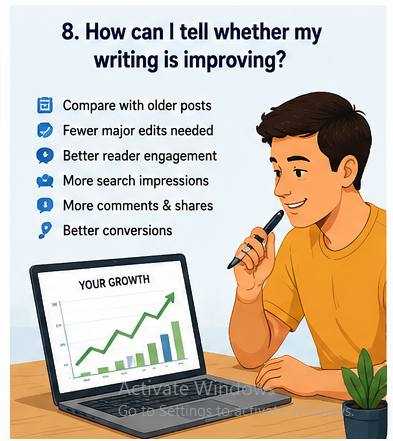
Record your research, drafting, and editing time. Also track major changes, weak claims, readability, clicks, engagement, conversions, and feedback.
Orbit Media’s 2025 survey found that a typical article took about 3 hours and 25 minutes to create. So, better writing matters more than fast typing.
After 30 days, compare your first and final drafts. Your 30-day content-writing improvement plan works when your ideas become clearer, your errors fall, and more readers take action.
How Long Does It Take to Become a Better Content Writer?
There is no fixed time to learn content writing. You may write clearer sentences within two to four weeks, but strong research, judgment, and a natural voice often take months.
Do not expect mastery in 30 days: use that month to build a steady habit. Write, publish, study reader comments and page data, then fix one weak area; focused practice and feedback build skill faster than private writing alone.
Your speed will rise at different rates. A familiar topic may take less time, while a new topic needs more research; Orbit Media’s 2025 survey found that a typical blog post took about 3 hours and 25 minutes.
Track progress with simple checks: Is the structure cleaner, are the examples stronger, and do readers stay or act? When results improve and major edits fall, you are starting to become a better writer and truly learn content writing.
If you enjoy writing, you can earn money by writing blog posts for clients, creating sponsored articles, publishing content on platforms like Medium, or growing your own blog and earning through ads and affiliate commissions.
Conclusion: Improve One Stage at a Time
To improve content writing skills, focus on your writing process, not just your word count. Strong content comes from good research, a clear outline, focused drafting, sound judgment, and careful editing.
Do not try to fix every writing skill at once. Use your diagnostic scorecard, find your weakest stage, and practise one simple exercise for seven days.
You may use AI to collect ideas, arrange notes, or check unclear sentences. However, you must verify the facts, add your own experience, and make the final choice about what readers should do.
Now, open one unfinished article: turn the reader’s main questions into headings, then write the first draft without editing each line. Record your writing time before and after this method; this simple test will show whether your plan helps you improve content writing skills.
Frequently Asked Questions
How can beginners improve their content-writing skills?
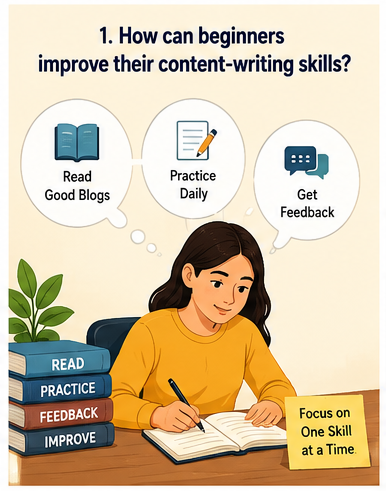
To improve content writing skills, start with short articles about topics you know well; then focus on clear sentences, useful examples, and a simple structure. Read good blogs, rewrite weak paragraphs, ask for honest feedback, and fix one skill at a time instead of trying to learn everything in one day.
Does writing every day improve content writing?
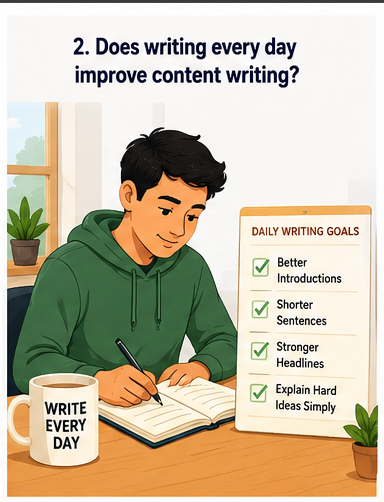
Yes, daily writing can help, but only when you practise with a clear goal; writing the same weak way each day may repeat your mistakes. Spend 20 minutes on one task, such as writing better introductions, shortening long sentences, improving headlines, or explaining a hard idea in simple words.
How can I write blog posts faster without losing quality?
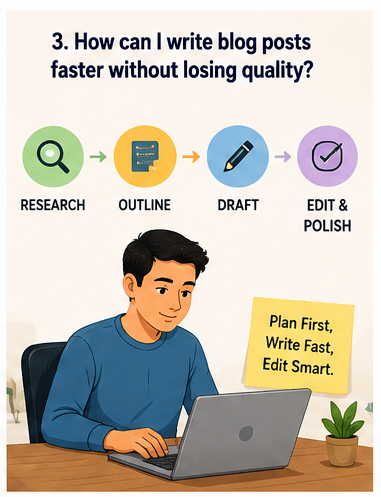
Research the topic first, collect trusted facts, and create headings before you start the draft; this removes many small decisions while writing. Draft each section without stopping to polish every sentence, and then check the structure, facts, grammar, links, and on-page SEO in separate editing rounds.
Can a 2,000-word article be written in two hours?
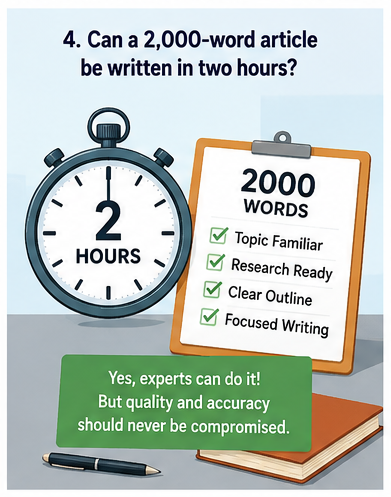
Yes, an expert may write 2,000 words in two hours when the topic is familiar, the research is ready, and the outline is clear. However, Orbit Media’s 2025 survey found that bloggers spent about 3 hours and 25 minutes on an average article, so do not trade accuracy for speed.
How do I make my writing sound natural instead of AI-generated?
Write as though you are helping one real person sitting beside you; use short sentences, direct advice, local examples, honest opinions, and lessons from your own work. Remove broad claims such as “content is king,” and replace them with exact details, tested steps, mistakes, limits, and results that readers can check.
Is content writing difficult for non-native English speakers?
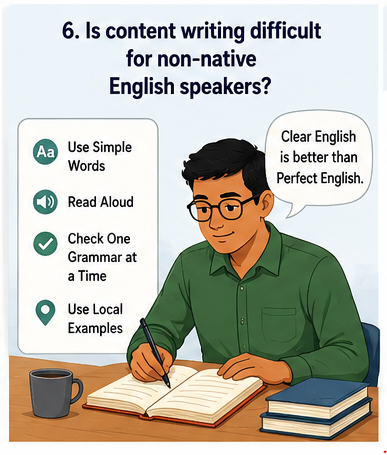
Content writing may feel hard at first, but you do not need rare words or perfect native-style English to help readers. Use simple words, read your draft aloud, check one grammar issue at a time, and keep examples close to your audience; clear Indian English is better than forced, complex English.
Should I use AI to write blog content?
Use AI to find questions, arrange notes, suggest headlines, or spot unclear lines; however, you should verify every fact and write the final advice in your own voice. Google says its systems focus on helpful, reliable, people-first content, not simply whether AI helped during the writing process.
How can I tell whether my writing is improving?
Compare your new work with an article you wrote one month earlier; check whether your ideas are clearer, your examples are stronger, and you need fewer major edits. Also track writing time, reader comments, search impressions, engagement, and conversions because real progress in content writing skills should help both you and your readers.




Leave a Reply