Your success in life starts with one clear goal and one small step each day. In 2026, real success also means protecting your peace, because both grow together.
Meaning of Success
The meaning of success is simple: reaching your goals without losing your health, family, or peace of mind. A truly successful person builds good habits, keeps learning, and enjoys the journey instead of chasing only money.
How to Get Success in 2026
Use this simple plan:
- Set one clear goal.
- Learn one new skill every week.
- Spend at least 30 minutes daily on focused work.
- Sleep 7–9 hours every night.
- Review your progress every Sunday.
These small actions help you become successful in life, even when the world changes fast with AI and new technology.
Key Takeaway
If you want to know how to get success in 2026, remember this: grow your skills, protect your peace, and stay consistent. Your success in life comes from small daily actions that you repeat every single day.
These are Real Words from My Own Experience
You are not looking for another success story. You want how to get success when life feels confusing and nothing works.
Many people feel stuck every day. So, you may even ask yourself: Why am I failing when I work so hard?
The truth is simple: you do not need another motivational speech. Instead, you need a practical roadmap that helps you understand success in life from every angle.
That is exactly what this guide gives you. It helps you stop guessing and start moving in the right direction.
What You Will Learn
By the end of this guide, you will clearly understand:
- What success really looks like.
- Why many people fail again and again.
- Why even talented people fail.
- Why consistency beats talent over time.
- How to bounce back after failure.
- How family, money, peace, and daily habits affect your future.
- The real formula behind long-term success.
- How to become successful without chasing shortcuts.
Why This Guide Is Different
Most articles start with habits and morning routines. However, real change starts after you understand your own problem first.
When you know what holds you back, every next step becomes easier. Then you can build lasting success in life with clear actions instead of empty motivation.
What Does Success Really Mean?
Many people ask what is success, but the answer is different for every person. The meaning of success depends on your goals, your values, and the life you want to build.
Money alone cannot define success in life. Likewise, peace alone or fame alone cannot define it because real success needs balance.
Success Changes with Your Life
Your idea of success changes as you grow. Therefore, what feels important at age 18 may not matter the same way at age 40.
- A student wants good marks.
- A parent wants a happy family.
- An entrepreneur wants a growing business.
- A farmer wants a healthy harvest.
- A teacher wants successful students.
- A doctor wants healthy patients.
So, what does success really mean? It means reaching meaningful goals without harming yourself or other people.
A Simple Example
| Person | Life Situation |
|---|---|
| Kishan | Rich, famous, but has no peace of mind |
| Srinivas | Average income, healthy family, peaceful mind, and helps others |
Now ask yourself:
Who do you think is more successful?
Most people choose Srinivas because the real meaning of success is not only about earning more. It is also about living well, staying healthy, building good relationships, and creating value for society. This idea matches the view that success is measured by the positive difference you make, not only by money.
Key Takeaway
The success meaning in life is personal, but strong success usually includes:
- Meaningful goals
- Good health
- Peace of mind
- Healthy relationships
- Honest work
- Positive value for society
In the next section, you will learn how this connects with the deeper Meaning of Life, and why both ideas work together to build a fulfilling future.
Can Everyone Become Successful?
Many people ask: can everyone become successful. The honest answer is no, but almost everyone can become better than yesterday.
You do not start from the same place as someone else. Therefore, your journey and your result will also be different.
Everyone Starts from a Different Place
Some people begin life with more support. Others must fight for every small step.
Your starting point may include:
- Rich or poor family
- Good or weak education
- Healthy body or disability
- Peaceful home or difficult environment
- Safe country or conflict area
Because of these differences, is success possible for everyone in exactly the same way? No, it is not.
Success Is Not Equal
Think about two people who work equally hard. One may have better schools, money, and guidance from childhood.
The other may spend years solving basic problems before reaching the same goal. Therefore, comparing both people is never fair.
| Situation | Possible Effect |
|---|---|
| Strong family support | Faster progress |
| Limited money | Fewer opportunities |
| Good education | Better career choices |
| Disability or illness | Extra daily challenges |
| Safe environment | More focus on growth |
Growth Is Available for Everyone
Instead of asking can anyone become successful, ask yourself one better question: “Can I become better than yesterday?”
That answer is usually yes. Small daily improvement often creates big results over time.
Avoid fake motivation like, “You can become anything.” A better truth is: You can become the best version of yourself.
What Global Data Shows
Recent global reports also show that opportunity is not equal. Around 273 million children and young people remain out of school worldwide, while entrepreneurship stays strong across many countries but still depends heavily on education, finance, and local support systems.
So, is success possible for every person in the same way? No, but steady growth, learning, and personal progress remain possible for almost everyone who keeps moving forward.
Why Do People Fail Even When They Have Talent?
If you wonder why people fail, you are not alone. Most failure in life happens because daily habits become weak, not because talent is missing.
Talent Helps: But Consistency Wins
Talent gives you a fast start. However, consistency helps you finish the race.
You can practice one small skill every day. Then, after months, your steady work beats natural talent.
Many successful people repeat simple work for years. Therefore, they improve while others stop halfway.
Why Talented People Fail in Life
Many people ask, why talented people fail in life. The answer is often simple: they stop doing the work.
| Reason | What Happens |
|---|---|
| Inconsistency | You work only when you feel excited. |
| Fear | You avoid trying because you fear failure. |
| Laziness | Small delays become big problems. |
| Distractions | Social media and notifications steal your focus. |
| Too many goals | You start many things but finish none. |
| Poor planning | You stay busy but make little progress. |
| Ego | You stop learning because you think you know enough. |
| Lack of patience | You expect quick success and quit early. |
| Giving up early | You leave just before results appear. |
“I Start Everything but Never Finish”
Many Reddit users share the same problem. They say, “I start everything but never finish.”
If this sounds like you, choose only one goal. Then work on it every day until you complete it.
Do not chase a new idea every week. Instead, finish one small task before starting another.
Common Mistakes That Keep You Stuck
Avoid these common mistakes:
- Waiting for motivation before working
- Comparing yourself with other people
- Learning all the time without taking action
- Blaming luck for every result
- Quitting after one failure
Practical Wisdom
Talent opens the door. Daily action keeps the door open.
Results come from repeating simple work, even on days when you do not feel excited. That is the biggest difference between people who succeed and the reasons people fail repeatedly.
In the end, why people fail has less to do with talent and more to do with what they choose to do every single day.
H2: Successful People vs Failed People — The Real Difference
When you understand the difference between success and failure, your daily choices start changing. The real gap between successful people and failed people is not talent, luck, money, or education.
Success and Failure Start with Daily Choices
Many people think success happens in one big moment. However, success grows from small actions that you repeat every day.
Failure also grows the same way. Small bad habits become bigger problems after weeks, months, and years.
Successful People vs Failed People
| Successful People | Failed People |
|---|---|
| Stay consistent | Quit often |
| Learn daily | Stop learning |
| Accept mistakes | Blame others |
| Observe deeply | Ignore lessons |
| Build habits | Depend on motivation |
| Finish work | Leave work halfway |
| Stay calm | Panic quickly |
| Think long term | Think only about today |
What Successful People Do Differently
The best successful people habits look simple at first. Yet, they create big results over time.
- They keep learning every day.
- They improve a little every week.
- They finish what they start.
- They accept feedback without feeling hurt.
- They build routines instead of waiting for motivation.
- They solve problems instead of making excuses.
These habits may look small today. However, after one year they create a huge difference.
Why Successful People Succeed
Many people ask: why successful people succeed while others stop early. The answer is surprisingly simple.
Successful people do not avoid failure. Instead, they keep moving after every failure.
Think about famous athletes, scientists, artists, and entrepreneurs. Many of them lose competitions, fail experiments, launch products that do not work, or hear hundreds of “No” answers before one success.
That is why failure never becomes their final story. They simply continue until something works.
Remember These Important Truths
- Failure is not a person.
- Failure is an event.
- Success is also temporary.
- Your daily actions decide tomorrow.
- Consistency beats motivation almost every time.
These simple ideas help you recover faster. They also help you keep improving every single day.
Related Reading: Daily Habits of Successful People
Key Takeaway
The real difference between success and failure appears in your daily routine, not in one lucky day. If you keep learning, stay consistent, and continue after every setback, you slowly build the habits that make successful people stand out.
Is There Any Secret or Shortcut to Success?
You may keep searching for the secret of success, but the truth is simple: there is no permanent shortcut to success. Every lasting success comes from daily work that you keep doing, even when nobody notices.
The Truth Behind Every Success
You usually see the result, not the journey. However, you rarely see these hidden years:
- Daily practice
- Rejections
- Failures
- Self-discipline
- Learning from mistakes
- Staying consistent
That is why many people ask, is there any shortcut to become successful. The honest answer is no, because every strong result needs time.
Luck Helps, but Preparation Wins
Yes, luck exists and timing matters. Still, preparation decides who can use the opportunity when it finally arrives.
Think about two people getting the same chance. The one who prepared for months or years almost always performs better.
Shortcut Mindset vs Long-Term Consistency
| Shortcut Mindset | Long-Term Consistency |
|---|---|
| Wants quick results | Builds skills every day |
| Gives up easily | Keeps going after failure |
| Looks for easy tricks | Follows simple habits |
| Depends on luck | Creates more chances |
The Real Secret Behind Successful People
The secret behind successful people is not hidden. They simply repeat the right actions until those actions become normal.
Research on deliberate practice by psychologist K. Anders Ericsson shows that expert performance grows through focused practice over many years, not talent alone. Habit research also finds that a new habit takes about 59–66 days on average to become automatic, although the time differs from person to person.
The One Secret Most People Ignore
Many YouTube comments ask, “Tell me one secret.” The answer is simple: consistency.
Consistency is not exciting. That is exactly why most people avoid it.
If you want the real secret of success, stop chasing every shortcut to success and keep improving one small step every day. That simple habit gives you the best chance to succeed over time.
Does Family Background, Genetics, or Luck Decide Success?
The short answer is no. If you ask does family background affect success, the truth is that no single factor decides your future.
Many things shape your journey. However, your daily choices decide how far you finally go.
Every Factor Plays a Part
Family support can give you confidence. Financial background can give you better schools, tools, or training.
Good health helps you work with more energy. Education helps you learn faster and solve better problems.
Your personality also matters: patience, discipline, and curiosity help you improve every year. Meanwhile, your environment, timing, and opportunities can open or close many doors.
Scientists also study genetics and success. Genetics may influence traits such as memory, height, or natural ability, but it does not decide your career or achievements by itself.
Does Luck Matter?
Many people ask: does luck matter for success. Luck can help you meet the right person, find a good job, or start at the right time.
Still, luck usually creates an opportunity. Your preparation and action decide whether you can use it.
Does Family Background Help?
Some people start ahead because of their family. This is common in business, politics, cinema, sports, farming, and other family professions.
They often receive early experience, strong networks, useful advice, and financial support. Even then, these advantages do not guarantee long-term success because poor decisions can waste every opportunity.
On the other hand, many first-generation entrepreneurs, scientists, artists, athletes, and professionals build successful careers without inherited wealth or powerful connections. Research across OECD countries also shows that parental background influences education and income, but it does not completely decide adult success because education, skills, and personal effort continue to change outcomes.
Practical Example
| Person | Starting Point | Long-Term Result |
|---|---|---|
| Person A | Plenty of money, but no discipline | Progress often slows or stops |
| Person B | Limited resources, but works every day for years | Keeps growing and creates more opportunities |
Now ask yourself: which person is more likely to keep improving after 10 years?
Key Points
- Family support can make the beginning easier.
- Money can create early opportunities.
- Genetics may influence some natural abilities.
- Luck can open doors at the right time.
- Discipline, learning, and consistent effort keep success growing.
- Can poor people become successful? Yes. Many people do it through steady learning, smart decisions, and years of consistent work.
- Do successful people have rich families? Some do, but many build success without inherited advantages.
Your starting point is never your final destination. When you understand does family background affect success, you also see that your daily habits, learning, and consistent action have the biggest influence on how far you can go.
Why Consistency Is More Powerful Than Talent
Many people believe talent vs consistency decides success. In real life, consistency leads to success because small daily work grows into big results over time.
Why Consistency Is Important
Talent can help you start fast. However, consistency helps you keep moving when the work becomes hard.
Your motivation changes every day. Still, discipline helps you follow the same routine even when you do not feel excited. Research in psychology also shows that routines last longer than motivation because habits need less mental effort over time.
That is why many successful people never wait for the perfect mood. Instead, they simply do the next small task.
Consistency Beats Talent in Daily Life
Think about these simple examples:
| Person | Daily Action | Long-Term Result |
|---|---|---|
| Farmer | Waters crops every day | Healthy harvest after months |
| Musician | Practices every day | Better speed and confidence |
| Athlete | Trains for years | Strong performance in competitions |
| Blogger | Publishes useful articles regularly | More readers and higher Google trust |
| Business owner | Improves one small process each day | Steady business growth |
None of these people become experts in one week. They simply repeat the right work every day.
How Consistency Creates Success
Your progress usually follows this simple path:
- Small daily actions
- ↓
- Weekly improvement
- ↓
- Monthly progress
- ↓
- Years of experience
- ↓
- Mastery
This is daily consistency for success. Every small step looks tiny today, but together they create huge results after months and years.
Why Do People Quit?
Many people stop because they expect quick results. Then they feel disappointed when nothing changes after a few days.
Real growth works differently. A bamboo plant grows underground for years before growing rapidly above the soil, and many skills develop in the same way because the foundation comes first. Success often becomes visible only after long, steady effort.
Key Takeaways
- Motivation comes and goes.
- Discipline builds routines.
- Small actions grow into big results.
- Consistency beats talent in the long run.
- Never judge your progress too early.
If you want to stay consistent every day, read our guide on How to Build Self-Discipline. That simple habit can help you keep moving until your hard work turns into mastery.
In the end, remember this simple truth: consistency leads to success because people who keep learning, improving, and showing up every day almost always move further than people who depend only on talent.
Why You Must Change Yourself Before Expecting Success
Your journey to change yourself starts long before your results change. Your outside life often shows what your daily habits look like inside.
Why Should You Change Yourself?
Many people ask, “Why should I change myself?” The simple answer is this: your future follows your daily actions.
Your personality does not need to change. Your behavior, skills, and responses do.
Success comes from self improvement every day. Small changes become big results over time. Research also shows that many daily actions happen automatically through habits, so changing your habits changes your direction.
Areas That Need Self Improvement
You do not need to improve everything at once. Start with the areas that affect your life every day.
| Area | Simple Improvement |
|---|---|
| Thinking | Replace excuses with solutions. |
| Habits | Build one good habit each week. |
| Communication | Listen before you speak. |
| Patience | Stay calm before reacting. |
| Responsibility | Own your mistakes and fix them. |
| Time management | Plan your top three tasks each morning. |
| Emotional control | Pause for 10 seconds before responding. |
| Learning attitude | Learn one new thing every day. |
| Decision making | Think about long-term results, not short-term comfort. |
How to Improve Yourself for Success
Many people look for secret success tips. However, personal development for success is usually simple.
- Wake up with a plan.
- Finish what you start.
- Keep learning new skills.
- Accept useful feedback.
- Stay consistent even on hard days.
These actions slowly build personal growth. Then your confidence grows with them.
Knowledge Is Not the Problem
Many people say, “I know what to do, but why don’t I do it?” That is the gap between knowledge and action.
Reading teaches you ideas. Taking action changes your life.
Do not wait until you feel ready. Start before you feel confident.
Practical Exercise
Ask yourself this question:
“If your daily routine stays exactly the same for the next five years, will your life change?”
If your answer is “No,” then today is the best day to begin. One small action today is better than one perfect plan tomorrow.
Key Takeaways
- Your external life reflects your internal habits.
- Changing yourself does not mean changing your personality.
- Improve your behavior, skills, and daily responses.
- Small habits create long-term success.
- Close the gap between knowing and doing.
- Change yourself one step at a time, and your success will begin to follow.
Physical Health and Mental Strength — The Foundation of Long-Term Success
Your physical health shapes how well your brain works every day. Better energy helps you think clearly, stay calm, and keep moving toward success.
Why Your Body Helps Your Brain
Your brain needs sleep, movement, water, and healthy food every day. Without them, your focus becomes weak and small tasks feel harder.
Research in 2025 shows that regular physical activity and enough sleep improve memory, attention, and thinking ability. Studies also show that about 30 minutes of moderate exercise and at least 6 hours of sleep can improve cognitive performance the next day.
Daily Habits That Build Success
Small habits create big results over time. You do not need a perfect routine to start.
| Habit | Practical Action | Benefit |
|---|---|---|
| Sleep | Sleep at the same time every night for 7–9 hours. | Better focus and memory |
| Walking | Walk for 20–30 minutes every day. | More energy and lower stress |
| Exercise | Do simple strength or cardio exercise 3–5 days each week. | Better brain performance |
| Healthy food | Eat fruits, vegetables, whole grains, and protein. | Steady energy all day |
| Hydration | Drink enough water throughout the day. | Better attention and thinking |
| Meditation | Sit quietly for 5–10 minutes daily. | Calmer mind |
| Deep breathing | Take slow deep breaths before stressful work. | Better emotional control |
Does Exercise Help Success?
Yes, it does. Exercise for success is not only about building muscles.
Regular movement improves blood flow to your brain. As a result, you learn faster, solve problems better, and stay productive for longer. Recent research also links regular physical activity with stronger memory, attention, and executive function.
Mental Strength Helps You Keep Going
Strong mental health helps you stay steady during difficult times. It lets you recover instead of giving up.
Real mental strength includes:
- Emotional control
- Better focus
- Patience
- Adaptability
- Recovery after setbacks
- Positive thinking under pressure
These skills grow with daily practice. They do not appear overnight.
Healthy Habits for Successful People
Successful people protect both physical and mental fitness for success. They know that long-term results come from daily discipline.
You can start with simple habits:
- Walk every day.
- Sleep at the same time.
- Reduce unnecessary screen time.
- Spend time in nature.
- Eat healthy food.
- Drink enough water.
- Practice meditation.
- Take deep breaths during stress.
- Spend a few quiet minutes reflecting every day.
These habits cost very little. However, they give long-term rewards.
Key Takeaways
- Healthy body supports a healthy brain.
- Good sleep improves memory, focus, and learning.
- Daily walking and exercise improve productivity.
- Healthy food and hydration keep your energy steady.
- Mental strength grows through patience and practice.
- Small daily habits create lasting success.
Your physical health and mental strength work together every single day. Build these simple habits now, and you will create a stronger foundation for lasting success in every part of your life.
Family, Friends, Nature, and Environment — Hidden Teachers of Success
Your environment and success always move together. You never build success alone, because people and places shape your daily choices.
Every day, your family, friends, and surroundings teach you something. Therefore, you should notice what they teach instead of only looking for lessons in books.
Family: Your First Teacher
Your family support starts long before school or work. It teaches values, respect, honesty, discipline, and responsibility.
Good family support gives you confidence during hard times. A few kind words can help you continue when you feel like giving up.
At the same time, some families create pressure. High expectations, comparisons, or fear of failure can reduce confidence.
So, learn from both situations. Keep the good values and leave unhealthy habits behind.
Friends: They Shape Your Future
The importance of good friends is much bigger than most people think. You slowly become like the people you spend time with.
Ask yourself these simple questions:
- Do your friends encourage learning?
- Do they respect your goals?
- Do they solve problems instead of complaining?
- Do they celebrate your progress?
If the answer is yes, stay close to them. If not, slowly spend more time with people who help you grow. This is one of the easiest answers to how environment affects success.
Nature Teaches Success Better Than Many Books
Many people ask, what nature teaches us. The answer is simple: nature teaches success every single day.
Look around carefully:
| Nature shows | Success lesson |
|---|---|
| A seed | Small actions become big results. |
| A tree | Strong roots build lasting success. |
| The seasons | Every stage has its own time. |
| A river | Keep moving around problems. |
| Sunrise | Every day gives a fresh start. |
Nature never rushes, yet everything grows at the right time. That is why patience is one of the biggest success skills. Research also shows that spending time in nature improves well-being and concentration.
Learn from Ordinary People
Success lessons are everywhere. Therefore, talk with people who have real experience.
Learn from:
- Farmers who understand patience.
- Craftsmen who improve through practice.
- Teachers who explain difficult ideas simply.
- Skilled workers who solve problems every day.
- Elders who have learned from many life experiences.
Watch how ordinary people handle challenges. Their practical knowledge often teaches more than long speeches.
Practical Activity
Today, spend one full hour outside without your phone.
Then write down 10 lessons you notice from people, nature, or your surroundings. This simple habit helps you understand the real connection between environment and success, and you will start finding teachers everywhere.
Know Yourself Before Chasing Success
Before you chase success, first know yourself. You cannot choose the right path until you clearly understand yourself and what truly matters to you.
Why Self Awareness Matters
Many people copy someone else’s dream. However, that often leads to stress, regret, and wasted years.
Good self awareness for success helps you make better choices. It also helps you stay confident when life becomes difficult.
Start Looking at Your Own Life
Do not compare your story with anyone else. Instead, look at your own experiences and answer honestly.
Think about these areas:
- Childhood interests: What did you enjoy without anyone forcing you?
- Strengths: What comes naturally to you?
- Weaknesses: What do you still need to improve?
- Mistakes: Which problems do you repeat again and again?
- Achievements: Which moments make you feel proud?
- Fears: What usually stops you from taking action?
- Influential people: Who changed your thinking?
- Important life events: Which experiences shaped your life?
- Values: What matters most to you?
- Dreams: What kind of future do you truly want?
How to Know Yourself Better
If you ask, “How do I know myself?” start by writing your answers in a notebook. Even 10 minutes each day can reveal clear patterns over time.
If you wonder, “How do I discover my strengths?” look at your daily work and feedback. Notice the tasks that feel easy to you and the work that others often praise.
Self-Reflection Checklist
Ask yourself these questions:
| Question | Why It Matters |
|---|---|
| What work gives me energy? | It shows your natural interests. |
| What work drains me? | It helps you avoid the wrong path. |
| What do people appreciate in me? | It reveals understanding your strengths. |
| What mistakes do I repeat? | It shows where you need to grow. |
| What do I truly enjoy learning? | It points toward long-term success. |
| What kind of life do I want in ten years? | It gives your decisions a clear direction. |
Your Answers Build Your Future
There is no perfect answer, so stay honest with yourself. Small discoveries today can completely change your future over the next few years.
Purpose becomes clear when your strengths, values, and actions work together. Then every step feels more meaningful and easier to follow.
Key Takeaway: You cannot choose the right path until you understand yourself.
Next Read: How to Find Your Purpose in Life.
Family Success, Personal Success, Business Success, and Social Success: Which One Matters Most?
When you think about success in life, do not look at money alone. Real success grows when personal success, family success, business success, and social success move forward together.
Many people earn a high income but still feel empty. That happens because success has different parts, and each one supports the others.
Personal Success
Personal success starts with you. It gives you the strength to handle every challenge.
| Focus Area | Why It Matters |
|---|---|
| Good health | Gives you energy every day |
| Self-respect | Helps you make better choices |
| Emotional balance | Keeps your mind calm during hard times |
| Self-confidence | Helps you take action without fear |
Without personal success, other achievements often become harder to enjoy.
Family Success
Family success gives you a safe place to grow. Strong relationships also make difficult days easier.
Focus on these simple habits:
- Spend quality time together.
- Build trust through honest words.
- Show care in small daily actions.
- Support each other during good and bad times.
Business Success
Business success or career success helps you build a stable future. However, money alone cannot complete your life.
Try to improve these areas:
- Learn new skills every year.
- Build financial stability.
- Protect your professional reputation.
- Think about long-term growth instead of quick results.
Social Success
Social success grows when people trust and respect you. Your positive actions can also improve your community.
You can build social success by:
- Helping others when possible.
- Treating everyone with respect.
- Sharing useful knowledge.
- Making a positive contribution to your community.
Which Success Is Most Important?
Many people ask, which success is most important. The simple answer is balance.
If you succeed only in business but lose your health or family, you may still feel unhappy. Research from the OECD shows that well-being depends on many factors, including health, relationships, work, and social connections, not income alone.
Key Takeaways
- Success has four main parts: personal, family, business, and social.
- Each part supports the others.
- Money is important, but it is not the only measure.
- How to balance success in life: improve a little in every area every week.
In the end, success in life means living with good health, strong relationships, meaningful work, and a positive impact on others. That balanced view brings deeper and longer-lasting happiness than income alone.
Peace, Money, Popularity, or Service: What Gives the Greatest Satisfaction?
Your search for the meaning of life often starts with one simple question: What brings real happiness? The answer is usually not one thing, but a healthy balance that gives you lasting satisfaction in life.
Money: It Gives Security, Not Complete Happiness
Money helps you pay bills and plan your future. It also gives freedom, comfort, and better choices during difficult times.
However, is money everything? Not really, because money cannot promise peace of mind, true love, or lifelong friendships. Studies also show that higher income often improves life satisfaction, but it does not guarantee lasting happiness by itself.
Popularity: It Gives Recognition, But It Changes Fast
Popularity helps people notice your work and trust your voice. It can also create new career and business opportunities.
Still, public opinion changes very quickly. Today people praise you, but tomorrow they may forget you, so popularity alone rarely brings lasting happiness.
Inner Peace: It Helps You Enjoy Every Part of Life
When comparing peace vs money, peace helps you stay calm even during hard times. You make better decisions and build stronger relationships because your mind stays clear.
At the same time, peace needs daily practice. Simple habits such as gratitude, exercise, prayer, meditation, or quiet thinking help you protect it every day.
Service to Others: It Creates Deep Satisfaction
Helping someone without expecting anything back gives a different kind of joy. Your small actions can improve another person’s life while giving your own life a stronger purpose of life.
Research, including the long-running Harvard Study of Adult Development, consistently shows that strong relationships, kindness, and caring for others contribute more to lasting well-being than wealth or fame alone.
Quick Comparison
| Pursuit | Main Benefits | Main Limitation |
|---|---|---|
| Money | Security, freedom, comfort | Cannot guarantee peace or meaningful relationships |
| Popularity | Recognition, influence | Temporary and depends on public opinion |
| Inner Peace | Emotional stability, better decisions, healthier relationships | Needs regular self-awareness and practice |
| Service to Others | Lasting fulfillment, positive social impact, strong purpose | Requires time, care, and commitment |
Key Takeaway
If you ask peace or success, choose balance instead of extremes. Build financial stability, protect your inner peace, care for your relationships, and serve others whenever you can, because this combination brings the deepest meaning of life, real happiness, and lasting satisfaction in life.
If You Fail Again and Again, How Do You Bounce Back?
When you fail again and again, you may feel stuck, tired, or lost. But you can bounce back from failure when you treat failure as feedback, not as your identity.
Failure does not say: “You are useless.” It only says: “This method did not work.”
Step 1: Accept the Failure Honestly
First, accept what happened without hiding it. Do not blame luck, people, or time too fast.
Say the truth to yourself: “This failed.” Then, your mind becomes calm and ready to learn.
Step 2: Identify the Real Reason
Next, ask why it happened. Most people fail again because they guess, not because they check.
Look at the real reason: poor planning, less practice, weak skill, wrong timing, or no clear system. This is the first step in overcoming failure.
Step 3: Keep What Worked
Even in failure, something may have worked. So, do not throw away everything.
Keep the good parts: your effort, your habit, your idea, your learning, or your small progress. This helps you move from failure to success with less waste.
Step 4: Change What Failed
Now, change only what failed. Do not change your whole dream because one plan failed.
For example: if your exam plan failed, change your study method. If your business idea failed, change your offer, price, audience, or message.
Step 5: Return to Consistent Action
After that, start again with small daily action. Big change comes from small repeat work.
Use this simple rule: work for 30 minutes daily, track your result weekly, and improve one thing each time.
Warning: Do Not Decide Too Fast
After failure, your emotions can speak louder than your brain. So, do not quit, fight, invest, resign, or post angry messages right away.
Pause for 24 hours if possible. Then reflect and restart with better understanding.
Practical Tool: Create a Failure Journal
Use a “Failure Journal” after each setback. Write short answers to these three questions:
| Question | Your Clear Answer |
|---|---|
| What happened? | Write the real event. |
| Why did it happen? | Find the main reason. |
| What will I change next time? | Pick one clear action. |
This works because writing slows your mind. It helps you see facts, not only feelings.
Key Points to Remember
- Failure gives information, not identity.
- Honest review helps you recover faster.
- Keep what worked, and change what failed.
- Small daily action rebuilds confidence.
- A Failure Journal helps you learn clearly.
So, when you ask how to recover after failure, start with one calm review. That is how you bounce back from failure, learn faster, and slowly understand how to become successful after failure.
The Story of Ramesh — Why Choosing Too Many Goals Can Waste Your Life
If you keep choosing one goal today and another tomorrow, you may stay busy for years. However, your life purpose becomes harder to reach because your time and energy keep moving in different directions.
Ramesh’s Story
Ramesh is highly educated and very intelligent. He also learns new skills very fast.
He loves trying new things. Therefore, every new career looks exciting to him.
First, he prepares for a government job. After three years, he leaves and starts learning software development.
Next, he moves into digital marketing. Then he changes again to stock trading, and later starts a small business.
Each time, he works very hard. However, he leaves before building deep knowledge and real experience.
Years pass like this. Finally, Ramesh looks back at his life with mixed feelings.
He has many certificates and many skills. Yet he has very few long-term achievements.
People know him as someone who always starts. Sadly, very few know him as someone who masters a field.
This happens because he confuses exploration with lifelong direction. Both are useful, but they are not the same.
Why Focusing on One Goal Matters
Exploring helps you discover what you enjoy. However, success through consistency begins only after you make one clear decision.
Think about a tree. It grows stronger because its roots stay in one place.
Your career works the same way. Deep work creates better results than constant switching.
“Years of focused effort often create results that scattered effort never can.”
When Changing Careers Is the Right Choice
Changing careers is not always a mistake. Sometimes your health, family, technology, finances, or job market can change your path.
In those situations, choosing a new direction is a smart decision. However, changing careers every few years without a clear reason usually slows your growth.
How You Can Stay Committed
If you are choosing the right career path, ask yourself these simple questions:
- Can I enjoy this work for the next 5 to 10 years?
- Am I improving every month?
- Will this skill still be valuable in the future?
- Am I changing because of fear or because of a real reason?
If your answers are clear, stay with your decision. Then keep learning and improving every year.
Key Takeaways
| Do This | Avoid This |
|---|---|
| Explore early | Keep changing without purpose |
| Choose one clear goal | Chase every new opportunity |
| Build skills every year | Quit before mastering a skill |
| Stay consistent | Expect quick success |
Your life purpose becomes clearer when you stop chasing every new path. In the end, choosing one goal with patience and consistency gives you a much better chance of building lasting success.
Your Personal Success Formula — A Life Audit Exercise
Your success formula starts with honest self assessment, not guessing. Before you make any life planning decision, you need to know where you stand today.
Why You Need a Life Audit
Many people stay busy every day. However, they never stop to evaluate their life.
That is why they repeat the same mistakes. As a result, years pass without real progress.
Take a notebook and answer every question below. Then, write the first answer that comes into your mind.
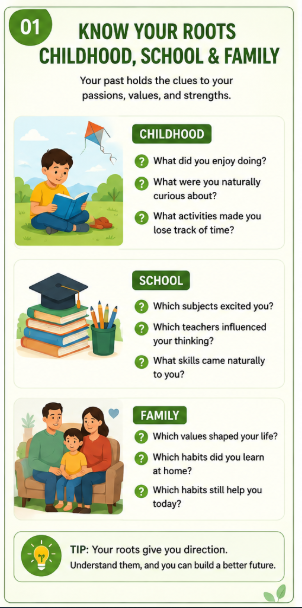
Childhood
Your childhood often leaves small clues about your future. So, begin from the beginning.
Ask yourself:
- What did you enjoy doing?
- What were you naturally curious about?
- What activities made you lose track of time?
School
School shows what easily catches your attention. It also shows what motivates you.
Ask yourself:
- Which subjects excited you?
- Which teachers influenced your thinking?
- What skills came naturally to you?
Family
Your family builds many of your beliefs. Some help you, while others may hold you back.
Write your answers:
- Which values shaped your life?
- Which habits did you learn at home?
- Which habits still help you today?
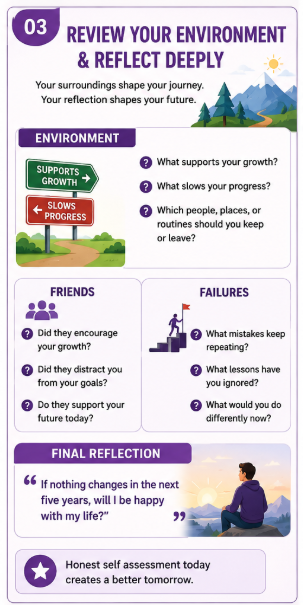
Friends
Friends can change your direction faster than you think. So, look at your circle honestly.
Ask yourself:
- Did they encourage your growth?
- Did they distract you from your goals?
- Do they support your future today?
Failures
Every failure teaches something useful. However, the lesson only works when you accept it.
Write down:
- What mistakes keep repeating?
- What lessons have you ignored?
- What would you do differently now?
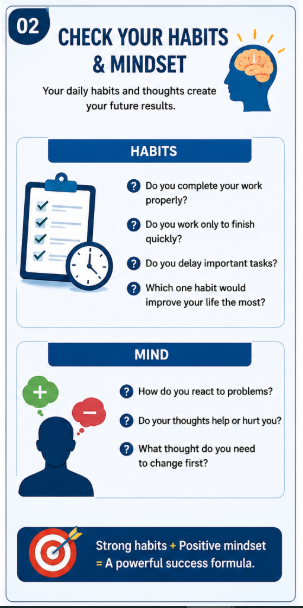
Habits
Small habits decide big results over time. Therefore, review your daily routine carefully.
Answer honestly:
- Do you complete your work properly?
- Do you work only to finish quickly?
- Do you delay important tasks?
- Which one habit would improve your life the most?
Mind
Your thoughts guide your actions every day. Because of that, your mindset matters.
Ask yourself:
- How do you react to problems?
- Do your thoughts help or hurt you?
- What thought do you need to change first?
Environment
Your surroundings affect your choices. Even small changes can improve your progress.
Think about:
- What supports your growth?
- What slows your progress?
- Which people, places, or routines should you keep or leave?
Personal Growth Checklist
Use this simple personal growth checklist before planning for success.
| Area | Yes | No |
|---|---|---|
| I know my strengths. | ☐ | ☐ |
| I know my weak habits. | ☐ | ☐ |
| I learn from my mistakes. | ☐ | ☐ |
| My friends support my goals. | ☐ | ☐ |
| My daily habits match my future. | ☐ | ☐ |
| I review my progress every month. | ☐ | ☐ |
Final Reflection
Now answer one final question. Take your time before writing it.
“If nothing changes in the next five years, will I be happy with my life?”
If your answer is “No,” then today is the right day to begin changing one small habit. Your success formula grows from honest self assessment, clear life planning, and small daily actions that you repeat every single day.
If you’d like, I can also create a printable Life Audit Worksheet (PDF-style table) that readers can download from your blog as a lead magnet.
Your Daily Actions Build Your Future
Your daily routine for success shapes your future more than one big win ever can. Every small choice you make today becomes part of your daily habits, and those habits slowly build your life.
Success Starts with Small Daily Actions
You do not become successful in one day. Instead, you become successful because you repeat the right actions every single day.
Think about these success habits:
- Speak honest and positive words.
- Make good decisions, even when they feel hard.
- Respect your time and avoid wasting hours.
- Keep your promises to yourself and others.
- Show kindness without expecting anything back.
- Learn one new thing every day.
- Take care of your health through food, sleep, and exercise.
- Spend quality time with people who support your growth.
These simple actions may look small today. However, they become powerful after weeks, months, and years.
Your Daily Routine Creates Your Results
Many people ask, “What daily habits create success?” The answer is simple: repeat good actions until they become your normal life.
The table below shows how small actions create big results.
| Daily Action | Long-Term Result |
|---|---|
| Read for 20 minutes | More knowledge |
| Exercise for 30 minutes | Better health and energy |
| Plan your day | Better time management |
| Save a small amount of money | Financial stability |
| Learn one new skill | Better career growth |
| Help one person | Stronger relationships |
Learn from the Habits of Successful People
The habits of successful people are not secret tricks. They simply protect their time, keep learning, stay healthy, act with integrity, and improve a little every day.
Research from University College London found that building a new habit can take about 66 days on average, although it varies from person to person. This shows that steady practice matters more than trying to be perfect.
Remember This Every Day
Do not wait for the perfect day to begin. Instead, improve by just 1% today, then repeat it tomorrow.
Your daily routine for success is building your future even when you cannot see the results yet. Keep your daily habits simple, stay consistent, and your small improvements will grow into major achievements over the coming years.
Final Thoughts: Success Is a Journey, Not a Destination
Your success journey starts when you know yourself. Then, you can choose the path that truly fits your life.
Do not copy someone else’s dream. Instead, build a life that matches your values and goals.
Next, accept that failure will come. Every mistake teaches you something that success never can.
So, learn the lesson and move forward. Small progress every day creates life success over time.
At the same time, stay consistent with your work. Even 30 minutes of focused effort each day adds up after months and years.
Also, keep learning because the world keeps changing. In 2026, new skills matter more than old titles in many industries.
Protect your health before you chase bigger goals. Without good physical and mental health, success becomes hard to enjoy.
Likewise, spend time with people who support you. Strong family bonds and trusted friends give you strength during difficult times.
Besides that, help other people whenever you can. Even a small act of kindness creates a positive impact on your community.
Here are the key points to remember:
- Know yourself before choosing your direction.
- Pick a path that matches your purpose.
- Accept failure and learn from it.
- Stay consistent every single day.
- Keep learning new skills.
- Protect your body and mind.
- Value your relationships.
- Give something back to society.
Finally, remember the real meaning of success: it is not only money, fame, or awards. Real success also brings peace, purpose, good character, healthy relationships, and a life that helps others.
If you want to know how to stay successful, keep improving one step at a time. Lifelong success comes from small daily actions, so begin your success journey today with one simple step.
FAQs
1. What is success?
Success looks different for every person. For you, it may mean good health, strong relationships, financial freedom, or peace, so choose your own path instead of following someone else’s.
2. Can everyone become successful?
Yes, anyone can improve their life with the right mindset and daily action. However, your starting point may be different, so focus on steady progress instead of perfect results.
3. Why do talented people fail?
Talent helps only at the beginning. Without discipline, learning, and consistent work, even gifted people lose opportunities over time.
4. Is there a shortcut to success?
No lasting success comes from shortcuts. Instead, build useful skills, solve real problems, and stay patient while improving every day.
5. Does family background matter?
Your family can give support or create challenges. Even so, your daily choices, habits, and learning matter more in the long run.
6. Does genetics affect success?
Genetics may influence some natural abilities. Still, your mindset, practice, and environment usually have a much bigger effect on your results.
7. Is consistency more important than talent?
Yes, consistency wins in most situations. Small daily actions repeated for months or years often beat natural talent without effort.
8. How can I stay motivated?
Do not depend only on motivation because it changes every day. Instead, create simple routines, celebrate small wins, and remember why you started.
9. What should I do after failure?
First, accept what happened without blaming yourself. Then, find the lesson, fix the mistake, and start again with a better plan.
10. How do I choose the right goal?
Choose a goal that matches your values and skills. Also, make sure it improves your life and keeps you excited for years.
11. What is the meaning of life?
The answer is personal for every person. Many people find meaning by growing, helping others, building relationships, and living with purpose.
12. Is money equal to success?
Money gives comfort and more choices. However, true success also includes health, happiness, freedom, strong relationships, and inner peace.
13. What daily habits create success?
Simple habits make a big difference over time. Focus on these every day:
- Wake up at a regular time.
- Keep learning new skills.
- Exercise for at least 30 minutes.
- Plan your most important task.
- Read for 20 to 30 minutes.
- Sleep for 7 to 9 hours.
14. How long does success take?
There is no fixed timeline because every journey is different. Many successful businesses and careers take five to ten years of steady effort before major results appear.
15. Can I become successful after 40?
Yes, many people build successful careers and businesses after 40. Your experience, patience, and better decision-making can become strong advantages.
16. What role does discipline play?
Discipline helps you keep moving even when motivation disappears. Because of that, it creates steady progress and long-term success.
17. How do I stop comparing myself?
Compare yourself only with your past version. This simple habit helps you stay confident and keeps your attention on real growth.
18. Can peace and ambition exist together?
Yes, they can work well together. Stay ambitious while protecting your health, relationships, and peace of mind.
19. What is the biggest reason people quit?
Many people quit because they expect quick results. Instead, accept that success takes time, practice, and patience before rewards appear.
20. What is one habit every successful person should develop?
Build the habit of showing up every day, even when you do not feel like it. This single habit keeps your how to become successful journey moving forward and creates lasting success.




Leave a Reply