The hardest part of keyword research is not finding phrases. It is finding low competition keywords that your new blog can truly rank for.
You may choose a popular niche, target high-volume terms, and publish ten useful posts. Yet Google may show almost no impressions because strong and trusted sites already control those search results.
High search demand does not always mean a good chance to rank. A new site often grows faster by answering narrow questions for a clear person, problem, place, or need.
Long-tail keywords for beginners can help, but a longer phrase is not always easy. In the same way, a low keyword-difficulty score is only a clue; you must still check the pages that rank on Google.
A low-competition keyword is a search query where the current results leave a fair opening for your website. That opening may come from old pages, weak answers, mixed search intent, or missing firsthand advice.
This guide gives you a free and repeatable workflow for keyword research for new blogs. By the end, you will choose one valid low competition keyword and build a small content cluster around it.
What Is a Low-Competition Long-Tail Keyword?
A low-competition long-tail keyword is a clear search term with lower demand and a fair chance to rank. It shows what a person needs, not just the broad topic they like.
Long-Tail Does Not Mean “Many Words”
A long-tail keyword sits at the low-demand end of search. Ahrefs explains that search volume—not the number of words—is what makes a query long-tail.
So, a two-word keyword can be long-tail when very few people search for it. An eight-word phrase can still be hard when strong websites target the same search intent.
Specific keywords also reveal what the reader wants. “Blogging” is broad, while “blog names for retired teachers” shows the exact audience and need.
What Does “Low Competition” Mean?
A keyword may have low competition for your website when:
- Your site closely matches the topic.
- The first page has results you could beat.
- Current pages miss part of the reader’s need.
- You can give a clearer or more useful answer.
| Keyword | Long-tail? | Easy to rank? |
|---|---|---|
| blogging | No | No |
| how to start a travel blog in India | Yes | Not always |
| blog names for retired teachers | Likely | Maybe |
Do not trust word count or a keyword difficulty score alone. To find a low-competition long-tail keyword, check the live search results, match the search intent, and spot what the top pages leave unanswered.
Why Low-Competition Keywords Matter for New Blogs
Low-competition keywords for new websites give you a more realistic way to enter Google Search. You avoid fighting large brands for broad terms like “blogging” or “digital marketing.”
Specific searches also show clear intent; for example, “free keyword tools for food bloggers” tells you exactly what the reader needs. This helps you write a focused answer instead of a broad post that serves no one well.
People who use long-tail searches often know what they want and may be ready to act. Semrush also notes that precise long-tail queries can attract qualified visitors, while many related low-volume keywords can produce useful traffic together.
You can then connect these easy keywords for new blogs into one content cluster. Early Google Search Console impressions will also show the words Google links with your site.
Low-Competition Keywords Work Best For
- New or low-authority blogs
- Small and narrow niche sites
- Businesses with a small content budget
- Writers with real skill in one problem
Avoid a Keyword When
- It does not match your niche
- No real person appears to search for it
- You cannot provide a useful answer
- You chose it only because a tool shows low KD
Low competition does not mean quick or guaranteed rankings. Use low-competition keywords for new websites only when they match real demand, clear search intent and your wider topic cluster.
Before Researching Keywords, Build a Simple Topic Cluster
Before you search for keywords, build a simple topic cluster. This step keeps your blog focused and helps each post support another post.
Start With One Reader Problem
Do not start with a keyword tool. First, choose one clear problem that your reader wants to solve.
For example, your niche may be indoor gardening. Your reader may want to grow fresh herbs in a small flat with little space.
Your main topic can be how to grow herbs indoors. This broad topic becomes your pillar page.
Break the Main Problem Into Small Clusters
Now split the main problem into smaller needs. Each need can become a cluster page or a useful section.
| Cluster | Search problem |
|---|---|
| Lighting | How to grow herbs without sunlight |
| Containers | Best pots for indoor herbs |
| Watering | How often to water indoor herbs |
| Herb guides | How to grow basil indoors |
| Plant problems | Why basil leaves turn yellow |
| Equipment | Cheap grow lights for herbs |
This content cluster strategy gives you a clear topical map for your blog. It also helps you find long-tail keywords that belong to the same reader journey.
Understand the Page Hierarchy
- Pillar page: Covers the main topic in a broad way.
- Cluster page: Explains one part of the topic in detail.
- Supporting query: Answers a small question inside a page.
- Internal link: Connects related pages and guides the reader.
You do not need to publish the pillar page first. Still, you should plan it before you write several cluster posts.
Start with three to six useful cluster posts, then grow the group as real questions appear. Every keyword should build your topic cluster, support topical authority, and help the same type of reader.
Before Researching Keywords, Build a Simple Topic Cluster
Before you search for keywords, build a simple topic cluster. This step keeps your blog focused and helps each post support another post.
Start With One Reader Problem
Do not start with a keyword tool. First, choose one clear problem that your reader wants to solve.
For example, your niche may be indoor gardening. Your reader may want to grow fresh herbs in a small flat with little space.
Your main topic can be how to grow herbs indoors. This broad topic becomes your pillar page.
Break the Main Problem Into Small Clusters
Now split the main problem into smaller needs. Each need can become a cluster page or a useful section.
| Cluster | Search problem |
|---|---|
| Lighting | How to grow herbs without sunlight |
| Containers | Best pots for indoor herbs |
| Watering | How often to water indoor herbs |
| Herb guides | How to grow basil indoors |
| Plant problems | Why basil leaves turn yellow |
| Equipment | Cheap grow lights for herbs |
This content cluster strategy gives you a clear topical map for your blog. It also helps you find long-tail keywords that belong to the same reader journey.
Understand the Page Hierarchy
- Pillar page: Covers the main topic in a broad way.
- Cluster page: Explains one part of the topic in detail.
- Supporting query: Answers a small question inside a page.
- Internal link: Connects related pages and guides the reader.
You do not need to publish the pillar page first. Still, you should plan it before you write several cluster posts.
Start with three to six useful cluster posts, then grow the group as real questions appear. Every keyword should build your topic cluster, support topical authority, and help the same type of reader.
Step 2: Find Long-Tail Keywords Using Free Google Tools
You can find long-tail keywords without buying an SEO tool. Start with Google Search, then use each free feature to learn how your readers describe their needs.
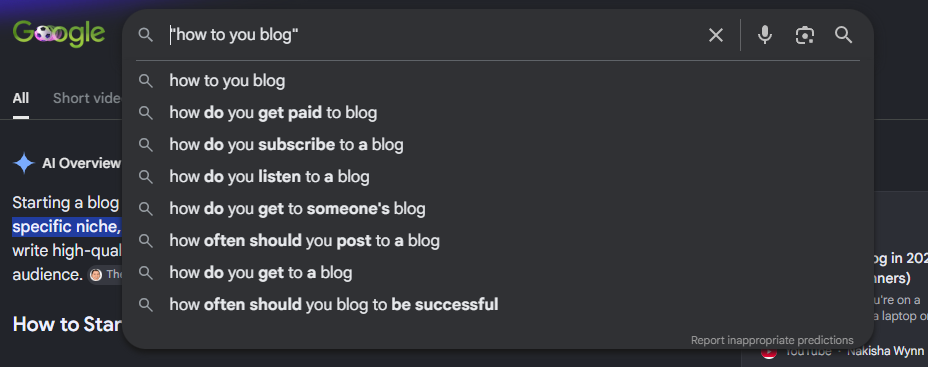
Use Google Autocomplete
Type your seed keyword into Google, but do not press Enter yet. Google will show search predictions based on real search activity, language, location and other signals.
Try your keyword with question words and simple modifiers:
- How to grow basil indoors
- Grow basil indoors without sunlight
- Why is my indoor basil dying
- Best soil for indoor basil
- Can basil grow indoors in winter
Add letters after your phrase, such as “a,” “b” or “c.” You can also place words like how, why, without, best, for beginners or in India before and after it.
Search from the country you plan to target. Suggestions may change when your location, language or search settings change.
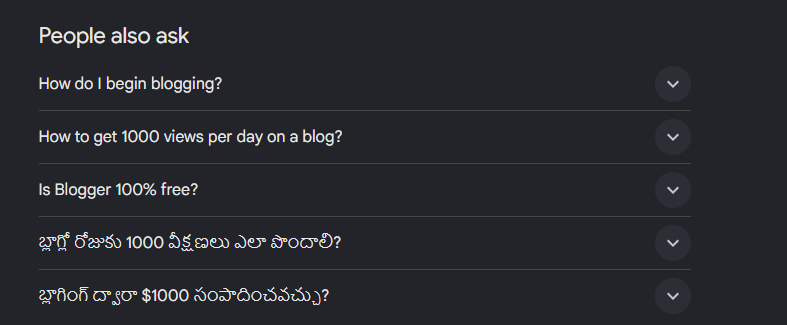
Check People Also Ask
Search your seed keyword and open the People Also Ask questions. Google says these questions help people explore topics related to their first search.
Use them to find:
- Basic definitions
- Common problems
- Required tools
- Mistakes to avoid
- Product comparisons
- Useful follow-up questions
Do not create a new post for every question. Add closely related questions to one page when they serve the same reader goal.
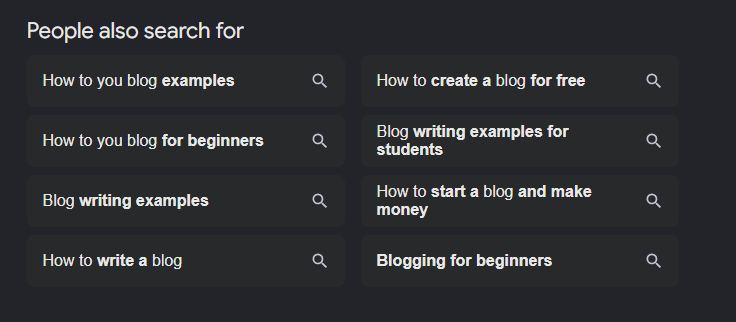
Review Related Searches
Scroll to the related searches shown on the results page. These phrases can reveal new wording, nearby topics, product needs and hidden problems.
For example, “grow basil indoors” may lead you to lighting, watering, soil and yellow-leaf questions. Save only the ideas that fit your niche and target reader.
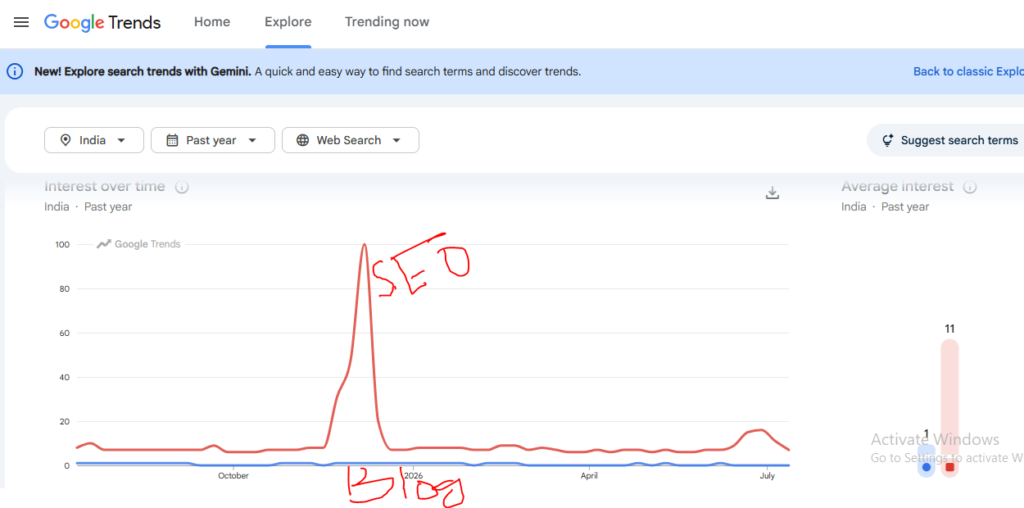
Compare Ideas in Google Trends
Google Trends lets you compare up to five groups of search terms. You can also study interest by time, region and related searches.
Use it to spot seasonal topics and regional wording. For example, compare two phrases in India before choosing the words used in your title.
Remember: Trends shows relative search interest, not exact monthly volume. Google autocomplete keyword research also reveals useful language, but it does not prove that a keyword has high traffic or low organic competition.
Therefore, use these free Google keyword tools to collect ideas first. Then check the search results manually before choosing your low-competition long-tail keyword.
Step 3: Find the Language Real People Use
Good audience language research starts where people speak without trying to sound like experts. Their words reveal fears, failed attempts, needs, and long-tail keyword ideas that tools often miss.
Search Reddit and Specialist Forums
Search Google with site:reddit.com "[seed topic]" or site:reddit.com "[problem]". For a niche forum, replace Reddit with the forum’s domain name.
Look for these useful signals:
- The same complaint appears in several threads.
- A question gets no clear answer.
- Users compare two tools or methods.
- People explain what they tried and why it failed.
- Beginners use simple phrases that experts rarely use.
- A user adds a clear limit: budget, place, skill, age, or device.
For example, a new blogger recently asked why Semrush showed no volume for useful long-tail terms. That question reveals two content ideas: “Should you target zero-volume keywords?” and “Why do SEO tools miss long-tail searches?”
Read YouTube Searches and Comments
Type your seed topic into YouTube and note its autocomplete suggestions. Then review video titles, chapters, comments, repeated questions, and requests for a follow-up video.
Comments can show what the video failed to explain. Ignore praise such as “Great video”; save clear questions such as “Will this work on a new site with no backlinks?”
Check Quora and Niche Groups
Focus on questions with several answers, mixed advice, or old answers. Personal details such as country, budget, tool, or experience level can turn a broad topic into a useful long-tail keyword.
Use Your Own Audience Data
Check support emails, sales calls, surveys, blog comments, and site-search records. In Google Search Console, the Performance report shows the queries that already create impressions and clicks for your pages.
Never trust one forum post as proof of demand. Complete your audience language research by confirming the idea through autocomplete, repeated discussions, related searches, or Search Console data.
Step 4: Use Google Keyword Planner Correctly
Google Keyword Planner for SEO helps you find new search terms and check demand. It works best as an idea tool, not as a final test for easy rankings.
Beginner Workflow
- Open Google Ads and go to Keyword Planner.
- Click Discover new keywords.
- Add three to five close seed terms.
- Select your target country and language.
- Remove brand names and terms that do not fit your topic.
- Export the useful ideas to a sheet.
- Group them by the goal behind each search.
For an Indian gardening blog, you may enter “grow basil indoors,” “indoor basil care,” and “basil without sunlight.” Set the location to India, since demand can change by country.
Google may require you to finish the Google Ads account setup before you can use its basic keyword tools. The tool was built to plan Search ad campaigns, though bloggers can still use its data for SEO research.
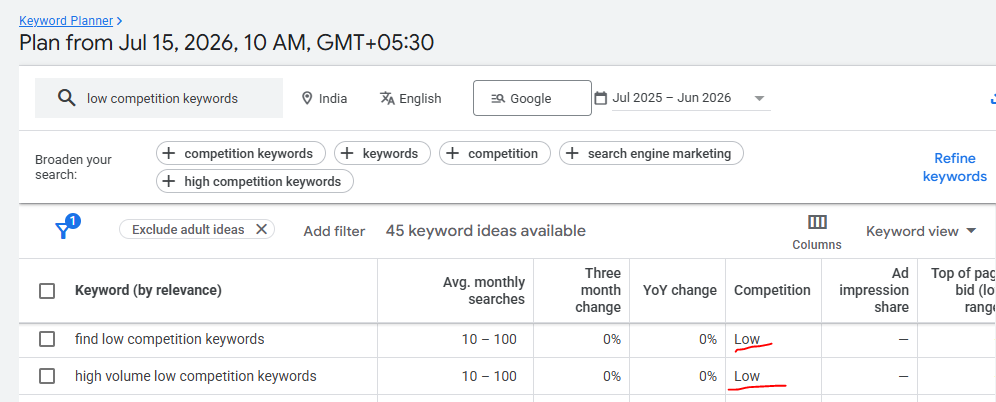
Read the Metrics With Care
| Metric | What it tells you |
|---|---|
| Average monthly searches | Past search demand, often based on a 12-month average |
| Three-month change | Recent rise or fall in interest |
| Year-over-year change | Demand compared with the prior year |
| Top-of-page bid | What advertisers may pay for a high ad spot |
| Competition | How hard advertisers compete for ad space |
Google provides search volume, competition levels, and estimated bid ranges based on your chosen place and language. These figures help you compare ideas, but they remain estimates.
Important: “Low competition” means low competition for paid ad space. It does not mean that the keyword is easy to rank for in free Google results.
Use Keyword Planner to find long-tail keywords, compare regions, spot trends, and judge buying interest. A high top-of-page bid may show strong sales value, but it does not prove high organic SEO difficulty.
Do not use the tool alone to judge backlinks, page quality, ranking time, or organic competition. After you shortlist a phrase, search it on Google and study the pages that already rank.
Google Keyword Planner for SEO gives you useful clues, not a final answer. Use its data to build your list, then use a live SERP review to make your choice.
Step 5: Find Proven Keywords From Competitors
Competitor keyword research works best when you study sites near your level. Your goal is not to copy them; it is to find proven searches they answer and useful searches they miss.
Choose Realistic Competitors
Do not start with giants like Forbes or HubSpot. Pick three to five sites that serve your audience, cover the same niche, publish often, and rank beside large brands.
Think of these sites as “side-door competitors.” A small gardening blog above a major shop may show that strong topic fit can beat broad brand power.
Find Competitor Keywords for Free
Check each site’s menu, blog archive, categories, article titles, tables of contents, and internal links. These areas show which topics form its main content clusters.
Then search Google with:
site:competitor.com your topicsite:competitor.com "how to"site:competitor.com "best"site:competitor.com "why"
List useful pages that do not exist on your blog. Also flag old posts, thin steps, vague tips, missing examples, and comments with unanswered questions.
Use a Paid Keyword Gap Tool
Ahrefs and Semrush can speed up keyword gap analysis. Their reports show keywords that competitors rank for but your site does not.
Filter by country, search intent, lower difficulty, modest volume, and results where small sites already rank. Semrush can compare your site with four competitors and group terms as “Missing” or “Weak.”
Do not target every content gap keyword. Choose competitor long-tail keywords that fit your niche, solve a clear problem, and support a page you can make better.
Step 6: Expand and Filter Ideas With Paid Keyword Tools
The best long-tail keyword tools help you turn a large keyword list into a small set of useful topics. They save time, but they cannot choose the right keyword for you.
Start with 5 to 10 seed keywords from Google, Reddit, YouTube, or your customer questions. Then, enter them into one paid tool and export the related keyword ideas.
Which Keyword Tool Should You Choose?
| Tool | Best for | Main strength | Main limit |
|---|---|---|---|
| Google tools | New bloggers with no budget | Free search ideas and demand clues | Weak organic competition data |
| Ahrefs | SERP and backlink research | Strong page and competitor data | Higher cost and learning time |
| Semrush | Full keyword research | Intent filters and keyword gaps | Many features may confuse beginners |
| Ubersuggest | Simple keyword research | Easy layout and keyword lists | Less detail than larger tools |
| LowFruits | Finding weak search results | Finds forums and weaker ranking sites | You must still check Google |
| Keywords Everywhere | Quick browser research | Shows data while you browse | All numbers are estimates |
| AnswerThePublic or AlsoAsked | Finding user questions | Expands questions by topic | Does not show if you can rank |
Semrush can filter keywords by informational, commercial, transactional, or navigational intent. Its Keyword Strategy Builder can also group up to 10,000 keywords into topics, pillar pages, and supporting pages.
LowFruits focuses on weak spots in Google results and groups keywords with similar intent. Ubersuggest offers keyword ideas, competitor research, rank tracking, and site checks through a simpler interface.
Apply These Filters
Filter your list by:
- Your target country and language.
- Clear search intent.
- A useful search-volume range.
- Three-word or longer phrases.
- Question words such as how, why, and which.
- Keyword difficulty.
- SERP features, such as videos or featured answers.
- Parent topic.
- Unwanted brands or unrelated words.
Do not set the same volume or difficulty limit for every niche. A new Indian gardening blog and an old US finance site face very different levels of competition.
Never Trust Keyword Difficulty Alone
Keyword difficulty is only an estimate because Google does not publish all its ranking factors. Each tool uses its own data and method, so a KD score of 20 in Ahrefs does not equal 20 in another tool.
Use KD to shorten your list, not to make the final choice. Open Google and check the top-ranking pages, their content, links, intent, age, and niche relevance.
For most beginners, Google tools offer the cheapest start, while Ubersuggest or a browser tool offers a simple upgrade. Ahrefs and Semrush suit deep competitor research, but the best long-tail keyword tools always work best with a manual SERP check.
Step 7 — Check Whether a Keyword Is Really Low Competition
A low score in an SEO tool does not prove that a keyword is easy. To check keyword competition well, study the live Google results yourself.
Search the Exact Keyword
Search the full phrase in a private window, then set the right country and language. Check phone and desktop results when both matter to your readers.
Write down the date because search results can change. Also note whether Google shows posts, shops, maps, forums, videos, or an AI answer.
Review the First 10 Results
Open the first 10 organic pages and judge them by the same rules. Record these points in a simple sheet:
- Page type and search intent
- Title and page match
- Site topic focus
- Content depth and update date
- Real tests, images, or expert proof
- Page backlinks, when available
- Missing questions or details
Backlinks matter, but they do not decide the result alone. Google uses many signals, and third-party authority scores are not Google metrics.
Look for a Weak SERP
You may have a fair chance when forums, old posts, small niche sites, or broad articles rank. Thin advice, weak titles, mixed intent, and missing firsthand proof also show a content gap.
For example, an Indian reader may search “how to grow coriander on a balcony in summer.” A broad US guide may be strong, yet your tested advice for Indian heat and watering may answer the query better.
Know When to Walk Away
Avoid the keyword when every result gives a fresh, expert, and exact answer. Also pause when Google prefers shops, maps, or videos, but you plan a basic blog post.
Manual SERP analysis matters because no keyword difficulty score covers every ranking factor. A keyword is truly low competition when real demand meets a clear gap that you can fill better.
Step 8: Apply the REAL Keyword Test
Use the REAL Keyword Test to find low-competition long-tail keywords that fit your blog. A low score saves you from writing a post that has little demand or no clear ranking chance.
1. R — Check Relevance
First, ask whether the keyword belongs to your niche and helps the people you want to reach. It should also link well with your current posts, services, or planned topic cluster.
For example, a home gardening blog may target “how to grow basil indoors without sunlight.” It should not target an easy keyword about outdoor farm machines just because the search volume looks good.
2. E — Find Evidence of Demand
Never trust one keyword tool alone; look for at least two clear demand signals. Check search volume, Google Autocomplete, People Also Ask, Search Console, customer questions, community posts, competitor traffic, or a rising Google Trends graph.
Most keywords have very small search demand: Ahrefs reported in June 2026 that 94.74% of keywords receive ten monthly searches or fewer. Low volume is not always bad, but you still need proof that real people ask the question.
3. A — Review the Achievable SERP
Search the keyword and study the first ten results. Look for weak pages, old advice, poor intent matches, thin answers, forum posts, or small sites that already rank.
Also ask whether you can match the preferred format and add better proof, examples, images, or direct experience. Never rely only on a keyword difficulty score; Ahrefs also advises checking keywords manually before making the final choice.
4. L — Measure Link and Cluster Value
Choose a keyword that supports your pillar page and links to at least two useful posts. Give extra value to topics that can attract links, subscribers, leads, or buyers.
| Factor | Score |
|---|---|
| Niche relevance | 3 |
| Intent clarity | 3 |
| Demand evidence | 3 |
| SERP opportunity | 4 |
| Audience value | 3 |
| Cluster value | 2 |
| Experience advantage | 2 |
| Total | 20 |
Use the final keyword opportunity score: publish 16–20 soon, keep 12–15 as a secondary topic, save 8–11 for later, and reject 0–7. This simple keyword research checklist helps you find low-competition long-tail keywords based on proof, not hope.
Step 9: Group Keywords by Search Intent
Keyword clustering means grouping keywords by what the reader wants, not by words that look alike. When you group keywords by search intent, you can build one strong page instead of several weak pages.
Do Similar Keywords Need One Page or Separate Pages?
Use one page when two searches seek the same result. You should also combine them when Google shows many of the same ranking pages.
For example, “how to grow basil indoors,” “growing basil inside,” and “indoor basil care” can fit one guide. Pick one primary keyword, then use the other phrases as secondary keywords in helpful sections.
Create separate pages when the reader wants a different answer. Split the keywords when one search asks for a guide, while another asks for a product, fix, cost, or comparison.
For example, “best grow light for indoor basil” needs a product comparison. “Why indoor basil leaves turn yellow” needs a troubleshooting guide, so adding both to the main article would make it less focused.
Try This Simple SERP-Overlap Test
- Search both keywords in the same country and language.
- Note the top 10 organic URLs for each keyword.
- Compare the two lists.
- Use one page when most URLs match and the intent is the same.
- Create separate pages when few URLs match or the page types differ.
SEO tools use SERP overlap because Google often ranks the same pages for keywords that serve one need. Ahrefs and Semrush also group terms by shared intent and ranking results, rather than word similarity alone.
This method can help you avoid keyword cannibalization because each page has one clear purpose. Before you publish, group keywords by search intent, choose one focus keyphrase, and give each page one useful job.
Complete Free Keyword Research Example
Here is how you can find low-competition long-tail keywords without collecting hundreds of random ideas. We will use one small plant, one clear problem, and one repeatable test.
Start With One Seed Topic
Your niche is indoor gardening for apartment beginners, and your seed topic is grow basil indoors. This seed is broad enough to produce ideas, yet narrow enough to keep your research focused.
Type the seed into Google, then check autocomplete, People Also Ask, related searches, Reddit, and YouTube comments. Google says autocomplete predictions help users complete useful searches, so treat them as demand clues—not proof of search volume.
You may find these ideas:
- How to grow basil indoors without sunlight
- Best soil for indoor basil
- Why is my indoor basil dying?
- How often should I water basil indoors?
- Can basil grow indoors in winter?
Check Each Keyword
Do not choose the phrase with the largest search number. Search each term and study the top-ranking pages, because SERP analysis reveals the search intent and missing information.
| Keyword | Demand clue | Search intent | SERP finding | Decision |
|---|---|---|---|---|
| Grow basil indoors | Strong | Broad guide | Strong competition | Future pillar |
| Grow basil without sunlight | Google + forums | Solve a problem | Generic answers | Target now |
| Best soil for indoor basil | PAA + tools | Product advice | Mixed results | Support post |
| Why indoor basil is dying | Repeated questions | Fix a problem | Forums rank | High priority |
| Basil indoors in winter | Seasonal interest | Seasonal guide | Medium competition | Publish early |
Choose the Best Opportunity
Select how to grow basil indoors without sunlight as your primary keyword. It solves one clear problem, shows real demand, fits your niche, and leaves room for a better answer.
Create a useful test: grow basil near a window, under a low-cost grow light, and with no added light. Record weekly growth, leaf colour, plant height, cost, and mistakes with original photos.
You now have one target article, three supporting posts, and one future pillar page. More importantly, you have a clear method to find low-competition long-tail keywords for any niche.
Should You Target Zero-Volume Keywords?
Yes, you should target zero-volume keywords when you can prove that real people need the answer. Treat the zero as a blind spot in the tool, not as a final verdict.
Keyword tools use samples, averages, grouped phrases, and past data. Google Keyword Planner may also place similar searches in one data group, so one phrase can show zero even when related searches exist.
Target the keyword when:
- Google Autocomplete or People Also Ask shows it.
- Readers ask it in emails, comments, Reddit, or forums.
- It solves a clear problem or supports a buying choice.
- It covers a new product, rule, tool, or trend.
- It fits an important content cluster.
- Current pages give weak, old, or vague answers.
- One useful page can rank for close search terms too.
For example, a new Indian gardening blog may find zero volume for “best balcony plants for Hyderabad summer heat.” Yet repeated local questions, hot-weather needs, and poor search results can show real value.
Avoid the keyword when:
- Only an AI tool suggested it.
- You find no other sign of demand.
- The wording sounds forced or unnatural.
- It attracts the wrong reader.
- The answer needs only one thin paragraph.
- It has no link to your wider blog plan.
Semrush’s 2026 guidance says zero-volume terms may still matter when first-party signals, such as repeated sales questions, confirm demand. Ahrefs also notes that low- or zero-volume pages may bring few visits alone, but related pages can add up over time.
So, how much search volume is enough for a new blog? Use zero-volume keywords only when you have real demand, a useful answer, clear intent, and strong topic value.
Common Keyword Research Mistakes
Keyword research mistakes can waste weeks of writing time. You may publish useful posts, yet gain no traffic because you chose the wrong search terms.
1. Chasing High Search Volume
A large search number looks tempting, but strong sites often own those results. Choose a smaller keyword when its topic fits your site, skills, and readers.
2. Thinking Every Long Phrase Is Easy
A long keyword is not always a low-competition keyword. Search it on Google, then check whether small sites, forums, old posts, or weak answers rank on page one.
3. Trusting One Keyword Difficulty Score
A KD score is only an estimate, not a promise. Ahrefs, for example, bases its score on backlinks to top pages, so you must also check brands, content quality, and search intent.
4. Confusing Ad Competition With SEO Competition
Google Keyword Planner shows how many advertisers compete for a keyword. It does not tell you how hard organic ranking will be, so always review the normal search results.
5. Ignoring Search Intent
A guide will struggle when Google mainly ranks product pages or videos. Match the page type, format, and answer that searchers already expect.
6. Publishing Every Variation Separately
Posts for near-identical terms can compete with each other; this is called keyword cannibalization. Keep phrases on one page when they share the same goal and mostly show the same ranking URLs.
7. Choosing Random Easy Keywords
An easy keyword still has little value when it sits outside your niche. Build each post around a clear pillar topic and content cluster.
8. Copying the Top Results
Competitor headings can guide your research, but copying them creates another plain article. Add tested steps, original images, local examples, clear opinions, or facts competitors missed.
9. Expecting Fast Rankings
Do not rewrite a new post after a few days. Track impressions and search queries first, then improve the title, missing answers, examples, and internal links.
Google recommends writing for people and adding real value instead of only summarizing other pages for search traffic. Avoid these keyword research mistakes, and choose each keyword through relevance, intent, SERP checks, and reader value.
What to Do After Choosing the Keyword
Choosing a keyword is only the first step; your keyword-to-blog-post workflow now turns that phrase into a useful page. First, define what the reader should know, solve, or do after reading your post.
Before You Write
Check the top Google results and note the format: guide, list, video, product page, or short answer. Then list the questions those pages missed, and gather your own screenshots, examples, test results, or expert sources.
Choose one primary keyword for the main topic, then place related phrases only where they fit. Also, plan links to your pillar page and two or three useful cluster posts.
After You Publish
Make sure Google can find the page through your sitemap, internal links, or URL Inspection tool; submitting a URL does not promise indexing. Google says most pages are found through normal crawling, so strong internal links still matter.
Next, track keyword rankings in Google Search Console. Check the page’s queries, impressions, clicks, click-through rate, and average position.
Relevant impressions are often your first good sign, even before page-one rankings arrive. Improve sections for useful queries, refresh old facts, and merge pages that answer the same intent.
In simple terms, what to do after keyword research is clear: publish, measure, learn, and improve. Let real search data guide each update, not guesswork.
Frequently Asked Questions
What keyword difficulty is good for a new blog?
There is no perfect keyword difficulty score for every new blog, so use KD only as a first filter when finding low-competition long-tail keywords. Each SEO tool calculates difficulty in its own way, while your niche relevance, content quality, authority and current search results also affect your real chance of ranking.
How much search volume should a beginner target?
Do not reject a useful keyword only because it gets fewer than 100 monthly searches. A clear, low-volume query that closely matches your audience can bring better results than a broad keyword that your new blog may never rank for.
Are long-tail keywords always low competition?
No; a long-tail keyword can still be hard when it has strong buying intent or when trusted specialist websites already cover it well. Long-tail keywords usually have low monthly search demand, but the number of words alone does not tell you how competitive they are.
Can I find low-competition keywords for free?
Yes; start with Google autocomplete, People Also Ask, related searches, Google Trends, Keyword Planner, Search Console, Reddit, forums and YouTube comments. Collect ideas first, and then search each term on Google to check the ranking pages, content quality and search intent yourself.
Can a new website rank without backlinks?
A new website may rank without backlinks for a narrow query when the current pages are weak, old or poorly matched to the reader’s need. However, backlinks can still help, and Google does not guarantee that it will crawl, index or show any page in its search results.
How many keywords should one blog post target?
Target one main search intent instead of chasing a fixed number of keywords. You can include several related keyphrases on the same page when they answer the same question and make the article more complete.
How long does it take to rank?
There is no fixed ranking time; results depend on indexing, competition, site history, content quality, internal links and website authority. Google says some changes may appear within hours, while others can take several months, so wait a few weeks before judging meaningful SEO work.
Are paid keyword tools necessary?
No; you can learn how to find low-competition long-tail keywords with free tools and careful Google search analysis. Paid tools become useful when you need faster bulk research, competitor keywords, backlink data, keyword clustering and deeper difficulty estimates.
Use this 30-minute plan to find low-competition long-tail keywords without getting lost in large keyword lists. Set a timer, open one spreadsheet, and work on one clear audience problem.
Minute 0–5: Choose the problem
Pick one real problem your reader wants to solve. Write three seed keywords that describe the problem in plain words.
Minute 5–10: Collect Google ideas
Type each seed keyword into Google. Save useful ideas from Autocomplete, People Also Ask, and Related Searches.
Minute 10–15: Listen to real users
Check Reddit, YouTube comments, or one trusted niche forum. Note questions that appear more than once, since repeated questions often reveal unmet needs.
Minute 15–20: Check demand
Use Google Keyword Planner or another keyword tool. Treat search volume as a clue, not a promise of traffic.
Minute 20–25: Study the search results
Search your five best keywords and inspect the first page. Look for weak, old, broad, or poorly matched pages that you can improve.
Minute 25–30: Make the final choice
Apply the REAL Keyword Test: relevance, evidence, achievable results, and linking value. Choose one main article, two supporting posts, and one pillar-page link.
Do not choose the keyword with the biggest number. Choose the reader problem you can answer best, because that is how you find low-competition long-tail keywords worth publishing.




Leave a Reply