SEO content ranking factors in 2026 are harder to judge because the web now has more content than ever. AI tools can draft a clean article in minutes, yet clean writing alone does not earn trust, clicks, or strong rankings.
In previous post, we had discussed about Content Ranking Problems. In this post, let us further discuss common raking factors of SEO in 2026,
Search pages have also changed: users now see AI Overviews, videos, forums, images, tools, and normal organic results. So, your page may keep the same rank but still lose clicks because Google answers part of the query before the user visits a site.
There is no public formula that gives each Google ranking factor a fixed score. Google says its ranking systems study many signals across hundreds of billions of pages to find the most relevant and useful results.
Your results can change based on:
- The search query and user intent
- The user’s country, language, and location
- How fresh the answer needs to be
- The strength of competing pages
- The content type Google believes users want
Therefore, adding keywords is not enough. You must also earn traditional rankings, AI-search citations, clicks, reader trust, and useful business actions.
This guide separates technical requirements, likely ranking inputs, quality frameworks, search appearance features, and common SEO myths. You will learn which SEO content ranking factors in 2026 deserve your time—and which ones you can safely ignore.
The Short Answer: What Matters Most in 2026?
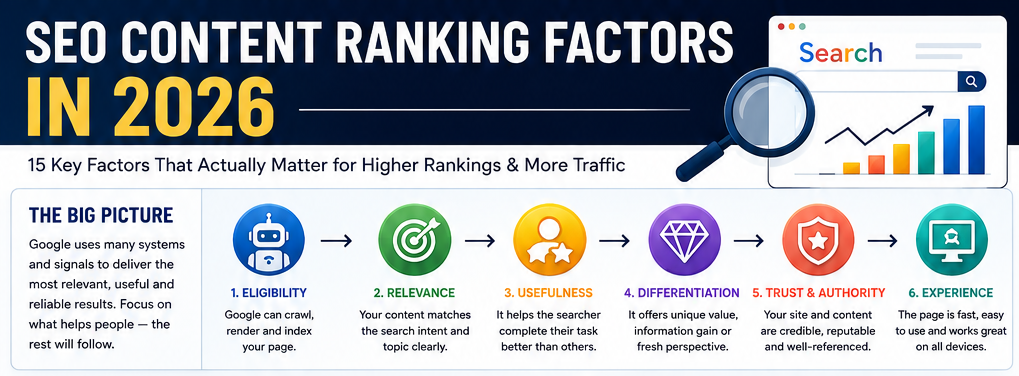
The most important SEO ranking factors in 2026 work as a chain: each layer supports the next one. You should fix them in order instead of chasing backlinks, word counts, or tool scores first.
Start with access: Google must be able to crawl, render, and index your page. Google calls these technical steps the basic requirements for appearing in Search, but meeting them does not guarantee a ranking.
Next, match the real search intent and solve the user’s problem. Your page should give a clear answer, useful steps, sound facts, and a result the reader can apply.
Then, give Google a reason to choose your page over ten similar pages. Add original tests, real examples, expert input, local data, useful tables, or lessons that competing pages missed.
Trust also matters: cite sound sources, name the author, correct old facts, and earn relevant links. Google says its systems aim to reward helpful, reliable, people-first information.
| Layer | Main question | Priority |
|---|---|---|
| Eligibility | Can Google access and index it? | Critical |
| Relevance | Does it match this search? | Critical |
| Usefulness | Does it solve the problem? | Critical |
| Differentiation | Why should this page win? | High |
| Trust | Why should readers believe it? | High |
| Experience | Is the page easy to use? | Medium–high |
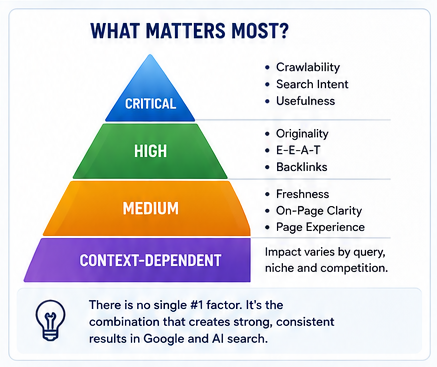
So, which SEO ranking factor is most important? Focus first on eligibility, relevance, and usefulness; then strengthen originality, authority, and page experience.
Ranking Factor, Requirement or Outcome? Know the Difference
A ranking factor vs ranking signal is easy to mix up, yet each one has a different job. When you know the difference, you can spend your time on changes that help your page.
Technical Requirements Help You Enter Search
A technical requirement makes your page eligible for Google Search. Google must access the page, receive a working HTTP response and find content it can index.
For example, a useful guide may never rank when a noindex tag blocks it. Meeting these SEO ranking requirements does not ensure that Google will crawl, index or show your page.
Ranking Signals Help Google Choose
Google ranking signals help its systems choose useful results for each search. These signals may include query relevance, links, suitable freshness and Core Web Vitals.
They do not carry one fixed weight for every search. A fresh page may matter for current news, while a clear and trusted page may matter more for an old fact.
Quality Frameworks Show Proof
E-E-A-T covers experience, expertise, authority and trust. It helps you review content quality, but it is not one direct score used by human quality raters to change rankings.
Show real proof: name the author, cite sound sources and explain tests or work you carried out. Do not add a thin author box and expect it to fix weak content.
Search Features Improve Visibility
Structured data helps Google understand a page and may make it eligible for a rich result. It does not ensure a rich result or a higher ranking.
Clear images, useful videos and valid schema may make your result easier to notice. They still cannot replace relevant and helpful content.
Business Outcomes Measure the Result
CTR, leads, sales, sign-ups and branded searches are business outcomes. They tell you what happened after people saw or used your content.
Use this simple path: Requirement → Ranking consideration → Quality proof → Visibility → Business result. This ranking factor vs ranking signal check helps you fix the right problem first.
1. Search-Intent Alignment
Search intent alignment means giving people the type of result they expect. Even a great article may fail when it does not match that need.
Google aims to show the most relevant and useful result for each search. Its systems assess many signals across web pages, videos, images, forums, products, and other content.
Check what the searcher wants
Before you write, search the main keyword in a private browser window. Then study the first page rather than trusting a keyword tool alone.
Look for these types of intent:
- Informational: The person wants to learn.
- Commercial: The person wants to compare choices.
- Transactional: The person wants to buy, join, or download.
- Navigational: The person wants a known site or brand.
- Local: The person wants help within a town, city, or region.
Next, inspect the ranking pages closely. Check their format, titles, age, depth, tools, videos, forums, maps, and other SERP features.
Match the format, not the wording
You should match the main content type without copying another page. Add your own examples, tests, views, steps, and useful details.
For example, a 4,000-word guide for “SEO audit” may not rank well. Searchers may want a free audit tool, a service page, or a short checklist instead.
A shorter page can outrank yours when it completes the task faster. Length cannot fix weak content relevance or the wrong query interpretation.
Handle mixed search intent
One page may meet two close needs through clear sections. However, split the page when each need requires a different format or action.
Recheck the SERP before you refresh old content. Intent can change as tools, trends, local needs, and user habits change.
Common mistake: Choosing an article format from keyword data without checking today’s Google results.
Use search intent alignment to choose your next step: rewrite, reformat, split, merge, or retarget the page. This simple check often explains why good content does not rank.
2. Topical Relevance and Semantic Clarity
Topical relevance SEO helps Google and your readers understand what your page is about. Your title, H1, opening, key H2s, and URL should all point to the same main topic.
Google also looks at meaning, not just exact keyword matches. Its neural matching system connects related ideas in search queries and web pages.
Make Your Main Topic Clear
Use your primary keyword where it helps the reader:
- Write it once in the title and H1.
- Mention it early in the introduction.
- Use it in a few useful headings.
- Add it to a short URL when it fits.
Do not force the same phrase into every section. Google advises you to use the words people search for in clear places, such as the title and main heading.
Use Related Words Naturally
Add synonyms, entities, and related terms that explain the topic. For example, a guide about content rankings may mention search intent, entities, subject coverage, natural language, and contextual meaning.
Google can understand synonyms and the general meaning behind a search. You do not need to write every keyword variation or pack the page with long-tail phrases.
Avoid the “LSI Keywords” Myth
LSI keywords are not a modern Google SEO rule. Use related words because they make your answer clear, not because a tool gives you an NLP score.
Compare these two styles: repeating “SEO ranking factors” eight times sounds forced. Explaining intent, authority, content format, and page context gives both readers and Google a clearer answer.
Keep every section true to its heading, and remove side topics that do not help. Strong topical relevance SEO comes from clear meaning, useful subject coverage, and natural language—not keyword density.
Task Completion and Practical Usefulness
Helpful content SEO starts with one simple test: can you use the page to solve your problem? Google says its systems aim to reward helpful, reliable content made for people, not pages made mainly to influence search rankings.
What Makes Content Helpful?
Helpful content moves you from a question to a clear result. It helps you:
- Understand the issue
- Find the cause
- Compare your choices
- Make a sound decision
- Apply the right steps
- Check the result
- Avoid common errors
For example, you may search for ways to fix a page that Google has not indexed. A useful guide does not stop after defining indexing; it shows you how to check the URL in Search Console, review the noindex tag, inspect the canonical URL, and choose the next fix.
Use a Six-Step Content Framework
Build each key section around this simple flow:
- State the exact problem.
- Explain why it happens.
- Show what to do.
- Give a clear example.
- Describe the likely result.
- State where the advice may not work.
This format supports task completion because you give practical advice and decision support. It also helps readers verify each step instead of trusting a broad claim.
Do Not Measure Value by Length
A long page is not always a useful page. Ten clear steps can solve a problem better than 3,000 words of repeated advice.
Ask one final question: can the reader act without opening five more tabs? When the answer is yes, your helpful content SEO is doing its job.
4. Original Information and Information Gain
Information gain SEO means adding useful details that readers cannot find on every other page. Your content must give them a new fact, test, example, tool, view, or way to make a choice.
Google says its systems aim to show original content and original reporting ahead of pages that merely repeat or cite it. However, Google does not provide a public “information gain score” that you can check in an SEO tool.
Rewriting Is Not Original Research
Reading ten ranking pages and rewriting their points does not create unique content SEO. You have changed the words, but you have not added new knowledge.
Instead, ask one useful question: What can I show that competing pages cannot show? Your answer may come from:
- Original surveys or small datasets
- Firsthand tests and screenshots
- Expert interviews with clear examples
- Templates, calculators or audit sheets
- Failed tests and lessons learned
- Before-and-after comparisons
- Local or regional findings
- A clearer decision-making method
Google’s people-first guidance asks whether content offers original information, research, analysis or added value instead of simply copying other sources. It also recommends showing firsthand expertise and explaining how the content was produced.
Weak Additions vs Strong Additions
| Weak addition | Strong addition |
|---|---|
| Rewriting ten articles | Testing ten weak pages |
| Adding a broad expert quote | Asking an expert for steps and examples |
| Using a statistic with no source | Sharing data, date and sample size |
| Publishing a long checklist | Building a ranked action plan |
| Creating an AI-made example | Showing a real screenshot and result |
Show What Changed
Suppose you update an old page on July 1, 2026: record its clicks, impressions, position and conversions before making changes. Then list what you changed, why you changed it and what happened after 28, 60 or 90 days.
Do not claim that one edit caused the whole result because links, demand, competitors and Google updates may also affect performance. This honest limit makes your case study more useful and trustworthy.
Use an information-gain audit sheet before publishing: mark every section as repeated, improved or truly new. Strong information gain SEO gives readers a clear reason to choose, cite and remember your page.
5. Depth Without Unnecessary Length
Content length SEO has one simple rule: write only as much as your reader needs. Google confirms that content length alone does not improve rankings, and it sets no preferred minimum or maximum word count.
A simple definition may need only 500 words. A detailed strategy guide may need 3,000 words because the reader must compare choices, follow steps, and avoid costly mistakes.
A calculator may need very little text because the tool gives the answer. However, medical, legal, or financial content may need more proof, expert input, warnings, and clear limits.
When Should You Write a Longer Article?
Use long-form content when:
- The reader must compare several choices.
- The task has many steps.
- The decision depends on many facts.
- Safety needs more detail and proof.
- The search results show mixed needs.
When Should You Keep It Short?
Choose shorter content when:
- The reader needs one clear fact.
- A tool completes the task.
- Extra sections repeat the same point.
- The reader wants a quick action.
A 500-word article can rank, while a 2,000-word article can fail. Long pages often perform well because they solve a complex task or earn useful links—not because their SEO word count is high.
Do not add a weak FAQ, history section, or glossary just to make the page longer. Strong content length SEO removes every sentence that does not help the reader learn, decide, or act.
Accuracy, Sources, and Fresh Facts
Content accuracy SEO starts with one rule: use the closest source to each fact. Link to Google for search rules, a government site for laws, the original paper for research, and the maker for product details.
Do Citations Help SEO?
A citation is not a magic ranking boost. Still, Google says links give readers and search engines more context, so trusted sources make your claims easier to check.
Check each number before you publish it. Add the source, date, region, sample size, and method; “60% of users” means little when the study group is unclear.
Keep Your Facts Fresh
Do not change the article year alone. Replace old laws, prices, tool features, statistics, names, links, and advice; then add a clear “Reviewed on” date.
Use this fact-check:
- Open each source.
- Prefer the original report.
- Mark opinions as opinions.
- Do not confuse a link with a cause.
- Fix broken citations.
- Keep a correction policy.
Traffic may fall as AI answers grow, but that does not prove AI caused every loss. Search demand, rank, season, title appeal, and page changes may also play a part.
Link out when a source helps readers test your claim. Clear attribution, sound evidence, and a real editorial review improve source credibility SEO; that is how content accuracy SEO builds trust.
Experience, Expertise, Authoritativeness and Trust
E-E-A-T SEO helps you show why readers should trust your content, advice and website. Google uses E-E-A-T as a quality framework, not as one simple score or direct ranking factor.
Experience: Show That You Did the Work
Share what you used, tested, saw or learned yourself. Add original photos, screenshots, steps, failed tests and honest limits.
For example: do not say that a tool “works well” after reading its sales page. Show the settings you used, the error you faced and the result you got.
Experience matters most when readers want a review, tutorial or personal view. A real test gives them proof that copied or generic content cannot provide.
Expertise: Give Safe and Correct Advice
Use correct facts, clear terms and trusted sources. Explain exceptions, risks and cases where your advice may not work.
Ask a qualified expert to review health, legal, safety or money content. These high-risk subjects are often called YMYL, or “Your Money or Your Life.”
Authoritativeness: Earn Trust Outside Your Site
Build authority through useful work that other people choose to cite. Relevant links, expert mentions, interviews and steady coverage of one topic can support your reputation.
A new site can still build authority: publish original research, answer narrow questions and share useful findings with real communities. Do not buy weak links or post your URL in every Reddit thread.
Trust: Make Your Site Easy to Check
Name the author and explain their real experience. Add sources, contact details, disclosures, update dates, editorial rules and a clear correction process.
Google advises using accurate bylines when readers would reasonably ask who wrote the content. Clear dates, author details and publisher information also help readers judge the source.
An author box alone will not raise your rankings. It works only when the person, proof and claims are real.
Key point: show the work, check the facts, cite good sources and admit limits. That is how you improve E-E-A-T SEO and create stronger content trust signals.
Build Brand Trust Before You Chase Links
Your brand authority SEO grows when other people talk about you. Buyers also check reviews, expert quotes, forum posts, and your public record.
Earn editorial backlinks with fresh data, a useful tool, a real test, or an expert view. Keep your name, address, phone, services, and brand story the same across your site, Google profile, and trusted listings.
Independent reviews and brand mentions show that real people know your work. An unlinked mention may build trust and branded search demand, but Google does not confirm it as a direct ranking factor.
Reddit, YouTube, and niche groups can send visits, links, and questions. One 2026 study of 30 million AI sources found that Reddit, YouTube, and LinkedIn were the most cited social sites in AI answers.
Use these groups to listen first: note the words, fears, doubts, and questions people use. Then solve the problem with proof, not a sales line.
Google’s Search Essentials tells site owners to stay active in relevant groups and share useful products or services. Yet fake reviews, planted links, and repeated self-promotion can harm your online reputation ranking.
Follow one rule: help the person before you mention your brand. That is how third-party validation builds lasting brand authority SEO.
Relevant Backlinks and Editorial Authority
Relevant backlinks still matter in 2026 because Google uses link analysis and PageRank to understand how pages connect and which pages may be important. Yet one trusted link from your field can be worth more than many random links.
What Makes a Backlink Valuable?
A strong backlink comes from a page that serves the same type of reader as your page. For example, a link from a respected SEO journal fits an SEO guide better than a link from a famous food website.
The position of the link also matters: an editor may cite your research inside a useful article. This editorial link is stronger than a profile, directory, comment, or listing that you created yourself.
Natural anchor text gives both people and search engines clear context. The words should explain the linked page without repeating the same keyword in every link.
| Link type | Typical value | Risk |
|---|---|---|
| Relevant editorial citation | High | Low |
| Expert resource-page link | Medium–high | Low |
| Genuine community reference | Contextual | Low |
| Generic directory | Low | Low–medium |
| Paid followed link | Uncertain | High |
| Link exchange network | Low or harmful | High |
| Mass guest-post links | Variable | Medium–high |
Are Paid Links Safe?
You may pay for ads, sponsorships, or placements, but you should mark those links with rel="sponsored" or rel="nofollow". Google lists paid links, large link exchanges, and low-value content made for links as possible link spam.
How Many Backlinks Do You Need?
There is no fixed number because the answer depends on the query, competition, website, and content. A new site may rank without backlinks for a narrow query, but hard topics often need stronger editorial authority.
Do not publish ten weak guest posts just to collect links. Create one reference-worthy asset, such as original data, a free tool, a tested template, or a clear industry study that people choose to cite.
Relevant backlinks can support strong content, but they cannot fix the wrong search intent or a weak answer. First create the best resource for your reader; then earn links from people whose audience truly needs it.
10. Internal Links and Topical Architecture
Internal linking SEO helps people and Google find the right pages on your site. Each useful link also shows how your pages and topics connect.
Google says clear anchor text helps users navigate and helps Google understand the linked page. Your anchor should describe the next page, so use “search intent guide” instead of vague text such as “click here.”
Build a Clear Content Cluster
Start with one pillar page about SEO content ranking factors. Then link it to focused guides about search intent, E-E-A-T, content updates, AI editing, internal-link audits, and Core Web Vitals.
Each supporting guide should also link back to the pillar page. This creates a clear content cluster and helps readers move from a broad topic to a detailed answer.
Add Internal Links Where They Help
Link to a new post from older pages that already discuss the same subject. Also, place each link near the sentence where a reader may need more detail.
There is no perfect number of internal links for a blog post. Add enough links to guide the reader, but remove links that feel forced, repeated, or unrelated.
Fix Weak Site Paths
Find orphan pages: these are useful pages with no internal links pointing to them. Add links from related pages, menus, category hubs, or resource pages.
Keep important pages within a few clear clicks from your main sections. A sitemap helps discovery, but Google says it should not replace a crawlable link structure.
Internal links can support a page stuck near page two, yet they cannot fix poor content or weak search intent. Strong internal linking SEO works best when every link gives readers a clear and useful next step.
Content freshness SEO matters when people need the latest and most accurate answer. Google uses freshness systems when newer content will better satisfy a search query.
For example, an article about SEO ranking factors in 2026 needs current Google policies, statistics, tools, and search changes. The same rule applies to news, laws, software updates, prices, schedules, and algorithm changes.
However, not every page needs a yearly rewrite. Stable definitions, old events, and maths facts may stay useful for years.
When Should You Refresh Old Content?
Update a page when you notice:
- Falling clicks or search impressions
- Old prices, laws, dates, or statistics
- Broken links or missing sources
- Outdated screenshots and tool steps
- Products or methods that no longer exist
- Advice that no longer matches search intent
Google advises you to review the whole page and make useful changes instead of searching for one quick fix after a ranking drop.
Use This Simple Update Checklist
- Replace old data with dated sources.
- Retest every tool and process.
- Check links, policies, and claims.
- Add new risks and better choices.
- Keep useful facts from the old version.
- Change the title and date only after real edits.
For example, do not turn “SEO Tips for 2024” into “SEO Tips for 2026” by changing one number. Google asks publishers to use clear and correct page dates, so a false update can weaken reader trust.
Republishing may help when the page becomes more accurate and useful, but a new date alone adds no value. Good content freshness SEO means fixing content decay before your reader finds the mistake.
12. Title, Headings, URL, and Answer Placement
Strong on-page SEO factors help readers and Google understand your page fast. Keep each part clear, honest, and tied to one main search need.
Write a Clear Title Tag
Your title tag should name the real topic and offer a fair benefit. For example: “SEO Content Ranking Factors in 2026: What Matters Most” is clear, while “Secret Tricks That Guarantee Rank One” makes a false promise.
Google may use your title tag, H1, or other visible page text to create the title shown in search. So, your title and H1 can differ, but they should share the same meaning.
Use One H1 and Helpful Headings
Use one clear H1 for the main topic. Then use H2 and H3 headings to guide readers through questions, steps, and choices.
Every heading does not need your main keyword. Add terms such as title tag ranking factor and heading structure SEO only where they sound natural.
Keep the URL Short
Use a clean URL such as:
/seo-content-ranking-factors/
Avoid dates, deep folders, filler words, and long URLs. A short, stable URL is easier to read, share, and keep during future updates.
Place the Answer First
Answer each question just below its heading. Then give the reason, one useful example, and one warning.
Your meta description can support clicks, but Google may replace it with page text when that text fits the search better. Write a clear summary for people; do not fill it with repeated keywords.
Clear, self-contained answers may also help Google understand your content for AI search. Still, no heading style, paragraph length, or keyword placement can promise an AI citation.
Images, Video, and Supporting Media
Good image SEO starts with one rule: add media only when it helps you explain, prove, compare, or show something. A useful chart or screenshot can make a hard point clear in seconds.
Use an image to show proof, steps, results, or key differences. For this guide, add a six-layer ranking model, an evidence matrix, a ranking diagnosis flowchart, and a before-and-after content example.
Name each file by what it shows: use seo-ranking-factor-matrix.webp, not IMG-2045.jpg. Place it near matching text, since Google uses the page text, captions, filenames, and alt text to understand an image.
Write alt text for people who cannot see the image. Describe its purpose in context; leave the alt field empty when an image is only decorative.
Compress each file and serve the right size for the screen. Add width and height values, so the browser saves space and stops the page from jumping as the image loads.
Embed a video when movement or voice explains the task better than text. Use a clear thumbnail, stable URL, useful title, and full transcript; Google can show indexed videos across Search, Video results, Images, and Discover.
Original screenshots often build more trust than staged stock photos because they show real work. Strong image SEO helps readers first; wider search visibility is the added gain.
Page Experience and Core Web Vitals
A Core Web Vitals ranking factor helps Google judge how well your page works for real users. Yet, a fast page will not outrank a more useful page just because it gets a better speed score.
Google uses Core Web Vitals in its ranking systems, but there is no single page experience score. Google may still rank a slower page when it gives the most useful answer.
What Do Core Web Vitals Measure?
| Metric | What it checks | Good score |
|---|---|---|
| LCP | How fast the main content appears | 2.5 seconds or less |
| INP | How fast the page reacts to a click or tap | Less than 200 milliseconds |
| CLS | How much the page moves while loading | Less than 0.1 |
Google checks these scores using real visits. A page passes when at least 75% of visits meet the good level for all three metrics.
Fix Problems That Your Visitors Can Feel
Start with faults that block people from reading or taking action. Fix these common page experience SEO problems:
- A large image takes too long to appear.
- A menu reacts late after a tap.
- A button moves before the user clicks it.
- A pop-up hides the main text.
- Ads push the article down.
- Text is hard to read on a phone.
Check PageSpeed Insights for quick tests, then review the Core Web Vitals report in Search Console. Field data shows what real visitors face, while lab data shows what happens during a controlled test; the two results may differ.
Speed or Content: What Should You Fix First?
Fix serious speed and mobile usability issues first when they stop people from using the page. However, do not remove a useful tool, chart, video, or form only to raise a PageSpeed score from 96 to 100.
A slow website can rank, but poor page experience may hurt when several pages give equally useful answers. Treat the Core Web Vitals ranking factor as a way to remove user pain, not as a shortcut to higher rankings.
15. Check Crawlability and Indexing Before You Edit the Content
A page cannot rank through normal Google Search unless Google can find, crawl, render, and index it. So, check crawlability and indexing before you rewrite titles, add keywords, or build links.
Follow This Seven-Step Check
- Can Google find the URL? Add a normal internal link from a related page, and include the preferred URL in your XML sitemap.
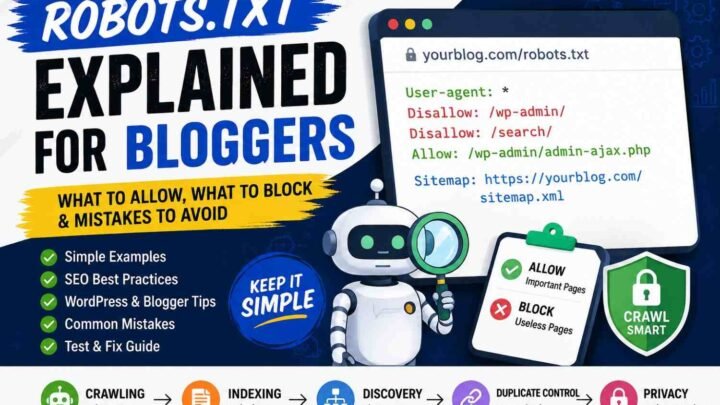
- Can Googlebot open it? Check
robots.txt, server blocks, login walls, and crawl errors. - Does it return the right HTTP status? A live article should normally return
200 OK, not404,500, or an endless redirect. - Can Google index it? Remove an accidental
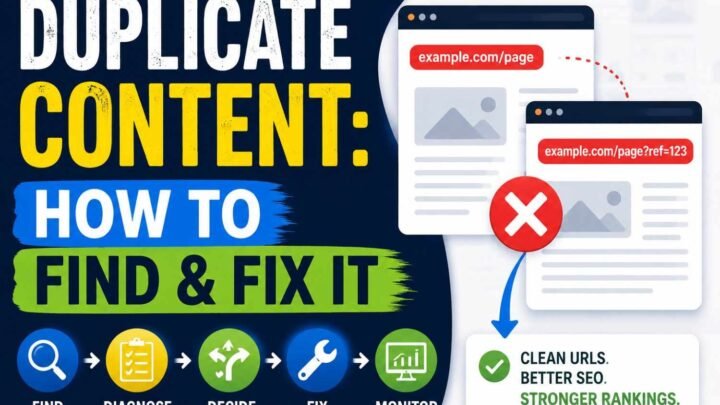
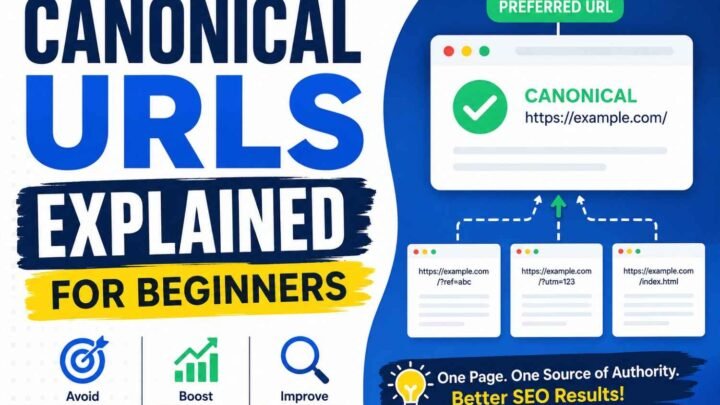
noindextag, and inspect the page in Google Search Console. - Is the canonical URL correct? A canonical tag tells Google which version you prefer when duplicate URLs contain the same content.
- Can Google see the main content? Test rendered HTML, since blocked scripts or failed JavaScript may hide text from Googlebot.
- Is the page worth indexing? Thin, copied, or near-duplicate pages may stay under “Crawled—currently not indexed,” even when the setup works.
Google mainly uses the mobile version of your page for indexing and ranking. Therefore, check that mobile users can read the same main text, links, images, and headings.
A sitemap helps Google discover a URL, but it does not guarantee crawling or indexing. Also, sending the same indexing request many times will not make Google crawl it faster.
Fix the cause instead: improve internal links, remove duplicates, correct the canonical tag, and add useful content. This crawlability and indexing check often saves you from rewriting a page that Google cannot properly access.
Can AI-Generated Content Rank in 2026?
Yes, AI-generated content can rank in 2026 when it gives people useful, correct, and original help. Google does not ban content just because you used ChatGPT or another AI tool to create it.
The real issue is why and how you made the page. Google may treat mass-made, copied, or thin pages as scaled content abuse when their main aim is to change search rankings rather than help readers.
AI Content vs Useful Content
Do not ask, “Did AI write this?” Instead, ask, “Does this page give the reader something worth using?”
| Weak AI content | Useful AI-assisted content |
|---|---|
| Repeats common advice | Adds a new test, view, or example |
| Uses made-up facts | Links to checked sources |
| Hides who reviewed it | Names the writer or reviewer |
| Creates hundreds of thin pages | Publishes fewer, stronger pages |
| Sounds sure about every claim | Explains limits and trade-offs |
Google’s May 2026 guidance says generative AI can help with research and structure. However, your page still needs unique, expert-led, non-commodity value.
A Safe AI Editorial Workflow
- Use AI to find ideas and group related queries.
- Check the live search results yourself.
- Gather facts from primary sources.
- Add your own tests, images, and lessons.
- Write around one clear point of view.
- Check every fact, date, quote, and link.
- Cut repeated or vague lines.
- Explain risks, limits, and other choices.
- Ask a skilled person to review the draft.
- Update it with real Search Console data.
Human Accountability Checklist
Before you publish, ask:
- Who checked each important fact?
- Which part comes from real work or testing?
- What does this page add that other pages lack?
- Could a false claim harm the reader?
- Can you prove every quote and number?
- Who will correct the page when facts change?
AI content is not bad for E-E-A-T by default. Yet fake expertise, false quotes, weak facts, and no named reviewer can quickly damage trust.
So, can AI-generated content rank in 2026? Yes—but AI should support your judgment, not replace your research, experience, and responsibility.
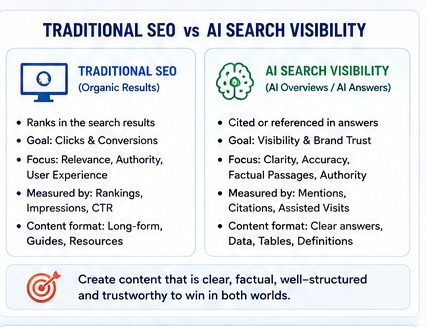
How Content Earns Visibility in AI Overviews and AI Search
Your AI search visibility depends on strong SEO, clear facts, and useful first-hand knowledge. However, ranking on Google and earning an AI citation are not the same goal.
Google says AI Overviews and AI Mode use its core search systems, so normal SEO still matters. Yet these tools may run several related searches, collect useful passages, and build one answer from many sources.
| Area | Traditional organic result | AI-generated answer |
|---|---|---|
| Main unit | A ranked page | Selected facts from one or more pages |
| User action | Click the result | Read, check a source, or ask more |
| Main focus | Relevance, trust, links, and title appeal | Clear facts, trusted sources, and useful passages |
| Measurement | Rank, impressions, CTR, and sales | Mentions, citations, visits, and brand reach |
| Main risk | Your page ranks too low | AI cites you but sends no click |
You do not need special AI schema, an llms.txt file, or odd “content chunking” tricks. Google says a page only needs to be indexed, eligible for a search snippet, crawlable, and useful to readers.
To improve your chance of getting cited by AI search:
- Answer the main question at once.
- Use headings that state the topic clearly.
- Write short passages that make sense alone.
- Link to primary and trusted sources.
- Add dates, sample sizes, and test methods.
- Name people, brands, tools, and places clearly.
- Use simple tables for close comparisons.
- Publish your own tests, data, or field notes.
- Keep author and publisher details consistent.
- Update prices, rules, dates, and fast-changing facts.
- Make sure Google can crawl and read the page.
You do not always need a top-ten rank to appear in an AI Overview. Ahrefs studied 863,000 search result pages and four million AI Overview URLs in March 2026; only about 38% of cited URLs also ranked in the top ten for the same search.
FAQs may help when they answer real questions, but FAQ schema does not promise an AI citation. Reddit, YouTube, forums, and expert interviews can also shape AI answers when they contain useful experience, yet fake mentions and mass link drops will not build trust.
Track impressions, cited pages, countries, devices, visits, leads, and sales—not rankings alone. Google started testing dedicated generative AI reports in Search Console in June 2026, which helps you measure AI Overview SEO and AI Mode visibility more clearly.
The best AI search visibility strategy is simple: publish clear, original, trusted content that helps a person first. Do not break natural writing into stiff fragments just because an AI tool may find them easy to extract.
SEO Content Factors That Are Exaggerated or Misunderstood
SEO ranking factor myths waste your time by turning weak clues into fixed rules. Google uses many systems and signals, but it does not publish an exact list of 200 factors or a public weight for each one.
| Claim | Verdict | Correct view |
|---|---|---|
| Google uses exactly 200 factors | Misleading | No proven public count exists. |
| Keyword density decides rank | Myth | Write naturally and cover the topic well. |
| Longer content always wins | Myth | Match length to the reader’s task. |
| E-E-A-T is one direct score | Misleading | Show experience, skill, trust, and proof. |
| Meta descriptions boost rank | Generally no | Use them to explain the page and earn clicks. |
| Schema guarantees higher rank | Myth | It may support rich search results. |
| Bounce rate lowers rank | Unproven | Use it as a page check, not penalty proof. |
| AI content gets a penalty | False | Low-value, scaled content is the real risk. |
| Perfect Core Web Vitals guarantee rank | False | Speed cannot replace useful content. |
| A new date makes content fresh | False | Update facts, links, images, and advice. |
| Social shares raise rank | Unproven | They may bring reach, links, and mentions. |
| Every page needs backlinks | It depends | Hard topics need more authority than narrow ones. |
Myth, Evidence, Action
Myth: keyword density is the key. Evidence: Google understands related words and meaning; action: answer the query clearly and remove repeated phrases.
Myth: bounce rate is a direct ranking score. Evidence: Google has called the claim that high bounce lowers rank false; action: use bounce data only to check user fit.
Myth: schema lifts every page. Evidence: structured data helps Google understand content and may support rich results; action: add valid markup that matches the visible page.
Myth: AI writing is unsafe. Evidence: Google warns about scaled content made to manipulate search; action: check facts, add real knowledge, and name the human editor.
Myth: speed beats content. Evidence: Core Web Vitals matter, but good scores do not ensure top rank; action: fix real user pain before chasing 100.
You may still ask: does meta description affect ranking, does schema improve SEO rankings, or does social media affect SEO? Improve the page for people first, then use each tool for its real job.
The best way to avoid SEO ranking factor myths is simple: stop hunting for magic numbers. Build a page Google can reach, your reader can trust, and a real person can use.
Which Factors Should You Prioritize for Your Situation?
Your SEO priorities in 2026 should match your website’s age, budget, data, and main problem. Do not build links when poor search intent, weak content, or an indexing issue is holding the page back.
Best Choice for a New Website
Start with narrow topics that solve one clear problem for one clear reader. Choose realistic, low-competition searches instead of broad keywords controlled by large brands.
Build a small internal content cluster around each main topic. Then publish one reference-worthy asset: a useful template, original test, local survey, calculator, checklist, or detailed case study.
Share it only in relevant communities where you already add value. Google recommends helpful, original content that gives readers more than common information.
Fastest Improvement for an Existing Article
First, check whether the article still matches the current search intent. Next, improve the title, opening answer, outdated facts, missing comparisons, and weak internal links.
Merge repeated sections and remove details that do not help the reader decide. A focused update often gives you a better return than adding another 1,000 words.
Cheapest Content Optimization Strategy
Use Google Search Console before buying another SEO tool. Its Performance report shows clicks, impressions, queries, pages, and country data, so you can find weak titles, lost queries, and pages close to page one.
Update those pages with expert input, original screenshots, current facts, and answers taken from real customer questions. Also, add useful internal links from pages that already receive traffic.
Safest AI Content Workflow
Let a named human own every article and final decision. Use AI for research support or structure, but verify facts through primary sources and expert review.
Do not publish hundreds of lightly edited pages. Google warns that scaled AI content created without added value may break its spam rules.
Expert-Level Strategy
Create original datasets, free tools, clear methods, and stories journalists can cite. Support them with digital PR, topic authority, consistent brand details, and AI citation tracking.
The right SEO priorities in 2026 are simple: fix access first, match intent next, add unique value, and then build authority. This order usually delivers the highest return from your time and budget.

Why Your Content Is Not Ranking: A Practical Decision Tree
When you ask why your content is not ranking, start with data instead of rewriting the page at once. Follow this path: Indexed? → Impressions? → Position? → Clicks? → Conversions?
1. Is the Page Indexed?
Search for the page in Google Search Console’s URL Inspection tool. If it is not indexed, check crawling, the HTTP status, noindex, robots.txt, JavaScript rendering, and internal links.
Also check whether Google chose another page as the canonical version. A noindex rule blocks a page from Google Search, while weak or duplicate content may give Google little reason to index it.
2. Is It Getting Impressions?
An indexed page with no impressions may target a query that few people search for. It may also use unclear wording, match the wrong intent, or sit outside your site’s main topic.
Check the page’s target query in Google Trends and review the current search results. Ask one simple question: does Google show guides, tools, videos, shops, forums, or service pages?
3. Does It Rank Too Low?
Impressions with a low average position mean Google can see some relevance, but stronger pages are winning. Compare usefulness, original insight, topic depth, backlinks, internal links, freshness, trust, and page quality.
Do not add words just because an article is stuck on page two. Add something useful: real results, screenshots, expert input, a clearer process, or a comparison that competing pages lack.
4. Does It Rank but Get Few Clicks?
Good rankings with a weak click-through rate often point to the title, snippet, or search result layout. Search Console reports clicks, impressions, CTR, and average position, so compare each metric by query, page, country, and device.
Your page may also compete with ads, videos, featured snippets, or AI answers. Rewrite the title only when it makes the result clearer, more specific, and more useful.
5. Does Traffic Fail to Convert?
Traffic without leads or sales often means you attract the wrong reader. Your offer may also lack trust, commercial fit, proof, or a clear next step.
Match the call to action with the reader’s stage. A beginner may need a checklist, while a ready buyer may need prices, proof, or a demo.
6. Did Traffic Fall While Rankings Stayed Stable?
Compare search demand, long-tail queries, seasonality, devices, countries, and changing search layouts. Google recommends using Search Console and Google Trends before deciding what caused a traffic drop.
Do not delete a useful page after a small ranking change or one weak week. Google advises against drastic edits when a page still performs well, so find the exact break in the path before acting.
This SEO content audit shows why your content is not ranking and what you should fix first. Update, merge, redirect, or delete a page only after the data points to the real problem.
A 10-Step SEO Content Optimization Workflow
Use this SEO content optimization workflow before you publish a new page or update an old one. It helps you fix the right problems instead of adding more words.
1. Set one clear goal
Choose the main task your page must help the reader finish. For example: teach a process, compare tools, solve an error, or support a buying choice.
2. Check the current search results
Search your main keyword and study the first page. Note whether Google shows guides, videos, tools, product pages, forums, or short answers.
3. Check crawling and indexing
Use Google Search Console to inspect the URL. Confirm that Google can crawl, render, index, and show the page in search results.
4. Map the topic
Choose one primary keyword and a few useful supporting terms. Add related questions and entities only when they help the reader.
5. Find competitor gaps
Do not copy the pages that already rank. Look for missing examples, costs, risks, comparisons, mistakes, limits, and next steps.
6. Add real proof
Use original screenshots, test results, templates, quotes, or case notes. A real example often adds more value than five generic paragraphs.
7. Build trust
Name the author and cite reliable sources. Also, show when the page was checked and explain any limits in your advice.
8. Add useful links
Link to related pages with clear anchor text. Google uses links to find pages and understand their context.
9. Fix mobile problems
Test the page on a real phone. Fix slow loading, moving buttons, hard-to-read text, and pop-ups that block the main content.
10. Measure the result
Track impressions, clicks, leads, sales, backlinks, brand mentions, and AI citations. Review the page after enough search data appears, then improve the weak point.
Stop doing this
- Stop adding words without adding value.
- Stop changing dates without making real updates.
- Stop buying weak or unrelated links.
- Stop publishing pages that target the same intent.
- Stop calling every SEO study a confirmed Google factor.
- Stop judging success by one keyword rank.
After publishing, check the page for technical errors first; then study its search data. Repeat this SEO content optimization workflow when the search intent, facts, competitors, or reader needs change.
H2: How to measure content performance beyond rankings
Rank alone does not show if your page works. Use SEO content metrics to track reach, trust, reader action, and real business value.
Track Discovery
Start with Google Search Console: check indexed pages, impressions, clicks, query coverage, CTR, and average position. Google reports clicks, impressions, average CTR, and average position in its Search Performance report.
Also track AI citations, brand mentions, and links from AI answers. Google now includes traffic from AI Overviews and AI Mode within Search Console reporting, so compare search changes by page, query, country, and device.
Measure Reader Engagement
Check engaged sessions, returning users, useful scroll depth, and video plays. In GA4, an engaged session lasts over 10 seconds, records a key event, or includes at least two page or screen views.
Measure Authority
Track editorial backlinks, referring domains, expert citations, branded searches, and relevant community mentions. One trusted industry link often tells you more than many weak directory links.
Connect Content to Revenue
Measure leads, sales, email sign-ups, assisted conversions, qualified enquiries, and revenue per landing page. Traffic matters, but conversions show whether your content attracts the right people.
Review these SEO content metrics each month: discovery shows visibility, engagement shows interest, authority shows trust, and revenue shows business impact.
9. Conclusion
SEO content ranking factors in 2026 work as a chain: first, Google must crawl and index your page. Then, your content must match the search intent and solve the reader’s real problem.
Useful content earns attention, but original examples give people a reason to trust and remember you. Strong sources, clear author details, relevant links, and honest limits add proof.
Page speed, mobile design, and simple navigation remove friction, but they cannot save weak content. AI Overviews also change the goal: you now need visibility, citations, clicks, trust, and useful actions.
Before you publish another post, audit one existing article with six checks: eligibility, relevance, usefulness, originality, trust, and experience. Fix the weakest layer first; this is the safest way to improve content rankings.
Frequently Asked Questions About SEO Content Ranking Factors
These quick answers cover the main SEO content ranking factors in 2026. Use them to choose what to fix first, instead of chasing every SEO claim you see online.
What is the most important content ranking factor in 2026?
There is no single factor that works for every search; however, your page must match the reader’s intent and give a clear, useful answer. Google uses many systems and signals to find relevant and helpful results, while crawl access and indexing remain basic needs.
For hard keywords, you may also need strong links, trusted sources, real examples, and clear proof of experience. Start with intent and usefulness, then build authority around the page.
Is E-E-A-T a direct Google ranking factor?
Do not treat E-E-A-T as one score that Google gives your page. It is a quality framework based on experience, expertise, authority, and trust; Google’s search raters use it to review how well ranking systems perform.
Trust matters most when your advice may affect a person’s health, money, safety, or legal choices. Show a real author, cite sound sources, explain your experience, and state your limits.
Does longer content rank higher?
Google does not set one ideal word count for blog posts. A long page may rank because it answers more useful questions or earns more links, but extra words alone add no value.
Write enough to help the reader finish the task; then stop. A short definition may need 500 words, while a detailed buying guide may need 2,500 words or more.
Can AI-generated content rank on Google?
Yes, AI-assisted content can rank when it is accurate, useful, original, and made for people. Google warns that publishing many AI-made pages without adding value may break its scaled content abuse policy.
Use AI to plan or shape a draft, but check every fact yourself. Add real tests, clear views, trusted sources, useful examples, and a human editor who owns the final work.
Are backlinks still important in 2026?
Yes, Google still uses links to find pages and judge their relevance. Its ranking systems also include link analysis and PageRank, so trusted links can help a strong page compete.
Still, one useful link from a related expert site can beat many weak links from random sites. A low-risk keyword may rank with good content and internal links, while a hard keyword may need wider authority.
Do Core Web Vitals affect rankings?
Yes, Google says Core Web Vitals are used by its ranking systems. Yet, a good score does not promise a top position because relevance, content quality, links, and other signals also matter.
Fix slow loading, delayed clicks, moving buttons, and poor mobile layouts first. Do not spend days chasing a perfect score while your page gives a weak or unclear answer.
Does keyword density matter?
There is no safe or ideal keyword percentage that makes a page rank. Repeating the same phrase too often makes your writing dull, forced, and hard to trust.
Use your main keyword in the title, opening, and a useful heading when it fits. Then use clear related terms, names, examples, and questions that help you explain the topic in natural speech.
How often should SEO content be updated?
Update content when its facts, tools, prices, laws, screenshots, or advice become old. A fast-moving SEO guide may need several checks each year, while a stable evergreen page may need only one review.
Do not change only the date; replace weak facts, test old steps, fix broken links, and remove advice that no longer works. That is how you keep SEO content ranking factors in 2026 useful for both readers and search engines.

Leave a Reply