If you’re writing a blog post to rank on Google, you’ve probably wondered how many times you should use your target keyword. Some people insist there’s a perfect percentage, while others say keyword density doesn’t matter anymore. The reality is a little more balanced.
Google has never published an official keyword density percentage for ranking webpages. What Google consistently emphasizes is creating helpful, people-first content that answers the reader’s question naturally and thoroughly. That said, keyword density is still a useful guideline. Using your primary keyword naturally gives search engines another relevance signal about your topic, alongside context, semantic meaning, and overall content quality. Use it too rarely, and your page may not clearly communicate its focus. Use it too often, and your writing can become repetitive and difficult to read.
I observed that most new blogs depends on the Keyword density initially. Later they change.
What Is Keyword Density?
Keyword density is simply a way to measure how often your primary keyword appears in relation to the total number of words in your article.
For example, imagine you’ve written a blog post containing exactly 1,000 words. If your target keyword appears 10 times, your keyword density is 1%.
The formula is simple:
Keyword Density = (Number of Keyword Uses ÷ Total Words) × 100
Most SEO tools calculate this automatically, so you rarely need to do the math yourself. More importantly, don’t try to chase an exact percentage. Your real goal is to write naturally while making it clear to both readers and search engines what your content is about.
What Is the Ideal Keyword Density for a 1000-Word Article?
This is one of the most frequently asked SEO questions, but there isn’t a universal answer.
Google doesn’t recommend a target keyword density because every topic is different. A technical tutorial may naturally repeat certain terms more often than a travel guide or a personal finance article.
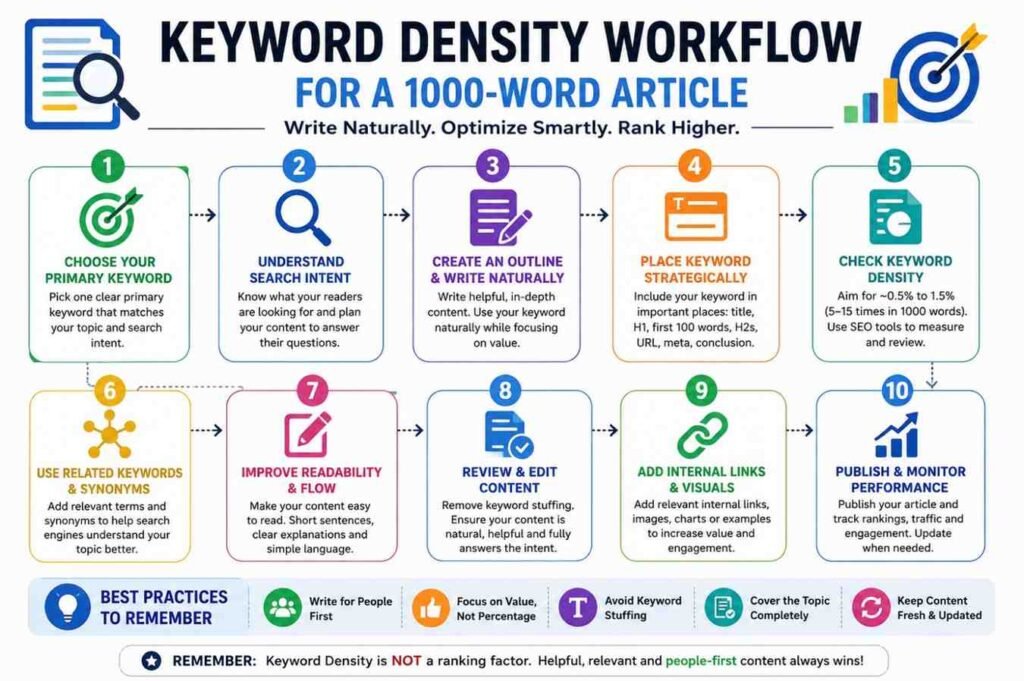
Although Google doesn’t recommend a specific percentage, many experienced SEO professionals naturally end up around 0.5% to 1.5% simply because that’s where well-written, topic-focused content often falls.
For a 1,000-word article, that roughly looks like this:
| Keyword Density | Approximate Keyword Uses |
|---|---|
| 0.5% | 5 times |
| 0.8% | 8 times |
| 1% | 10 times |
| 1.2% | 12 times |
| 1.5% | 15 times |
| 2% | 20 times (usually more than necessary) |
For most blog posts, mentioning your primary keyword around 8 to 12 times usually feels natural. It provides enough context without making your writing repetitive.
Instead of counting every occurrence, read your article from your visitor’s perspective. If your keyword fits naturally and doesn’t interrupt the flow, you’re probably using it the right way.
Does Google Use Keyword Density as a Ranking Factor?
No. Keyword density is not a direct Google ranking factor.
Modern search engines are far more advanced than simply counting how many times a keyword appears on a page. Google’s systems analyze the overall meaning of your content, understand related terms and synonyms, and evaluate how well your page satisfies the user’s search intent.
Because of this, a genuinely helpful article that thoroughly answers a reader’s question can easily outrank another article that repeats the same keyword dozens of times.
Google evaluates many signals together, including factors such as:
- Whether the content satisfies search intent
- Helpful, original, and people-first content
- Overall topical relevance
- User experience and readability
- Logical internal linking
- Content freshness where appropriate
- Experience, Expertise, Authoritativeness, and Trustworthiness (E-E-A-T)
- Natural semantic relationships between words and concepts
Instead of asking, “Have I used my keyword enough?” ask yourself, “Will someone leave this page with a complete answer to their question?” That’s the kind of content modern search engines are designed to reward.
Where Should You Place Your Primary Keyword?
Where you place your keyword is generally more important than how many times you repeat it.
Include your primary keyword naturally in places where it genuinely helps readers understand the page, such as:
- The page title (H1)
- The first 100 words
- At least one H2 heading
- One or two H3 headings where relevant
- The SEO title
- The meta description
- The page URL
- Image alt text (only when it accurately describes the image)
- The conclusion
- Internal links where the anchor text fits naturally
You don’t need to force your keyword into every one of these elements. If it reads smoothly and serves the reader, you’re following good SEO practice.
Why Keyword Stuffing Hurts SEO
Years ago, some websites tried to rank by repeating the same keyword over and over again. Today, that approach does more harm than good.
Keyword stuffing makes your content harder to read, reduces trust, and creates a poor user experience. Google also considers excessive keyword repetition a spam practice, which means it can negatively affect your site’s visibility.
For example, this sentence feels awkward and unnatural:
“Keyword density is important because keyword density improves keyword density and helps keyword density rankings.”
No real person writes like that, and readers notice immediately.
A much better approach is to use natural variations throughout your content, such as:
- SEO keyword usage
- Primary keyword
- Target keyword
- Search terms
- Relevant keywords
- Keyword optimization
- On-page SEO
These related phrases make your writing more engaging while helping search engines better understand your topic. That’s exactly how modern, high-quality SEO content is written today.
Keyword Density vs. Keyword Prominence: What’s the Difference?
When people talk about on-page SEO, keyword density usually gets all the attention. But there’s another concept that’s just as important: keyword prominence.
Keyword density tells you how often your keyword appears. Keyword prominence focuses on where it appears. Strategic keyword placement helps search engines understand your page more quickly while also helping readers immediately recognize what your content is about.
Instead of repeating your keyword throughout the article, place it naturally in important sections, such as:
- The page title (H1)
- The opening paragraph
- At least one H2 heading
- The SEO title and meta description
- The page URL
- The conclusion
These placements provide strong context without making your writing feel repetitive. If the keyword fits naturally, you’re already following a good SEO practice.
Why Related Keywords Matter More Than Repeating One Keyword
Google’s search systems have become much better at understanding language. They no longer rely on exact-match keywords alone. Instead, they evaluate your content using context, related terms, and the overall topic you’re covering.
For example, if your article is about keyword density, it’s perfectly natural to also mention phrases like:
- SEO content writing
- On-page SEO
- Search intent
- Keyword optimization
- Content optimization
- Google Search
- Primary keyword
- Long-tail keywords
- Related keywords
- Topical relevance
These terms help search engines build a clearer understanding of your page while making your writing sound more natural. After all, real conversations rarely repeat the exact same phrase over and over again.
Rather than trying to reach a specific keyword percentage, focus on explaining the topic thoroughly. That’s what modern SEO rewards.
Common Keyword Density Mistakes to Avoid
Even experienced writers occasionally fall into habits that weaken their SEO. Here are some of the most common mistakes.
Using the Exact Keyword Too Often
Repeating the same phrase in every paragraph quickly makes your article sound unnatural.
Instead, use your primary keyword where it fits naturally and support it with related words and phrases. This improves readability while still giving search engines enough context about your topic.
Writing for Search Engines Instead of Readers
One of the biggest SEO mistakes is writing every sentence just to include another keyword.
Your first priority should always be helping the reader. If your content is easy to understand, answers questions clearly, and provides useful information, keyword usage usually takes care of itself.
Ignoring Search Intent
A perfectly optimized article won’t perform well if it doesn’t answer the question behind the search.
Before you think about keyword density, understand what the reader wants. Are they looking for a definition, step-by-step instructions, expert advice, or a comparison? Build your content around that intent.
Obsessing Over Keyword Percentages
Some writers spend more time checking keyword density than improving the quality of their content.
Remember, keyword density is only a guideline. A helpful, well-structured article that naturally covers the topic is far more valuable than one that simply reaches a target percentage.
Best Tools to Check Keyword Density
You don’t need expensive software to review keyword usage.
Some tools calculate keyword density directly, while comprehensive SEO platforms evaluate keyword usage as part of a broader on-page SEO analysis.
Popular options include:
- Yoast SEO
- Rank Math SEO
- SEO Review Tools Keyword Density Checker
- Small SEO Tools Keyword Density Checker
- Screaming Frog SEO Spider
- Semrush On Page SEO Checker
- Ahrefs Site Audit
These tools can help identify overused or missing keywords, but don’t rely on them blindly. If a sentence feels awkward just to satisfy a tool, rewrite it for your readers instead.
Best Practices for Optimizing Keyword Density in 2026
SEO continues to evolve, but one principle has remained consistent: create content that genuinely helps people.
Here are a few practical habits that continue to work well:
- Choose one clear primary keyword for each page.
- Cover the topic thoroughly instead of repeating the same phrase.
- Use related keywords naturally throughout your content.
- Write in simple, conversational language.
- Organize your article with clear headings.
- Include examples, data, and practical advice where they add value.
- Add internal links only where they genuinely help readers discover related information.
- Read your article aloud before publishing. If a sentence sounds repetitive, rewrite it.
When your content feels natural to readers, it usually performs better in search results as well.
Frequently Asked Questions
What is the best keyword density for a 1,000-word article?
There isn’t an official percentage recommended by Google. In practice, many well-written articles naturally fall between 0.5% and 1.5%, but the exact number matters far less than creating helpful, relevant content.
Is 2% keyword density too high?
Not necessarily. Some technical articles naturally repeat important terms more often than others. If the keyword appears naturally and the content remains easy to read, the percentage itself isn’t a concern. If repetition starts sounding forced, it’s a good idea to reduce it.
Can keyword stuffing hurt rankings?
Yes. Excessive keyword repetition creates a poor reading experience and is considered a spam practice by Google. Always write for people first and use keywords naturally.
Do synonyms count toward keyword density?
No. Most keyword density tools count only exact keyword matches. However, related words and synonyms help search engines understand your topic better and improve the overall quality of your content.
Should I focus on keyword density or search intent?
Always prioritize search intent. Once you’ve fully answered the reader’s question, use your primary keyword naturally throughout the article instead of forcing it into every paragraph.
Final Thoughts
Keyword density isn’t a secret ranking formula, and it never has been. While using your primary keyword naturally is still important, it’s only one part of a much bigger SEO strategy.
The pages that consistently perform well don’t rank because they hit a perfect keyword percentage. They rank because they answer real questions, cover the topic thoroughly, and provide genuine value to readers.
Instead of chasing numbers, focus on writing clear, helpful, and trustworthy content. Use your primary keyword where it makes sense, include related terms naturally, and explain the topic as if you’re teaching another person.
When you consistently put readers first, good keyword usage naturally becomes part of the writing process—and that’s exactly the kind of content modern search engines are designed to reward.




Leave a Reply