Every parent wants their child to do well in school. Good marks make us happy. A rank card filled with high scores feels rewarding. But after watching many children grow up, one thing becomes clear—life doesn’t ask for marks alone.
A child may score 95% in exams and still struggle with honesty, discipline, kindness, or confidence. On the other hand, a child who learns good values, takes responsibility, respects others, and keeps learning throughout life often goes much farther than anyone expected.
So, how can you raise a successful child? The answer is simpler than many people think. Don’t focus only on report cards. Focus on the whole child.
Teach your child how to study, but also teach them how to treat people. Help them become curious, not just competitive. Encourage them to read books, ask questions, solve problems, and learn from mistakes. These small habits quietly shape their future.
Many parents ask, “How can I make my child excel in studies and life?” The truth is that success in school and success in life are deeply connected. A child who learns discipline, patience, communication, and self-control usually performs better in academics too.
And what should parents teach children besides academics?
A lot, actually.
Teach gratitude. Teach honesty. Teach respect. Teach them how to handle failure without giving up. Teach them to care about others. These lessons may not appear in exam papers, but they appear every day in real life.
At the end of the day, the goal is not just to raise a child who gets good grades. The goal is to raise a person who can stand on their own feet, make wise decisions, help others, and live with character. Good students are admired. Good human beings are remembered.
Parent carries a dream in their heart for their child
Every parent carries a dream in their heart for their child. Srinivas and Mamatha are no different.
They have a son named Varshith, a bright boy studying in 7th class. Like many working parents, both Srinivas and Mamatha are busy with their careers. Their days start early and often end late. Meetings, deadlines, responsibilities—life moves fast. Yet, no matter how busy they are, one thought keeps coming back to them.
“What will Varshith’s future look like?”
It’s a question many parents quietly ask themselves.
They want him to study well. Of course. But that’s not the only thing that worries them. They also think about his behaviour, discipline, confidence, habits, and the kind of person he will become as he grows older. Good marks are important, but good character matters too.
Deep down, Srinivas and Mamatha have a special dream. One day, they hope to see Varshith become an IAS officer. Not because of the status or power. They want him to serve society, make wise decisions, and live a meaningful life.
But then another question appears.
How is it possible?
How do you make your child successful in life when you have limited time? How do you guide your child toward IAS or any big goal without putting pressure on them? How do you balance academics and character development so your child becomes both intelligent and responsible?
The truth is, there isn’t a magic formula.
Children aren’t shaped by one big moment. They are shaped by hundreds of small moments. Daily conversations. Family values. Reading habits. Discipline. Encouragement. The examples they see at home.
This article is for parents like Srinivas and Mamatha—and maybe for you too. If you’re wondering how to help your child become a strong student, a confident individual, and a good human being, you’re in the right place.
Let’s walk through it together.
What Makes a Child Truly Successful?
As usaually, parents ask the same question: What makes a child successful? Is it getting top marks in every exam? Winning competitions? Studying in a famous college?
Honestly, I don’t think so.
Good marks are helpful. No doubt about that. They can open doors to opportunities. But when you look at people who are truly respected in life, you’ll notice something interesting. People rarely admire them only because they scored high in school. They admire them because of their character, attitude, and the way they treat others.
A truly successful child grows into a person who can handle challenges, make good decisions, respect others, and keep moving forward even when life gets difficult. That’s where success starts to take a deeper meaning.
Success Is More Than Marks
Many children score very well in school. Some become toppers year after year. But life outside the classroom is different.
Nobody gives marks for honesty.
Nobody conducts an exam on kindness.
There isn’t a report card for responsibility.
Yet these qualities often decide how far a person goes in life.
I’ve seen students who were average in academics become excellent leaders later. I’ve also seen brilliant students struggle because they couldn’t work with others, control their emotions, or handle failure. School teaches subjects. Life teaches lessons.
Both matter.
Character + Knowledge + Skills = Real Success
If I had to describe success in one simple formula, it would be this:
Character + Knowledge + Skills = Real Success
Knowledge helps a child understand the world.
Skills help them solve problems.
Character helps them choose the right path.
When these three grow together, children become strong from the inside. They don’t just chase success. They earn trust and respect along the way.
Why Toppers Don’t Always Become Leaders
This surprises many parents.
Being a topper and being a leader are not the same thing.
A leader needs more than subject knowledge. They need confidence, communication skills, discipline, emotional intelligence, and the ability to work with different kinds of people.
Think about an IAS officer, a business owner, a teacher, or a team leader. Their success doesn’t come only from what they learned in books. It also comes from how they manage people, handle pressure, and make decisions.
That’s why children should learn life skills, not just textbook lessons.
Build the Whole Child
If your dream is to raise a child who succeeds in school and in life, focus on the whole picture.
Teach them to read, but also teach them to listen.
Teach them to win, but also teach them to lose gracefully.
Teach them to speak confidently, but also to stay humble.
Help them develop discipline, leadership, empathy, and emotional intelligence. These qualities may not appear on a school report card, but they shape a person’s future more than many parents realize.
At the end of the day, the goal isn’t to raise a child who simply gets the highest marks in class. The goal is to raise a good human being who can create a meaningful life, contribute to society, and make others proud—not just because of achievements, but because of who they are.
The Modern Parenting Mistake Most Families Make
Most of the parents genuinely want the best for their children. They work hard, sacrifice a lot, and dream of seeing their son or daughter succeed. The problem is that somewhere along the way, many families start measuring success with only one thing—marks.
A child scores 95%, everyone is happy. The next exam comes, and the question becomes, “Why not 98%?” Slowly, learning turns into pressure. Curiosity disappears. The child studies for marks, not for knowledge.
Another issue is excessive screen time. Phones, tablets, YouTube videos, short reels, and games are everywhere. Most children aren’t bad or lazy. They’re simply distracted. When a child’s brain gets used to constant entertainment, sitting quietly with a textbook for thirty minutes starts feeling difficult. This is one reason many parents ask, “Why are children losing focus?” In many cases, the answer is right in front of us—the screen has become more exciting than real life.
There’s also something many families don’t notice. They live in the same house but rarely have meaningful conversations. Parents are busy. Children are busy. Everyone is looking at a screen. A family may spend hours together and still not truly connect.
I have seen children who are brilliant in studies but struggle to handle disappointment, respect others, or make good decisions. This is often why intelligent students fail in life. Knowledge alone isn’t enough. Life also demands patience, discipline, kindness, honesty, and emotional strength.
Schools teach subjects. Parents teach values.
A child doesn’t learn integrity from a textbook. They learn it by watching how their parents speak, behave, treat others, and handle problems. Marks matter, of course. Education matters too. But if we focus only on grades and ignore character, we may raise a good student while missing the chance to raise a good human being.
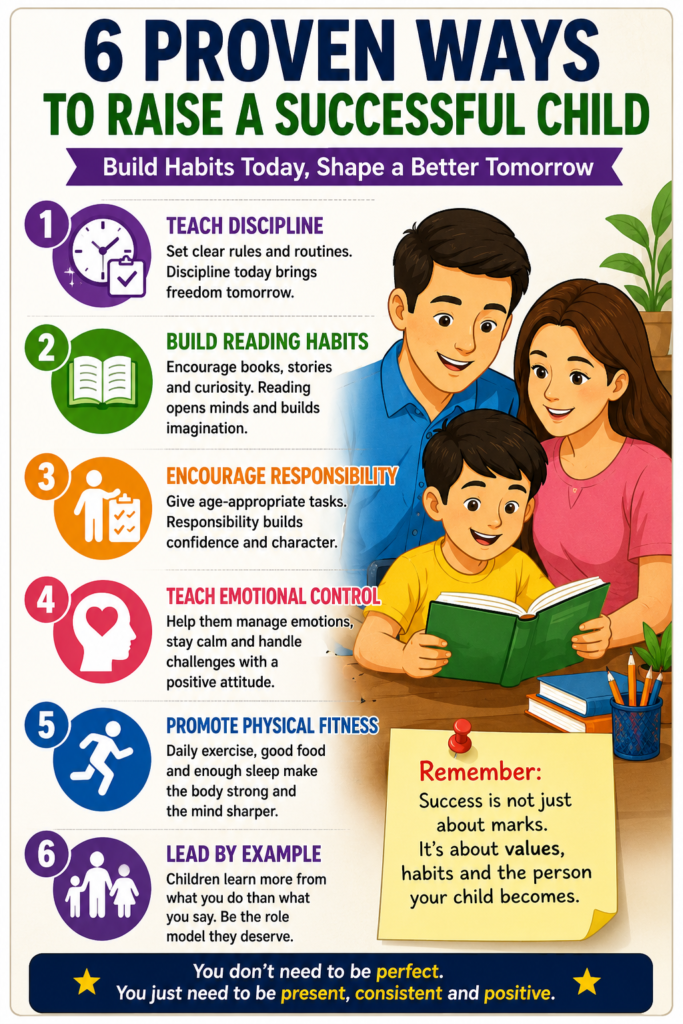
6 Proven Ways to Raise a Successful Child
Every parent wants the same thing deep down. We want our children to do well in school, make good decisions, stay away from bad influences, and grow into decent human beings.
But here’s something I’ve noticed over the years. Successful children aren’t usually the ones with the highest marks. They’re the ones who learn discipline, responsibility, kindness, and self-control early in life. Good grades matter, of course. But character lasts much longer than any report card.
If you’re wondering how successful parents raise children who do well both in school and in life, these six habits can make a real difference.
Teach Discipline Before Motivation
Many parents wait for their child to feel motivated before expecting them to study, read, or complete responsibilities.
That’s a mistake.
Motivation comes and goes. Discipline stays.
Think about adults. Most people don’t wake up every morning excited to work, exercise, or handle responsibilities. They do those things because they have built habits.
Children are no different.
A child who studies for one hour every day at the same time develops discipline. A child who only studies when they “feel like it” struggles to stay consistent.
Start small.
Set regular times for studying, reading, sleeping, and playing. Follow them every day. At first, your child may complain. That’s normal. Over time, those routines become automatic.
The truth is simple. Successful kids don’t always do what they want. They learn to do what they should.
Build Reading Habits
If I could recommend only one habit to parents, it would be reading.
Books quietly shape a child’s thinking.
A child who reads regularly learns new words, develops imagination, improves focus, and gains knowledge without even realizing it.
You don’t need expensive coaching classes to begin. A few good books can change a child’s future.
Many successful leaders, scientists, and civil servants developed strong reading habits when they were young.
Love of Learning Examples
Parents often ask for real love of learning examples. Here are a few simple ones that work surprisingly well.
Reading biographies
Children become inspired when they learn about people who overcame challenges.
Read stories about great personalities, scientists, freedom fighters, sports champions, and civil servants. These stories teach perseverance better than lectures ever can.
Simple science experiments
Mixing baking soda and vinegar. Growing a plant from a seed. Making a small volcano model.
Children love discovering things with their own hands. Curiosity grows naturally when learning feels fun.
Current affairs discussions
Spend ten minutes during dinner talking about something happening in the country or the world.
Ask questions.
“What do you think about this?”
“What would you do if you were the leader?”
These conversations develop awareness, thinking skills, and confidence.
Encourage Responsibility
One common parenting mistake is doing everything for children.
We pack their bags. We organize their books. We solve every little problem.
It feels like we’re helping.
Sometimes we’re actually preventing growth.
Children become responsible when they have responsibilities.
Give age-appropriate tasks.
Let them arrange their study table. Ask them to water plants. Let them manage a small pocket-money budget. Encourage them to prepare their school bag for the next day.
Will they make mistakes?
Absolutely.
That’s part of learning.
Every responsible adult was once a child who was trusted to handle small responsibilities.
Teach Emotional Control
Life won’t always go according to plan.
Children will lose competitions. They will face criticism. Sometimes they will fail despite working hard.
How they respond matters.
A child who can manage emotions has a huge advantage in life.
Teach them that feeling angry, sad, nervous, or disappointed is normal. What matters is how they handle those feelings.
Instead of saying, “Don’t cry,” try asking, “What happened?”
Listen first.
Help them understand their emotions rather than suppress them.
Children who learn emotional control usually handle school pressure, friendships, and future challenges much better than those who don’t.
Promote Physical Fitness
Many parents focus completely on studies and forget about physical health.
That’s risky.
A tired, unhealthy child cannot perform at their best academically.
Children need movement.
Running, cycling, swimming, football, cricket, badminton—almost any physical activity is better than sitting with screens all day.
Exercise improves concentration. It reduces stress. It boosts confidence.
I’ve seen children become more focused in their studies simply because they started spending time outdoors every day.
Strong body. Strong mind.
The two go together.
Lead by Example
This may be the most powerful parenting lesson of all.
Children watch far more than they listen.
You can tell your child to read books, but if they never see you reading, the message becomes weak.
You can teach honesty, respect, and discipline. But they will pay more attention to how you behave than what you say.
If you want your child to speak politely, speak politely yourself.
If you want your child to avoid excessive mobile phone use, put your own phone aside sometimes.
If you want your child to love learning, let them see you learning too.
Parents are a child’s first teachers.
And whether we realize it or not, we’re teaching every single day.
The habits children see at home often become the habits they carry for the rest of their lives.
So when people ask, “What habits create successful kids?” my answer is simple.
Teach discipline. Encourage reading. Give responsibility. Build emotional strength. Keep them active. And most importantly, become the example you want them to follow.
These six things won’t create overnight success.
But year after year, they help shape something even better than a good student.
They help shape a good human being.
How to Teach a Kid to Study Without Pressure
Some of parents ask the same question: “How can I improve my child’s study habits without constantly forcing them?” The truth is, children learn best when studying feels like a normal part of life, not a punishment.
One mistake I see quite often is parents focusing only on marks. Every conversation becomes about homework, tests, or grades. After some time, children start feeling that studying is something stressful. They study because they are afraid of being scolded, not because they want to learn.
A better approach is to make learning easier and less overwhelming.
One simple method is the Pomodoro Technique. Instead of asking your child to sit for two or three hours continuously, encourage them to study for 25 minutes and then take a short 5-minute break. It sounds almost too simple, but it works surprisingly well. Most children can stay focused when they know a break is coming soon.
Another powerful habit is active recall. Smart students don’t just read the same page again and again. They close the book and try to remember what they learned. For example, after reading a science lesson, ask your child, “Can you explain this chapter in your own words?” That small exercise helps the brain remember information much longer.
Then comes spaced repetition, which is really just a fancy name for reviewing lessons at regular intervals. A child who studies a chapter today, reviews it after three days, and looks at it again next week will usually remember more than a child who studies everything the night before an exam.
Good note-making also makes a big difference. Encourage your child to write short points, draw diagrams, use colors, or create simple summaries. Children often remember what they write better than what they only read.
If you’re wondering how to teach a kid to study, try becoming a guide instead of a supervisor. Sit with them occasionally. Ask questions. Listen to what they understood. Avoid turning every study session into an inspection.
And if your goal is how to make your child smart in school, remember this: smart students are not always the ones who study the longest. More often, they are the ones who study consistently, stay curious, and enjoy the learning process.
Small daily habits matter far more than pressure. A child who studies peacefully for one focused hour every day will usually go much further than a child who studies for four stressful hours once in a while.
Read More: What is the Factorial of 100?
How Working Parents Can Shape Their Child’s Future
90% of the parents carry the same worry in their hearts.
They work hard every day. They leave home early, come back tired, and do everything they can to give their children a better life. Yet when they look at their child, a question quietly appears in their mind:
“Am I doing enough?”
Srinivas and Mamatha often felt this way. Both were busy with their careers. Their son, Varshith, was studying in 7th class. Like many parents, they dreamed of seeing him grow into a successful person, maybe even become an IAS officer one day. But they also wanted something more important. They wanted him to be disciplined, respectful, confident, and kind.
The good news is this.
Children don’t measure love by the number of hours parents spend with them. They remember the quality of those moments.
Many parents ask, “How can busy parents help children when they hardly have free time?” The answer is simpler than most people think. You don’t always need three or four hours every day. Sometimes, even thirty focused minutes can create a stronger impact than spending an entire day together while everyone is distracted by phones, television, or work.
The 30-Minute Daily Parenting Formula
This simple routine can fit into almost any family’s schedule.
10 Minutes of Listening
Just listen.
No lectures. No corrections. No advice.
Ask your child how school went. Ask what made them happy. Ask what annoyed them. Let them talk freely.
Some days they may speak for ten minutes. Other days they may say only two sentences.
That’s okay.
The goal is not conversation. The goal is connection.
Children who feel heard are more likely to trust their parents when bigger challenges appear later in life.
10 Minutes of Reading Together
This habit looks small, but it can change a child’s future.
Read a biography, a story, a newspaper article, or even a chapter from a good book. One day it might be about Dr. A.P.J. Abdul Kalam. Another day it could be about a scientist, an athlete, or an IAS officer.
Reading does more than improve marks.
It builds vocabulary. It improves thinking. Most importantly, it develops a love for learning.
And children who enjoy learning rarely stop growing.
10 Minutes of Future Planning
Keep it light.
Ask simple questions.
“What did you learn today?”
“What skill would you like to improve this month?”
“What dream do you have for yourself?”
For Varshith, this could mean discussing current affairs, improving communication skills, or setting a small study goal for the week.
These conversations help children think beyond tomorrow’s homework. They slowly begin to see a bigger picture of their future.
How Much Time Should Parents Spend With Children?
There is no magic number.
Some parents spend five hours with their children but stay glued to their phones. Others spend only thirty focused minutes and build a deep bond.
Children need attention more than presence.
They need encouragement more than expensive gifts.
They need guidance more than pressure.
Years from now, Varshith may not remember every lesson from school. He may forget many exam scores too. But he will remember the evenings when his parents listened to him, read with him, and talked about his dreams.
That’s the kind of investment that keeps paying back for a lifetime.
Helping Students Reach Their Full Potential
One of the biggest mistakes many parents make is believing that every child should be good at the same things. That’s simply not true. Every child is different. Some children love numbers. Some enjoy drawing. Others can speak confidently in front of a crowd, while a few are naturally curious about how things work.
If you’re asking, “How can I discover my child’s talent?”, start by observing instead of directing. Watch what your child chooses to do when nobody is forcing them. What excites them? What do they talk about most? What kind of activities make them lose track of time?
I have seen children who struggled with textbooks but could build amazing things with their hands. I’ve also seen students who were average in exams become successful because they were excellent communicators. Marks tell only a small part of the story.
Identify Strengths Before Fixing Weaknesses
Many parents spend all their energy trying to improve areas where their child is weak. Of course, weaknesses shouldn’t be ignored. But strengths deserve attention too.
If a child enjoys writing, encourage writing. If they love science experiments, give them opportunities to explore. When children spend time developing their natural strengths, their confidence grows. And confidence often leads to better performance in other areas as well.
So if you’re wondering, “How do I identify my child’s strengths?”, look for three simple signs:
- What they enjoy doing repeatedly
- What they learn quickly
- What others often praise them for
Those clues rarely lie.
Encourage Career Exploration Early
Children don’t need to decide their entire future at age 12. That’s too much pressure. But they should start learning about different careers.
Talk about doctors, teachers, entrepreneurs, scientists, engineers, IAS officers, artists, and sportspersons. Visit workplaces when possible. Watch interviews. Read biographies together.
A child cannot dream about a future they have never seen.
For example, if Varshith dreams of becoming an IAS officer one day, he should gradually develop habits that support that goal—reading newspapers, improving communication skills, understanding society, and learning to think independently. These habits help in life, even if his career path changes later.
The Power of Mentorship
Sometimes children listen to mentors more than parents. That’s normal.
A good teacher, coach, relative, or family friend can have a huge influence on a child’s growth. Mentors provide guidance, encouragement, and a different perspective that children often need during their teenage years.
Parents don’t have to do everything alone.
The real goal of helping students reach their full potential isn’t to turn them into someone else. It’s to help them become the best version of themselves. When children discover their strengths, explore possibilities, and learn from positive role models, they begin building a future that matches who they truly are—not who others expect them to be.
What Can Teachers Do to Help Students Learn Better?
Sometimes, parents ask, “What can teachers do to help students learn better?” The answer is actually much bigger than simply completing the syllabus or giving homework every day.
Great teachers don’t just teach subjects. They teach children.
Every child walks into a classroom with different strengths, weaknesses, interests, and struggles. Some students understand a lesson the first time. Others need a little more explanation, encouragement, or practice. That’s why personalized teaching matters so much. A teacher who takes time to understand how each student learns can make a huge difference. Sometimes a small adjustment—using a real-life example, asking a different question, or spending five extra minutes with a child—can completely change how that student feels about learning.
I’ve often noticed that students work harder when they believe they can improve. That’s where growth mindset feedback comes in. Instead of saying, “You’re smart,” effective teachers say things like, “You worked hard on this,” or “I can see your progress.” It may sound simple, but these words help children understand that success comes from effort and practice, not just talent. When students stop being afraid of mistakes, they become more willing to learn.
Another powerful approach is project-based learning. Children naturally enjoy exploring, building, creating, and solving problems. A science project, a class presentation, a school garden, or even a small community activity can teach lessons that textbooks alone cannot. Students remember experiences far longer than memorized answers.
When people ask, “How can teachers motivate students?” my answer is always the same: make learning meaningful. Children learn better when they see a purpose behind what they are studying.
And when it comes to how to help struggling students in the classroom, patience is often the most underrated tool. Some children need extra guidance. Some need confidence. Others simply need someone who believes in them before they learn to believe in themselves.
Years later, students may forget formulas and definitions. They rarely forget a teacher who encouraged them when they were struggling. Sometimes that encouragement becomes the reason a child succeeds.
What Can Teachers Do to Help Students Learn Better?
Often, parents ask, “What can teachers do to help students learn better?” The answer is actually much bigger than simply completing the syllabus or giving homework every day.
Great teachers don’t just teach subjects. They teach children.
Every child walks into a classroom with different strengths, weaknesses, interests, and struggles. Some students understand a lesson the first time. Others need a little more explanation, encouragement, or practice. That’s why personalized teaching matters so much. A teacher who takes time to understand how each student learns can make a huge difference. Sometimes a small adjustment—using a real-life example, asking a different question, or spending five extra minutes with a child—can completely change how that student feels about learning.
I’ve often noticed that students work harder when they believe they can improve. That’s where growth mindset feedback comes in. Instead of saying, “You’re smart,” effective teachers say things like, “You worked hard on this,” or “I can see your progress.” It may sound simple, but these words help children understand that success comes from effort and practice, not just talent. When students stop being afraid of mistakes, they become more willing to learn.
Another powerful approach is project-based learning. Children naturally enjoy exploring, building, creating, and solving problems. A science project, a class presentation, a school garden, or even a small community activity can teach lessons that textbooks alone cannot. Students remember experiences far longer than memorized answers.
When people ask, “How can teachers motivate students?” my answer is always the same: make learning meaningful. Children learn better when they see a purpose behind what they are studying.
And when it comes to how to help struggling students in the classroom, patience is often the most underrated tool. Some children need extra guidance. Some need confidence. Others simply need someone who believes in them before they learn to believe in themselves.
Years later, students may forget formulas and definitions. They rarely forget a teacher who encouraged them when they were struggling. Sometimes that encouragement becomes the reason a child succeeds.
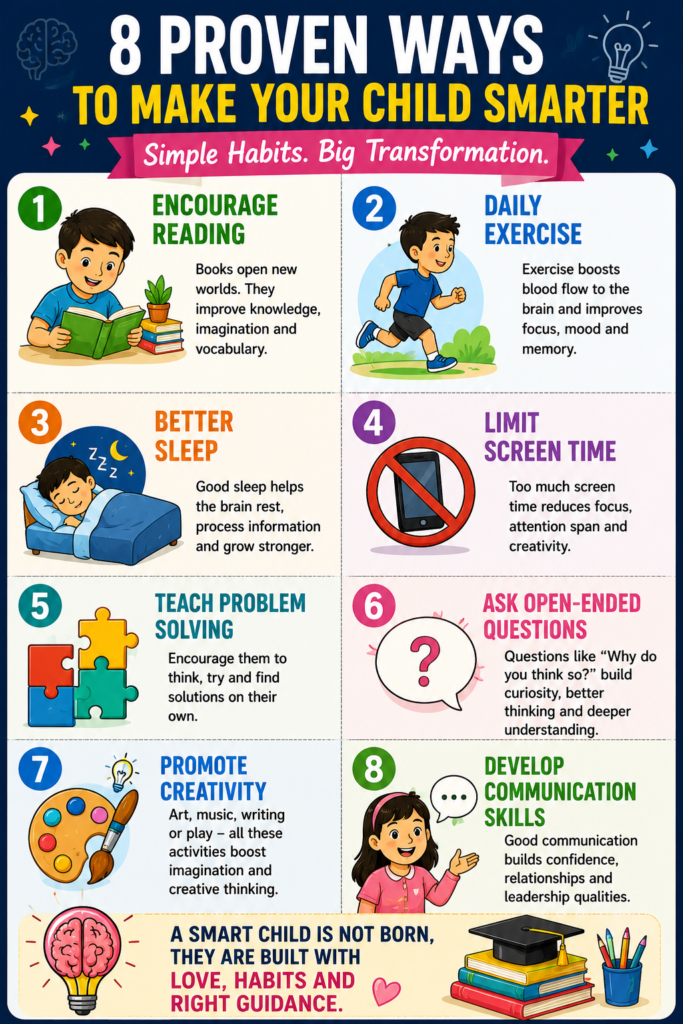
8 Proven Ways to Make Your Child Smarter
Every parent wants to know how to make their child smarter. I’ve noticed something interesting over the years, though. The smartest children aren’t always the ones who score the highest marks. They’re often the kids who stay curious, ask questions, solve problems on their own, and keep learning even when nobody is forcing them.
If you’re wondering how to make your child smart and confident, don’t focus only on textbooks. Intelligence grows from daily habits, family environment, and the small lessons children learn every single day.
Here are eight simple but powerful ways that really work.
Encourage Reading
Reading is probably one of the easiest and most effective ways to develop a child’s mind.
A child who reads regularly learns new words, understands different ideas, and develops better thinking skills without even realizing it. That’s the beauty of reading. It teaches while entertaining.
Don’t limit reading to school books. Let your child explore stories, science magazines, biographies, history books, or anything that sparks interest. One child may love space. Another may enjoy cricket stories.
The goal isn’t to force reading. It’s to help children fall in love with learning.
Even twenty minutes a day can make a surprising difference over time.
Daily Exercise
Many parents think intelligence develops only at a study table. That’s not true.
The brain and body work together.
When children run, play sports, ride bicycles, or simply spend time outdoors, blood circulation improves and the brain gets more oxygen. They often return home more focused and energetic.
I’ve seen children struggle to sit and study after spending an entire day indoors. Give them time to move. Let them sweat a little. It helps more than most people realize.
A healthy body supports a healthy mind.
Better Sleep
Sleep is often ignored, especially when exams are approaching.
Some parents believe longer study hours automatically lead to better results. In reality, a tired brain learns very little.
Children need proper sleep to remember information, stay focused, and manage emotions.
A child who sleeps well usually learns faster than a child who studies late into the night every day.
Try creating a simple bedtime routine. Turn off screens early. Keep the room quiet. Let the brain rest.
Sometimes the smartest thing a child can do is sleep.
Limit Social Media
Phones aren’t the enemy. Uncontrolled screen time is.
Many children spend hours scrolling through short videos without realizing how much time disappears. Those constant notifications train the brain to jump from one thing to another.
As a result, concentration suffers.
This doesn’t mean children should never use technology. Technology can be useful when used wisely.
Set reasonable limits. Encourage activities that require focus, such as reading, drawing, sports, puzzles, or learning a new skill.
Balance matters.
Teach Problem Solving
One of the biggest differences between average students and highly successful people is their ability to solve problems.
Instead of giving answers immediately, encourage your child to think.
If a toy breaks, ask how it can be fixed.
If a school project seems difficult, ask what solutions they can come up with.
At first, they may struggle. That’s okay.
Children develop confidence when they discover answers on their own. They begin trusting their ability to handle challenges rather than waiting for someone else to rescue them.
Ask Open-Ended Questions
Many conversations with children end with one-word answers.
“How was school?”
“Fine.”
Conversation over.
Try asking questions that make them think a little deeper.
“What was the most interesting thing you learned today?”
“If you were the class teacher, what would you do differently?”
“What problem would you like to solve in the world?”
Questions like these encourage imagination, reasoning, and communication.
Sometimes children’s answers will surprise you. They often see things adults miss.
Promote Creativity
Creativity isn’t only for artists.
Creative thinking helps children in science, business, leadership, and everyday life.
Allow children to build things, draw, write stories, experiment, or come up with their own ideas. Not everything needs instructions.
Some of the best learning happens when children are simply exploring.
A child who learns to think creatively becomes more adaptable, more confident, and better prepared for future challenges.
Develop Communication Skills
A brilliant child who cannot express ideas clearly often struggles to reach full potential.
Communication matters.
Encourage your child to speak confidently at home. Let them share opinions during family discussions. Ask them to explain what they learned at school.
Reading improves communication. Listening improves communication. Practice improves communication.
These small daily conversations slowly build confidence.
Years later, those skills can help during interviews, leadership roles, public speaking, and professional careers.
Lessons from “How to Raise a Genius” Studies
Most of the parents secretly wonder about this.
Can genius be taught? Or are some children simply born with special abilities that the rest of us can never match?
For years, people believed intelligence was mostly decided at birth. A child either had it or didn’t. But some of the most famous studies on child development tell a very different story.
What surprised me most while reading about these studies is how often ordinary habits beat extraordinary talent.
The Laszlo Polgar Experiment: A Father Who Challenged the World
One of the most talked-about examples is the story of Laszlo Polgar, a Hungarian educational psychologist.
He had a bold belief.
He believed that geniuses are not born. They are made.
To test his idea, he and his wife decided to educate their own children using a unique approach. They chose chess as the learning field and started teaching their daughters from a very young age.
The results shocked many people.
All three daughters became world-class chess players. His daughter Judit Polgar eventually became one of the strongest female chess players in history and defeated several top male grandmasters.
Now, this doesn’t mean every child can become a chess champion. That’s not the real lesson.
The bigger lesson is that focused learning, consistent practice, family support, and a rich learning environment can help children achieve far more than most people imagine.
How to Raise a Genius: Lessons from a 45-Year Study of Super Smart Children
Another interesting piece of research followed highly gifted children for decades. Researchers wanted to understand what helped these children succeed later in life.
The findings were surprisingly simple.
Children who stayed curious, worked hard, practiced regularly, and had supportive adults around them often achieved more than those who relied only on natural intelligence.
In other words, being smart was not enough.
Many gifted children did well. Some didn’t.
The difference usually came down to habits, effort, emotional stability, and opportunities.
That’s something every parent should remember.
A child doesn’t need to be the smartest student in the classroom to build a successful future.
What Raising Smart Kids Books Keep Teaching Us
When you read books about raising smart children, whether it’s Raising Smart Kids, How to Raise a Genius, or similar parenting books, a common theme appears again and again.
The home environment matters.
A lot.
Children learn from what they see every day.
If parents read books, children notice.
If parents solve problems calmly, children notice.
If parents show kindness, discipline, patience, and curiosity, children slowly absorb those habits.
Not overnight.
But year after year.
That’s how character forms.
Environment Beats Talent
Many parents worry because their child isn’t the class topper.
Honestly, that’s often the wrong thing to worry about.
A child with average talent but a strong environment usually goes much further than a talented child who lacks guidance and support.
The conversations at home matter.
The books on the shelf matter.
The friends they spend time with matter.
Small things add up.
Practice Beats IQ
Natural intelligence helps. Nobody can deny that.
But practice changes everything.
Think about sports, music, public speaking, writing, or mathematics. The children who improve the most are rarely the ones who rely only on talent. They are the ones who keep showing up and doing the work.
Day after day.
Even when they don’t feel like it.
Consistency Beats Motivation
This may be the most valuable lesson of all.
Parents often wait for children to become motivated before they act.
Real growth works the other way around.
Children study because it is part of their routine.
They read because reading is normal in the family.
They exercise because it is expected.
Motivation comes and goes. Everyone experiences that.
Consistency stays.
And over ten or fifteen years, consistency creates results that motivation alone never can.
So, can genius be taught?
Maybe not in the way most people imagine.
But excellence can absolutely be developed.
A child may not become a chess grandmaster, a scientist, or an IAS officer simply because parents want it. Yet when parents create the right environment, encourage steady practice, and teach strong values, they give their child something even more powerful than talent.
They give them the ability to keep growing for life.
The IAS Officer Parenting Blueprint for Varshith
Generally, few of the parents dream of seeing their child become an IAS officer. Srinivas and Mamatha are no different. They look at their son Varshith, who is now studying in 7th class, and wonder what his future will look like. Will he study well? Will he be disciplined? Will he become a responsible person? Most importantly, will he be happy and successful in life?
The truth is, becoming an IAS officer doesn’t start in college. It doesn’t even start in high school. It begins much earlier, through small daily habits, good values, curiosity, and discipline.
Age 12–15: Build Strong Foundations
This is the age where children slowly start forming their identity. What they read, think, and do every day matters more than most parents realize.
One simple habit can make a huge difference: reading newspapers. Not because Varshith needs to memorize current affairs at this age, but because newspapers help children understand the world outside their classroom. Even reading one interesting article a day can spark curiosity.
Public speaking is another skill worth developing early. Many brilliant students struggle later because they cannot express their thoughts confidently. Encourage your child to participate in school assemblies, small presentations, or even family discussions at home. Confidence grows through practice, not magic.
Essay writing also deserves attention. IAS officers spend a lot of time communicating ideas clearly. A child who learns to organize thoughts on paper develops better thinking skills. It doesn’t have to be complicated. Writing a page about a book, a festival, or a school event is enough to start.
Age 15–18: Develop Leadership and Character
Teenage years are not just about scoring marks. They’re about learning how to deal with people, responsibilities, and challenges.
Leadership activities help children step outside their comfort zone. Joining student councils, organizing events, leading school projects, or managing a team activity teaches lessons that no textbook can provide.
Debates are equally valuable. They teach children to think from different perspectives, listen carefully, and defend their ideas respectfully. These skills become useful throughout life, whether someone becomes an IAS officer or chooses another career.
Social service is something many parents overlook. Yet it teaches empathy better than any lecture. Visiting an orphanage, participating in cleanliness drives, helping younger students, or volunteering during community events can help children understand real-life problems and develop compassion.
A future civil servant must care about people. That habit starts young.
Age 18+: Begin UPSC Foundation the Smart Way
Once Varshith enters college, he can gradually start building his UPSC foundation. There is no need to rush into coaching institutes immediately.
A strong reading habit, awareness of national issues, good communication skills, and disciplined study routines already put a student ahead of many others.
At this stage, he can begin reading standard books, improving answer-writing skills, and exploring subjects that genuinely interest him. More importantly, he should continue developing integrity, humility, and a service mindset.
Many people ask, “How do IAS officers study as students?” Surprisingly, most successful candidates were not necessarily child prodigies. They were consistent. They read regularly. They stayed curious. They learned from failures and kept moving forward.
For Srinivas and Mamatha, the goal shouldn’t be only to raise an IAS officer. The bigger goal is to raise a thoughtful, disciplined, honest young man. If Varshith develops those qualities, success will follow him wherever life takes him.
100 Things to Teach Your Child Before Age 18
When parents think about their child’s future, they usually think about marks, college, and career. That’s normal. Every parent wants their child to do well in life.
But after watching many successful people over the years, one thing becomes very clear.
The children who do well in life are not always the ones who scored the highest marks in school.
They’re often the ones who learned how to handle people, manage emotions, make good decisions, and stay honest when nobody was watching.
A child may forget many chapters from a textbook. That’s okay. Life won’t ask them to remember every formula. But life will definitely test their character, patience, confidence, and judgment.
That’s why parents should focus on teaching more than just academics.
If I had to create a list of 100 things to teach your child, I would group them into five areas that matter the most.
Personal Values: The Foundation of Everything
A strong building needs a strong foundation. The same is true for children.
Teach your child to tell the truth, even when it’s uncomfortable. Teach gratitude, not entitlement. Help them understand that saying “thank you” and appreciating small things can change how they see the world.
Integrity matters too. A child should learn to do the right thing even when nobody is checking.
Other important values include kindness, respect, humility, responsibility, forgiveness, honesty, loyalty, fairness, and keeping promises.
These lessons may seem simple, but they shape the person your child becomes.
Life Skills: Things School Doesn’t Always Teach
Many children leave school knowing algebra but don’t know how to cook a simple meal or manage money.
That’s a problem.
Before age 18, every child should learn basic cooking, personal hygiene, budgeting, saving money, using public transport, organizing their room, and speaking politely with others.
Communication is especially important.
A child who can clearly express thoughts, listen carefully, and hold a respectful conversation will have an advantage in almost every part of life.
These skills build independence. And independent children become confident adults.
Success Skills: Habits That Create Results
Success is rarely about talent alone.
Most successful people follow good habits for years before anyone notices their achievements.
Teach your child how to manage time. Show them how to create a daily routine. Help them develop a reading habit. Encourage goal setting and tracking progress.
Reading deserves special attention.
A child who reads regularly gains knowledge, improves vocabulary, develops focus, and learns how others think. Books quietly become teachers for life.
Also teach problem-solving, self-learning, consistency, curiosity, and how to keep going when things become difficult.
Small habits repeated every day often beat natural talent.
Leadership Skills: Preparing Them for Real Life
Leadership is not about giving orders.
It’s about helping people, solving problems, and taking responsibility.
Children can start learning leadership much earlier than most parents think.
Encourage teamwork through sports, school projects, and family activities. Let them make decisions sometimes. Allow small mistakes. That’s how judgment develops.
Public speaking is another valuable skill.
Many adults fear speaking in front of others because they never practiced when they were young. A child who learns to express ideas confidently can stand out almost anywhere.
Leadership also includes listening, cooperation, decision-making, initiative, and respecting different opinions.
Emotional Skills: The Skills That Protect Them for Life
This area is often ignored, but it may be the most important of all.
Children face pressure. Friendships change. They experience disappointment, failure, rejection, and self-doubt.
They need tools to handle those moments.
Teach empathy so they can understand other people’s feelings. Teach patience because not everything happens immediately. Teach self-control because emotions can sometimes make people act in ways they later regret.
Help your child learn how to stay calm during difficult situations, manage stress, apologize when wrong, accept feedback, and bounce back after failure.
A child who can control emotions has a huge advantage in life.
At the end of the day, raising a successful child isn’t about creating a perfect student. It’s about raising a capable, kind, disciplined, and responsible human being.
Marks matter. Of course they do.
But twenty years from now, people won’t remember your child’s report card.
They’ll remember how your child treated others, handled challenges, kept their word, and contributed to the world around them.
Those are the lessons that last a lifetime.
Five Ways to Improve Your School as a Student
Many students think improving a school is only the principal’s job. Honestly, that’s not true. A school becomes better when students take small steps and work together. You don’t need a special position or a lot of money. Sometimes a simple idea can create a big change.
1. Show Student Leadership
Leadership isn’t about giving orders. It’s about setting an example.
If you reach class on time, respect teachers, help classmates, and follow school rules, others often notice. Good habits spread faster than most people think. I’ve seen students influence an entire class simply by doing the right thing consistently.
2. Take Part in Cleanliness Drives
Nobody enjoys studying in a dirty classroom.
Start small. Pick up litter, keep your desk clean, and encourage friends to do the same. You can even organize a monthly cleanliness drive. When students take pride in their surroundings, the whole school feels more welcoming and positive.
3. Create or Join Reading Clubs
One thing many successful students have in common is a love of reading.
A reading club doesn’t have to be complicated. Gather a few friends, choose a book, article, biography, or even a newspaper topic, and discuss it once a week. These conversations improve vocabulary, confidence, and thinking skills. More importantly, they help build curiosity, which is something every student needs.
4. Help Through Peer Mentoring
Not every student learns at the same pace.
Some students understand math quickly. Others may be good at science, languages, or public speaking. When students help one another, everyone benefits. A friend explaining a difficult topic can sometimes make more sense than a textbook. Peer mentoring also teaches patience, teamwork, and empathy.
5. Work on Innovation Projects
Schools grow when students bring fresh ideas.
Maybe you can start a small science project, create a water-saving campaign, build a school garden, or develop a simple technology solution for a common problem. The goal isn’t perfection. The goal is learning how to think, create, and solve problems.
These are five ways to improve your school as a student, and none of them require extraordinary talent. They simply require willingness. Schools don’t become better overnight. They improve little by little, through the actions of students who care enough to make a difference.
The Help Every Student Need Series – A Parent’s Checklist
Every parent wants the best for their child. That’s normal. We dream big. Good marks, a great career, a happy life. But after watching many children grow over the years, I’ve noticed something simple. Students don’t need only books and homework. They need support from different directions.
That’s really what The Help Every Student Need Series is all about.
Academic Support
Children need help with studies, but not constant pressure. There is a difference.
A child learns better when parents show interest instead of acting like inspectors. Ask what they learned today. Sit with them while they study sometimes. Celebrate effort, not just results.
If your child struggles in mathematics, don’t immediately worry about the future. Find the reason first. Maybe they missed a basic concept. Maybe they are afraid of making mistakes. Small problems become big only when nobody notices them.
Emotional Support
This part often gets ignored.
Many children carry stress silently. School pressure, friendships, competition, fear of disappointing parents—it all adds up.
Sometimes your child doesn’t need advice. They just need someone who listens.
A ten-minute conversation before bedtime can do more than an hour-long lecture. When children feel safe at home, they become more confident everywhere else.
Physical Health
A tired child cannot focus well.
Good sleep. Healthy food. Outdoor play. These things sound ordinary, but they matter more than many parents realize.
I’ve seen students attend coaching classes for hours while barely getting enough sleep. It rarely ends well. A healthy body helps build a healthy mind.
Character Development
Good grades are valuable. Good character is priceless.
Teach honesty. Teach respect. Teach responsibility. These lessons stay with children long after school exams are forgotten.
Let them help at home. Give them small responsibilities. Allow them to make mistakes and learn from them. Character grows through daily experiences, not motivational speeches.
Career Awareness
Children don’t need to decide their entire future at age twelve. They do need exposure.
Talk about different careers. Introduce them to inspiring people. Encourage reading biographies of leaders, scientists, entrepreneurs, and civil servants.
For parents who dream of seeing their child become an IAS officer, doctor, engineer, or entrepreneur, remember this: career success starts with curiosity, discipline, and good values long before professional training begins.
You may have come across The Help Every Student Needs Video online. Most of them share one common message: every child succeeds faster when parents, teachers, and the child work together as a team.
That’s the checklist.
Support their learning. Protect their emotional health. Take care of their physical well-being. Build strong character. Help them understand the world of careers.
Do these consistently, and you’re not just raising a good student. You’re raising a capable, responsible, and confident human being.
Daily Success Routine for Students
Many parents find for the best daily routine for students, hoping to find some secret formula. The truth is much simpler. Successful students don’t usually do extraordinary things. They do ordinary things consistently.
A good day starts in the morning.
Don’t let your child wake up and immediately grab a phone. That small habit can steal focus before the day even begins. Instead, encourage 15 to 20 minutes of physical activity. It doesn’t have to be anything fancy. A brisk walk, cycling, skipping, stretching, or even playing outside works well.
After that, spend a little time reading.
Not textbooks. Something interesting.
A biography, a science magazine, a newspaper article, or even a good storybook can help build curiosity. Children who develop a reading habit often become better thinkers over time. They start asking questions. They notice things. They learn beyond the classroom.
During school hours, the focus should be on active learning. Many students sit in class physically but their minds are somewhere else. Encourage your child to listen carefully, ask questions when confused, and participate in discussions. Learning becomes easier when students engage with the lesson instead of simply trying to memorize it later.
Evening is where many successful students separate themselves from the crowd.
After a short break and some playtime, it’s time for homework and revision. Not endless studying. Just focused studying. One hour of concentrated effort is often more useful than three hours of distracted work.
Then comes something most families overlook.
Reflection.
Ask your child a few simple questions:
“What did you learn today?”
“What was difficult?”
“What made you happy?”
These conversations help children think about their progress instead of moving through life on autopilot.
At night, keep the family discussion alive. Sit together during dinner if possible. Talk about current events, values, school experiences, or future goals. Some of the most valuable lessons children learn never come from textbooks. They come from everyday conversations at home.
When people ask me how successful students manage their day, I always give the same answer. They follow a routine that balances learning, health, family, and self-discipline. Not perfectly. Nobody does.
But they keep showing up every day.
And over the years, that consistency creates remarkable results.
Final Action Plan for Parents
Reading parenting books and watching videos can give you ideas, but real change happens when you start doing small things every day. That’s where many parents get stuck. They know what to do, but life gets busy and plans slowly disappear.
Don’t try to change everything at once. Most children don’t need perfect parents. They need consistent parents.
A simple 30-day implementation challenge can be a good starting point.
Week 1: Focus on Discipline
Start with basic daily habits. Fix wake-up time, study time, meal time, and sleep time. Nothing complicated.
Children feel more secure when there is a routine. They may complain in the beginning. That’s normal.
Ask your child to make their bed, keep their school bag ready, and complete small responsibilities without reminders. These little actions teach discipline far better than long lectures.
Remember, discipline isn’t punishment. It’s learning to do the right thing even when you don’t feel like doing it.
Week 2: Build a Reading Habit
This week, spend at least 20 minutes a day reading.
It doesn’t have to be a textbook.
Story books, biographies, science facts, history, current affairs—anything that sparks curiosity works. The goal is to create a love for learning, not force more studying.
One thing I’ve noticed is that children who enjoy reading usually become better thinkers. They ask better questions. They understand the world differently.
And honestly, that’s a skill that helps for life.
Week 3: Grow Confidence
Many children know the answers but hesitate to speak.
Give your child opportunities to express their thoughts. Ask them about their day. Let them explain a news story. Encourage them to speak in front of family members.
Don’t interrupt immediately when they make mistakes.
Listen first.
Confidence grows when children feel their voice matters.
Praise effort more than results. A child who tries again after failure is already learning one of life’s biggest lessons.
Week 4: Develop Leadership
Leadership doesn’t begin in an office. It starts at home.
Ask your child to organize a family activity, help younger children, lead a small project, or participate in community service.
Simple responsibilities create leadership habits.
Children learn to make decisions, solve problems, and think about others.
If your dream is to see your child become an IAS officer, doctor, entrepreneur, or any successful professional someday, start here. Titles come later. Character comes first.
After these 30 days, don’t stop.
Repeat the cycle.
Improve one percent at a time.
Years from now, you may not remember every homework assignment or exam score. But you will remember raising a child who is disciplined, curious, confident, respectful, and ready for real life.
That’s the kind of success that truly lasts.
Conclusion: Raising a Good Student Is Not Enough
At the end of the day, every parent wants their child to succeed. Good marks feel great. Academic achievements matter. But if we’re honest, they aren’t the whole story.
The real goal isn’t to raise a child who can score 100 out of 100 on an exam. The goal is to raise a child who can earn people’s respect, make wise decisions, solve problems when life gets difficult, help others, and stand strong when nobody is watching.
Think about Srinivas and Mamatha. Like many parents, they work hard every day and worry about their son Varshith’s future. They dream of seeing him become an IAS officer one day. That’s a wonderful dream. But that dream won’t be built only through textbooks, homework, and report cards.
It starts much earlier.
A simple conversation at dinner. Reading together for a few minutes. Teaching him to be honest when he makes a mistake. Showing kindness to others. Encouraging discipline even when nobody is forcing him. These small moments may not look important today, but over the years they shape a child’s character.
And character lasts longer than marks.
If Srinivas and Mamatha can consistently invest just one focused hour each day in Varshith’s growth—through reading, communication, discipline, values, and encouragement—they will be building something far bigger than academic success. They will be helping him become a confident, responsible, and compassionate young man.
Whether Varshith becomes an IAS officer, a scientist, an entrepreneur, or chooses a completely different path, one thing will matter most: that he grows into a good human being.
Because in the end, successful people are admired. Good human beings are remembered.
FAQ Schema Section
1. How can I make my child successful in school?
Focus on daily habits, not just marks. Encourage reading, regular study time, good sleep, and curiosity. Children do better when parents show interest in what they learn, even for a few minutes each day.
2. What are the qualities of successful children?
Successful children are usually disciplined, responsible, curious, respectful, and willing to learn from mistakes. They don’t have to be perfect. They simply keep improving little by little.
3. Can parents prepare children for IAS from school age?
Yes, but don’t start with UPSC books. Build strong reading habits, communication skills, general knowledge, and confidence. These foundations help much more than early exam preparation.
4. How much study time should a 7th-class student have?
Most children in 7th class do well with about 2 to 3 focused hours outside school. Quality matters more than sitting with books for long hours.
5. What life skills should every child learn?
Every child should learn time management, communication, problem-solving, empathy, money basics, self-discipline, and decision-making. These skills stay useful for life.
6. How can working parents guide their children?
Even 20 to 30 minutes of meaningful conversation daily can make a difference. Listen, ask questions, and stay involved in their goals and challenges.
7. What are the best books for raising smart kids?
Many parents find value in How to Raise a Genius, Raising Smart Kids, and books about growth mindset, habits, and emotional intelligence.
8. How do I develop discipline in my child?
Start with simple routines. Be consistent. Children learn more from what parents do than what parents say. Small daily habits often create lifelong discipline.




Leave a Reply