You type “Human Blogs vs AI Platforms” one line on Google, ChatGPT, Perplexity, or Gemini.
In seconds, you get an answer.
That feels powerful.
But here is the real question: did it solve your problem, or did it just stop your search?
In 2025, Google said AI Overviews reached more than 2 billion monthly users across 200 countries and territories.
Pew also found that users clicked normal search links only 8% of the time when an AI summary appeared, compared with 15% without one.
So, yes, AI search is fast.
But fast is not always full, safe, or deeply useful.
For decades, human blogs built the web.
Real people tested tools, made mistakes, lost money, fixed problems, and shared what worked.
That matters because real-world problem solving needs more than a short answer.
It needs human experience, warning signs, emotion, proof, and small details from daily life.
Here is the simple truth:
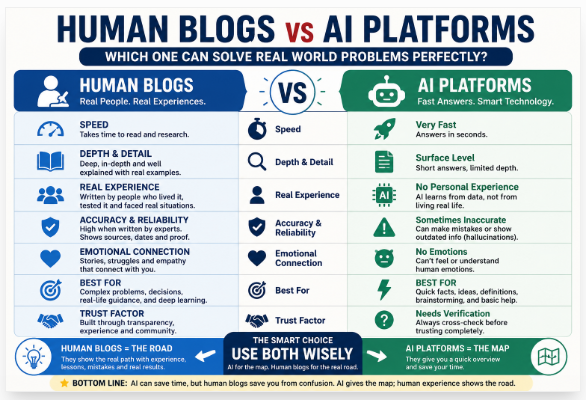
- AI is best for scanning.
- Human blogs are best for deep learning.
- AI gives quick direction.
- Blogs show the real road.
So this human blogs vs AI platforms debate is not about hate for AI.
It is about using AI for speed, and using human published content for truth, depth, and better life decisions.
Where We Are Now: The Zero-Click Web Is Changing Everything
The zero-click web is changing everything for bloggers, writers, and small websites.
You still search on Google, but now you often get the answer before you click any blog.
Today, more than 600 million blogs exist online, and people publish about 7.5 million blog posts every day. That is a huge human library built by writers, experts, moms, students, workers, travelers, and small business owners.
But here is the hard truth: most of this work now fights for fewer clicks.
In 2024, SparkToro found that only 360 clicks from every 1,000 U.S. Google searches went to the open web. That means many users search, read the short answer, and leave.
So, Google clicks are going down for a simple reason: the answer now sits on the search page.
AI Overviews make this stronger because they collect points from many pages and show a fast summary. You get speed, but the blogger may lose the visit.
For small publishers, this is not a small change. Chartbeat data reported by Axios in March 2026 showed small publishers lost 60% of traditional search traffic over two years.
That hurts because a blog is not just words on a page. It is time, money, testing, hope, and real life.
Key Points
| What changed | What it means for you |
|---|---|
| Google gives answers faster | You click fewer websites |
| AI Overviews summarize pages | Blogs lose traffic |
| Small sites lose more | Big brands survive better |
| Readers save time | Deep human stories get hidden |
So, the web is not dying.
But the old traffic model is breaking: human blogs still solve real problems, but AI platforms now stand between the reader and the writer.
What AI Platforms Do Well
AI platforms work best when you need quick answers. In 2026, AI platforms are no longer rare tools; Pew Research found that 60% of U.S. adults read AI search summaries.
You can use AI tools when your question is simple, low-risk, and general. For example: “What is compound interest?” or “Give me a checklist before buying a laptop.”
AI Gives Fast Summaries
AI search engines save time when you do not want to open ten tabs. They scan a topic and give you the main idea in seconds.
This helps when you are busy at work, cooking, travelling, or studying. You ask once; you get a short answer.
AI Helps You Compare Options
AI tools are useful when you want to compare two or three choices. For example: “ChatGPT vs Google Search” or “budget phone vs flagship phone.”
But still, use your brain after that. AI can compare; you must decide.
AI Explains Simple Ideas
AI platforms explain hard words in plain language. They are good for beginners who feel lost.
For example, a student can ask: “Explain cloud computing like I am 12.” In one minute, the topic feels less scary.
AI Creates Useful Checklists
AI is strong at checklists. It can make a travel list, study plan, blog outline, resume checklist, or shopping checklist.
This is where quick answers really help. You do not need deep research for every small task.
AI Translates Complex Ideas
AI can turn complex text into simple steps. It can also translate ideas from one language to another.
In India, this helps many readers who think in Telugu, Hindi, Tamil, Bengali, or Marathi but search in English. AI becomes a small bridge between thought and action.
When Should You Use AI Instead of Google?
Use AI when speed matters more than depth. Use blogs when truth, proof, and real experience matter more.
| Your Need | Use AI? | Why |
|---|---|---|
| Quick meaning | Yes | Fast and simple |
| Basic checklist | Yes | Saves time |
| Medical decision | No | Too risky |
| Money decision | Not alone | Needs proof |
| Product review | Not alone | Needs real testing |
| Deep learning | With blogs | Blogs give depth |
Key Takeaway
AI platforms do well with fast summaries, simple ideas, quick comparisons, and small checklists. So, use AI platforms for quick answers, but use human blogs when your real life, money, health, or future is involved.
Where AI Platforms Fail in Real-World Problems
AI search can help you fast, but it can also fail you fast. So, you must know the risks of AI search before you trust one short answer.
AI can summarize a topic in seconds. But it may miss your city, your budget, your family issue, your health condition, or your real-life pressure.
For example, a money tip for the US may not fit India. A parenting tip for a calm child may not fit your child at 11 PM during an exam week.
AI Can Sound Right, Even When It Is Wrong
This is the biggest danger: AI often sounds very confident. But confidence is not proof.
In May 2024, Google had to make more than a dozen technical fixes after AI Overviews gave strange and wrong answers. Some viral examples included unsafe or silly advice, like glue on pizza and eating rocks.
So, yes, AI can give wrong answers. This is why AI answers need fact checking.
Where You Should Not Trust AI Alone
Use AI as a helper, not as the final judge.
| Topic | Risk | What You Should Do |
|---|---|---|
| Health | Wrong advice can harm you | Ask a doctor |
| Finance | Bad choices can cost money | Check expert sources |
| Legal | Wrong steps can create trouble | Talk to a lawyer |
| Parenting | Generic advice may not fit your child | Use human judgment |
| Career | One bad move can hurt growth | Ask real people too |
Quick Safety Check Before You Act
Before you follow any AI answer, ask this:
- Is this advice updated?
- Does it fit my country or state?
- Does it fit my budget?
- Is there a real source?
- Can a human expert confirm it?
- What can go wrong if this is false?
Key Points
AI is good for first help. But it is weak when your problem needs emotion, local facts, money limits, timing, or lived experience.
Never use AI alone for high-stakes decisions. The safest way is simple: use AI to scan, use human online data resources to understand, and use experts to decide. This is the real way to reduce the risks of AI search.
What Human Blogs Do Better
Human online content vs AI platforms is not a small fight. It is a fight between fast answers and lived answers.
AI can tell you what to do. But a good blog shows what happened when a real person did it.
1. Blogs Show Real Tests
A human blogger can buy a tool, use it for 30 days, and show the truth. You may see screenshots, bills, failed steps, and final results.
That proof matters. Google says helpful content should serve people first, not search engines first.
2. Blogs Share Mistakes
AI often gives clean steps. Real life is not clean.
A blogger may say: “I tried this plugin, but it slowed my site in India on mobile data.” That one line can save your time, money, and stress.
3. Blogs Give Emotional Support
Sometimes you do not need only an answer. You need someone to say: “I faced this too.”
This is where human-written content wins. It gives hope, care, and small real details AI may miss.
4. Blogs Build Trust Over Time
Good blogs are not one-time answers. They grow with updates, comments, and reader feedback.
There are over 600 million blogs online, and millions of posts go live daily. So readers still search for human views, not only machine answers.
5. Blogs Give Local Context
A US blogger may suggest one tool. But an Indian blogger may explain UPI, low-cost plans, local jobs, or Hindi support.
That local flavor solves real problems. AI may miss these small but useful points.
Quick Comparison
| Need | Human Blog Benefit |
|---|---|
| Product review | Real screenshots and use |
| Personal finance | Real budget mistakes |
| Health routine | Lived daily limits |
| Career advice | Actual interview stories |
| Parenting | Empathy and patience |
Key Points
- Blogs show real proof.
- Blogs explain failures.
- Blogs give local examples.
- Blogs update over time.
- Blogs carry human trust.
In the end, human researched online data vs AI platforms is not about hate for AI. Use AI for quick scanning, but read human blogs for deep knowledge, real proof, and life-tested answers.
Human Blogs vs AI Platforms: Practical Comparison Table
When you ask, should I trust AI or blogs, start with one rule: match the source to the risk. AI is useful for speed, but human blogs help when your real life is involved.
In 2025, Pew Research found that people clicked normal Google results only 8% of the time when an AI summary appeared. Without an AI summary, they clicked 15% of the time.
| Your Need | Best Choice | Why |
|---|---|---|
| Quick meaning | AI | You get a fast answer. |
| Money decision | Human blog + expert source | You need trust and real examples. |
| Product comparison | Human blog + AI summary | AI scans; blogs test. |
| Health issue | Doctor or expert source first | One wrong answer can hurt you. |
| Travel planning | Blogs + forums + AI | Real travelers show real costs. |
| Coding or DevOps issue | Docs + blog + AI | AI helps; docs confirm. |
| Emotional advice | Human stories | You need empathy, not just steps. |
How to Use This in Daily Life
Use AI when you need a quick start. For example, ask AI what “zero-click search” means, then move on.
But use human blogs when you need proof. A travel blogger who missed a train in Hyderabad or Tokyo teaches more than a clean AI list.
For money, health, parenting, and career choices, do not stop at AI. Read blogs, check expert sources, and compare real stories.
Key Points
- AI is best for speed.
- Blogs are best for depth.
- Official sources are best for safety.
- Forums show raw user problems.
- Your best answer often comes from all three.
So, AI vs human content for decision making is not a fight. Use AI to scan, but read human blogs when you need real-world judgment.
Bloggers’ Pain: What Happens to Writers, SEO, CTR, and SERP?
AI Overviews killing blog traffic is not just SEO talk. You may still rank, but the click may never come.
In 2025, Pew Research found this: users clicked normal Google results only 8% of the time when an AI summary appeared. Without an AI summary, clicks were almost double at 15%.
So, the pain is real. Your post can sit on page one, yet the reader may stop at the AI answer.
What Bloggers Feel Right Now
You write for hours. Then Google gives your answer in two seconds.
That hurts because blogging was never just typing words. It was hope, skill, late nights, testing, editing, and waiting.
On Reddit, many bloggers say the same thing: “I rank, but I get fewer clicks.” Some also ask if blogging is still worth starting in 2026.
What Changed in SEO and CTR
Before, SERP ranking meant traffic. Now, ranking does not always mean visitors.
AI Overviews, ads, videos, forums, maps, and snippets all fight for the same screen. Your blue link moves lower, even when your content is good.
| Area | Old SEO World | AI Search World |
|---|---|---|
| Ranking | Page one brought clicks | Page one may bring no click |
| CTR | Higher rank meant more visits | AI answer may take the click |
| SERP | Links were the main path | Answers appear before links |
| Blogger job | Write and rank | Write, prove, and build trust |
Is Blogging Dead in 2026?
No, blogging is not dead. But lazy blogging is dying fast.
Small publishers are hit hard; Axios reported that small sites saw a 60% drop in traditional search traffic over two years.
Publishers also fear an “end of traffic era,” as AI summaries and chatbots reduce referrals. The Guardian reported this concern in January 2026.
What You Should Do Next
Do not write only for Google. Write for people who need depth after the short AI answer.
Add real photos, tests, costs, mistakes, dates, local examples, and personal proof. AI can copy facts, but it cannot copy your lived day.
The new rule is simple: AI gives the first answer, but your blog must give the trusted answer. That is how you survive AI Overviews killing blog traffic.
Human Published Online Content vs AI Tools
Most posts on human blogs vs AI platforms sound the same.
They say: AI is fast, humans are creative, so use both.
But you need to go deeper.
What Other Posts Miss
They miss the real pain.
Bloggers are not only losing traffic; they are losing hope.
In 2025, Pew found that users clicked normal Google links only 8% of the time when an AI summary appeared.
Without an AI summary, clicks were almost double: 15%.
That means your post should not just compare tools.
It should ask: who pays the price when AI answers everything first?
What Your Post Should Add
Add these fresh points:
- Emotional cost: bloggers write for years, then lose clicks.
- Zero-click truth: many users get answers without visiting sites.
- Reader guide: tell people when to trust AI and when to read blogs.
- Risk list: AI can miss facts, dates, local details, and human pain.
- Real use cases: health, money, parenting, jobs, travel, and tech.
- Clear line: AI is for scanning; blogs are for depth.
Simple Reader Decision Table
| Reader problem | Use AI | Read blogs |
|---|---|---|
| Quick meaning | Yes | No |
| Real life advice | Maybe | Yes |
| Product review | Maybe | Yes |
| Health or money | No alone | Yes, with expert source |
| Deep learning | Maybe first | Yes |
Your Unique Angle
Write like a person who has seen the web change.
Say this clearly: AI can answer fast, but human blogs carry scars, tests, mistakes, and care.
So your edge is not more words.
Your edge is more truth.
That is how human blogs vs AI platforms becomes a real reader-first post, not another SEO copy.
How to Assess Whether AI or a Blog Solves Your Problem
When you search online, do not ask only this: “Is the answer fast?”
Ask this first: “Can I trust this answer for my real life?”
AI can help you scan a topic in seconds.
But human blogs vs AI platforms is not a speed race; it is a trust test.
Start With the Risk
Some questions are small.
Some questions can hurt your money, health, job, or family.
Use AI for low-risk questions, like simple meanings, ideas, lists, or first drafts.
Use human blogs, expert sites, and official sources for serious choices.
For example, do not trust one AI answer for tax, medicine, legal, or loan advice.
In 2025, Stanford researchers warned that even legal AI tools can still give false or misleading answers.
Use This Simple Trust Checklist
Before you believe any AI answer or blog post, check these points:
| Check this | Why it matters |
|---|---|
| Is the topic high-risk? | High-risk topics need expert proof. |
| Are sources shown? | No source means weak trust. |
| Are there screenshots or real results? | Real proof beats smooth words. |
| Is the author experienced? | Lived experience catches hidden problems. |
| Is the content updated? | Old advice can fail today. |
| Does AI say “I may be wrong”? | Honest limits build trust. |
| Can you check official docs? | Official pages reduce mistakes. |
Google also says helpful content should serve people first, not just search rankings.
Use the AI → Blog → Official Source → Personal Decision Method
First, ask AI for a quick map.
Use it to learn the basic words, steps, risks, and options.
Next, read two or three human blogs.
Look for dates, prices, screenshots, mistakes, comments, and personal results.
Then, check the official source.
This may be Google docs, government sites, brand pages, medical bodies, or product manuals.
Finally, decide based on your life.
Your budget, city, skill, time, health, and family matter more than a perfect-looking answer.
My Simple Rule
If the answer saves only five minutes, AI is fine.
If the answer can change your life, read human blogs and verify it.
This matters more now because AI summaries can stop people from clicking websites.
Pew Research found users clicked normal Google results only 8% of the time when an AI summary appeared, compared with 15% when it did not.
So, use AI as your scanner.
Use trusted human blogs as your deep guide.
That is the safest way to compare human blogs vs AI platforms.
Fast answers are useful, but verified human experience solves real-world problems better.
Real-World Use Cases
Human websites vs AI platforms is not a fight. It is a daily choice you make.
AI helps you scan fast. Human blogs help you decide with care.
Use Case 1: Health or Wellness
You may ask AI about fever, sleep, food, or stress. It can give basic steps in seconds.
But do not stop there. For health, read doctor-led blogs, hospital pages, and real patient stories too.
AI may miss your age, country, medicine, pregnancy, allergy, or past health issue. That small miss can become a big risk.
Use this simple rule:
- AI: for general awareness
- Medical blog: for deeper safety
- Doctor: for final action
Use Case 2: Personal Finance
AI can explain SIP, credit cards, tax, debt, or budgeting. It is useful when you feel lost.
But money has emotion. A human blog shows real salary, rent, bills, mistakes, fear, and recovery.
For example, a ₹50,000 salary budget in Hyderabad is not the same as in Mumbai. Local human experience matters.
So first learn the idea from AI. Then check real blogs, calculators, bank rules, and tax dates.
Use Case 3: Remote Work and Career
AI can draft your resume, cover letter, and LinkedIn bio. That saves time.
But hiring managers now see many similar AI resumes. A 2025 job report said 44% of candidates may use AI to exaggerate skills.
So your real story matters more. Human blogs show interview fear, salary talk, rejection pain, and actual job lessons.
Use AI for structure. Use your own work proof, numbers, tools, and project results to sound real.
Use Case 4: Tech and AI Tools
AI can compare tools like Notion AI, ChatGPT, Gemini, Canva, or Zapier. It gives a quick table.
But a human blog tests the tool. It shows bugs, pricing traps, slow support, bad output, and real screenshots.
For example, an AI tool may look cheap on the home page. But the real limit may appear after 20 tasks.
So read hands-on reviews before you pay. One real test can save your money.
Use Case 5: Parenting and Education
AI can make study plans, bedtime routines, lunch ideas, and activity lists. That helps busy parents.
But children are not templates. A parent blog gives patience, tears, school pressure, and small home tricks.
In 2025, HEPI reported that 92% of higher education students used AI tools. Still, many students worry AI can make learning shallow.
So use AI as a helper. Use human blogs for empathy, values, and real family balance.
Quick Decision Table
| Your problem | Use AI for | Use human blogs for |
|---|---|---|
| Health | Basic awareness | Safety and lived cases |
| Money | Simple explanation | Real budgets and mistakes |
| Career | Drafting | Real interview lessons |
| Tech tools | Fast comparison | Honest testing |
| Parenting | Ideas | Empathy and experience |
Key Points
AI is good for speed. Human blogs are good for depth.
AI gives the first map. Human blogs show the real road.
So human published online content vs AI platforms has one smart answer. Use AI to scan, but trust human experience when life gets real.
Final Verdict: Which One Solves Real-World Problems Perfectly?
Human Content resources vs AI platforms is not a fight with one clear king. You need both, but you must use each one for the right job.
AI platforms give you the fastest answer. So, use AI when you need a quick idea, a short list, or a simple meaning.
But human blogs give you real life depth. They show pain, mistakes, cost, screenshots, proof, and small details AI often misses.
| Need | Better Choice | Reason |
|---|---|---|
| Fast answer | AI platforms | You save time |
| Safe decision | Human blogs + official sources | You reduce risk |
| Easy start | AI first, blog next | You learn step by step |
| Deep trust | Human content | You see proof and experience |
Here is the simple rule: use AI for scanning, and use human blogs for real understanding. In 2025, Pew Research found Google users clicked normal search links only 8% of the time when an AI summary appeared, but 15% when it did not.
That number shows one hard truth: people get fast answers, but many good writers lose clicks. Still, Google says helpful content should be made for people first, not only for search engines.
So, never trust speed alone. Before you act, check proof, date, author, source, and real user experience.
My honest verdict is this: AI helps your head, but human Online resources help your life. Human blogs vs AI platforms works best when AI opens the door, and human experience walks you through it.
Conclusion: Read Blogs, Use AI Wisely, Live Better
Today, you can ask AI and get a fast answer. But if you ask why blogs still matter, the answer is simple: humans show real life.
In 2025, Pew Research found that users clicked normal Google links only 8% of the time when AI summaries appeared. So, yes, AI saves clicks; but it can also hide deeper help.
Use AI for quick scans. Then read human blogs for proof, pain, cost, mistakes, and real steps.
Here is the smart way:
- Use AI: for a fast map.
- Use blogs: for lived road signs.
- Use experts: for health, money, law, and safety.
Google still says helpful content should serve people first, not search engines first. That is the real future of blogging in the AI era.
So, do not leave blogs behind. AI gives the map; human experience shows the road, and that is why blogs still matter.


Leave a Reply