If you want steady Google traffic, you need a blog content strategy instead of random blog posts. It helps you choose the right topics, write for real people, and grow your blog with a clear plan.
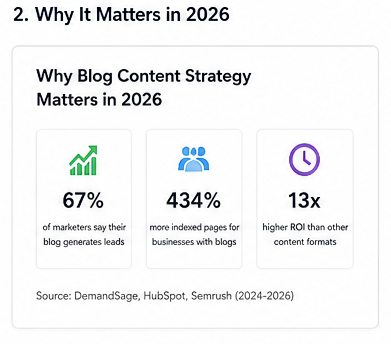
In this guide, you will learn how to find the best keywords, build topic clusters, plan a simple content calendar, and measure results step by step. This approach matters because blogs remain one of the top five content formats for marketing ROI in 2026, while websites, blogs, and SEO continue to deliver strong long-term results.
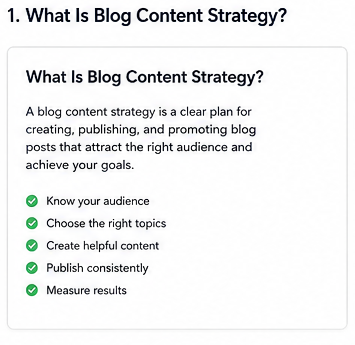
What Is a Blog Content Strategy?
You need a blog content strategy before you write your first post. It gives every article a clear purpose, so your blog grows in the right direction instead of growing by chance.
Writing blog posts is only one small part of the process. A good content strategy for blog connects your readers, keywords, topics, publishing plan, internal links, and business goals into one simple system.
Think about what happens without a plan: you publish random topics every week. After a few months, your blog has many articles, but they do not support each other or answer what your audience really wants.
A strong strategy fixes that problem. Every new post supports another post, answers one search intent, and moves your readers toward one clear goal.
For example, imagine your blog is about AI tools. Instead of posting random AI news, build topic groups like these:
- AI writing tools
- AI productivity tools
- AI SEO tools
- AI image tools
- AI coding tools
This approach helps both readers and search engines understand your website better. It also builds topical authority because related articles connect through natural internal links.
Many beginners also mix up these four terms. They work together, but each one has a different job.
| Term | Main Job |
|---|---|
| Blog content strategy | Decides your audience, goals, topics, and overall direction. |
| Keyword plan | Chooses the search terms each article should target. |
| Content calendar | Schedules when every article will be published and updated. |
| SEO content strategy | Improves content structure, search intent, internal links, and optimization so pages rank higher. |
This simple system saves time because every article has a reason to exist. Instead of chasing random traffic, you build a blog that solves real problems, covers one topic deeply, and grows steadily over time. That is the real blog content strategy successful blogs follow today.
Why Blog Content Strategy Matters More in 2026
Your blog content strategy matters more than ever in 2026 because people no longer search in just one place. They now use Google, AI search, Reddit, YouTube, social platforms, and online communities before they trust a website.
Blogs still bring organic traffic, but only when every post helps someone solve a real problem. Random topics may get indexed, yet they rarely build topical authority, trust, or loyal readers.
Search has also changed because of AI Overviews and zero-click search. SparkToro found that 68.01% of Google searches in early 2026 ended without a click, and AI Overviews now appear in more than 20% of searches, reducing click-through rates by almost 60%.
That sounds worrying, but it also creates a new chance for you. Your content should be useful enough that people still choose your page for deeper answers, practical steps, and real experience.
A strong SEO content strategy no longer focuses only on Google rankings. It also helps your content earn mentions in Reddit discussions, YouTube videos, newsletters, social posts, and AI-generated answers where people discover new ideas today.
Brand trust now matters as much as keywords. HubSpot’s 2026 research shows that AI is becoming common, while brands with a clear point of view and human expertise stand out in crowded search results.
If your blog is not getting traffic, do not publish more random articles. Instead, answer one clear search question, share practical experience, connect related posts, and update older content regularly.
Use this simple checklist before publishing every post:
| Focus Area | What You Should Do |
|---|---|
| User intent | Answer one real question completely |
| Search visibility | Optimize for Google and AI search |
| Trust | Share practical examples and honest advice |
| Authority | Build related topic clusters instead of random posts |
| Growth | Update and improve older articles regularly |
This approach makes your blog content strategy stronger, improves long-term visibility, and helps your blog grow even as search continues to change.
Reader Intent Analysis: What Your Blog Reader Actually Wants
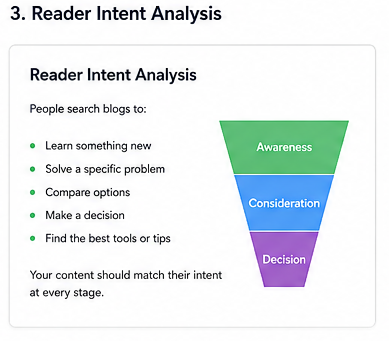
A strong blog content strategy always starts with your reader, not your content. Before you write even one word, know exactly what your reader wants to achieve because Google now ranks pages that satisfy search intent, not pages that simply repeat keywords.
Start With Your Reader’s Goal
When someone lands on your blog, they already have a question or a problem. Your job is to give a simple answer that helps them take the next step.
Most readers want to know:
- What should I write on my blog?
- How can I rank on Google?
- How often should I publish blog posts?
- Which keywords should I target?
- How can my blog bring traffic, leads, or income?
Think About the Result They Want
Your reader is not searching for another long theory. Instead, they want a simple plan they can follow today.
Use this quick guide before choosing any topic.
| Reader wants | Your content should provide |
|---|---|
| More traffic | Practical SEO steps |
| Better rankings | Search intent and keyword intent |
| Blog ideas | Topics people already search for |
| More readers | Helpful answers with real examples |
| More income | Clear next steps and strong calls to action |
Know the Risk Before You Write
Many beginners publish for months without checking whether people search for their topics. As a result, they spend time writing posts that never receive steady organic traffic.
Always check what people search for before creating content. Then match your article to the same search intent, because Google rewards pages that answer the user’s real question instead of only matching keywords.
Turn Reader Questions Into Blog Topics
A simple blog audience research strategy helps you choose topics with real demand. Therefore, collect questions first and build your content around them.
Start with these sources:
- Google Autocomplete
- People Also Ask
- Google Search Console
- Reddit discussions
- YouTube comments
- Quora questions
- Facebook groups in your niche
These places show real audience pain points and beginner intent. They also help you understand the reader’s decision stage before you write.
Your Next Step
After finding what your readers want, build a topic list, group related keywords, and create a simple content calendar. This approach saves time, prevents random publishing, and gives your blog content strategy a clear direction from the very beginning.
According to HubSpot’s 2026 marketing research, improving audience targeting remains one of the most common optimization priorities for marketers because better audience understanding leads to stronger SEO and higher conversions.
Blog Content Strategy Framework: 7 Simple Steps
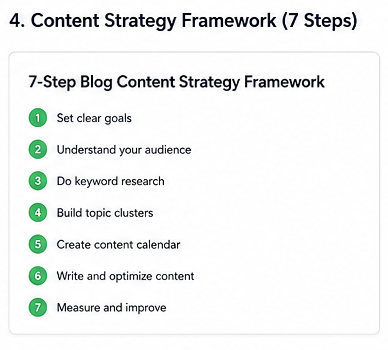
A strong blog content strategy framework gives every post a clear purpose before you write a single word. When you follow a simple blog content plan, you stop guessing and start publishing content that readers and search engines both understand.
1. Define One Clear Blog Goal
Start with one goal only: more traffic, more email subscribers, more leads, or more sales. If you chase every goal at once, your content quickly loses direction.
Write your goal in one simple sentence, and then measure it every month. Many marketers use SMART goals because they make progress easy to track, while HubSpot also recommends planning with buyer personas, editorial calendars, SWOT analysis, and SMART goal templates before creating content.
2. Choose Your Target Audience
Write for one type of reader instead of everyone. This helps you answer real questions with simple and useful advice.
Ask yourself these questions before you write:
- Who is your reader?
- What problem do they have?
- What do they want to achieve?
- What is stopping them today?
- What action should they take after reading?
When you know these answers, your content becomes much easier to plan.
3. Research Keywords by Intent
Do not choose keywords only because they have high search volume. Instead, choose keywords that match what people really want.
For example:
| Search Query | Search Intent | Best Content |
|---|---|---|
| blog content strategy | Learn | Complete guide |
| blog content strategy template | Download | Template page |
| blog content planning steps | Learn | Step-by-step tutorial |
| best content strategy tool | Compare | Comparison article |
Ahrefs explains that keyword intent should act as your first filter during keyword research. If a keyword does not match your website or reader, skip it even if the search volume looks attractive.
4. Build Topic Clusters
Do not publish random articles every week. Instead, group related topics around one main guide.
For example:
- Pillar page: Blog Content Strategy
- Blog Content Calendar
- Keyword Research for Bloggers
- Content Brief Template
- Internal Linking Guide
- Blog SEO Checklist
These topic clusters connect your articles through internal links. Over time, this structure helps build topical authority and makes your website easier to understand.
5. Create a Simple Content Calendar
Keep your editorial calendar simple because you need to follow it every week. A complicated plan often stays unfinished.
Your calendar only needs these columns:
| Field | Purpose |
|---|---|
| Topic | Article idea |
| Primary keyword | SEO focus |
| Search intent | Reader goal |
| Publish date | Schedule |
| Internal links | Related posts |
| Status | Draft, Review, Published |
Plan the next 60 to 90 days instead of an entire year. This gives you enough flexibility to cover new trends and update your SEO plan.
6. Write Helpful, Experience-Based Posts
Always write to solve one real problem. Share practical steps, common mistakes, personal observations, and simple examples that readers can apply today.
Current content marketing research shows successful marketers continue to focus on useful, trustworthy, and audience-focused content instead of relying only on AI. Helpful experience still builds more trust than generic information.
Before publishing, check that your post includes:
- One clear focus keyword
- Natural related keywords
- Helpful examples
- Easy-to-read headings
- Internal links
- Clear action steps
- A simple conclusion
7. Measure, Update, and Improve
Publishing is only the beginning. Check your content every month and improve pages that are losing traffic.
Track only the numbers that matter:
- Organic clicks
- Keyword rankings
- Click-through rate (CTR)
- Average engagement time
- Email sign-ups
- Leads or sales
Update old articles with fresh examples, current statistics, and better answers whenever search trends change. Small improvements often produce better long-term results than constantly publishing new posts.
A simple blog content strategy framework works because every article follows the same process: set a goal, understand your audience, choose the right keywords, build topic clusters, plan your calendar, publish helpful content, and keep improving it. Follow this blog content plan consistently, and your blog grows into a trusted resource instead of a collection of unrelated posts.
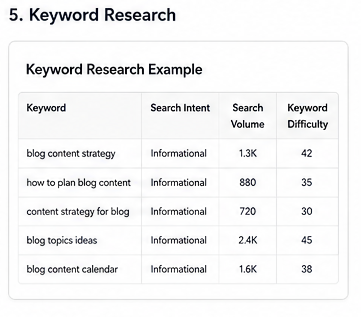
Keyword Research for Blog Content Strategy
If you want your blog content strategy to work, start with keyword research instead of writing ideas. This helps you create posts that people already search for, so your blog has a better chance to rank and grow.
Don’t chase big keywords first because they are harder to rank for. Instead, find simple problems your readers want to solve, and then write one helpful post for each problem.
How to Find Blog Keywords
Follow these simple steps before writing any blog post.
- Pick one broad topic from your niche.
- Type it into Google Search.
- Note Google Autocomplete suggestions.
- Check the People Also Ask section.
- Read the related searches at the bottom.
- Visit Reddit, Quora, and YouTube comments to find real questions.
- Save every useful idea in one spreadsheet.
These ideas come from real people, so they usually match user intent. That means your content answers the same questions people already ask online.
Check These Four Keyword Signals
Do not choose a keyword by search volume alone. Check these four things together before you decide.
| Signal | What to Check |
|---|---|
| Search volume | Enough people search for it each month. |
| Keyword difficulty | Easier keywords are better for new blogs. |
| User intent | Match exactly what the reader wants. |
| Topical relevance | The topic fits your blog naturally. |
A keyword with lower search volume but clear intent often brings better visitors. Many SEO experts recommend choosing long-tail keywords because they usually have lower competition and higher conversion potential.
Group Keywords Before Writing
Next, organize similar keywords into one topic instead of writing separate posts. This creates a stronger content strategy for your blog and avoids competing with your own pages.
| Keyword Type | Example |
|---|---|
| Primary | blog content strategy |
| Long-tail | how to create a blog content strategy |
| Related | SEO content strategy, content calendar |
| Semantic | search intent, topic clusters, internal linking |
| Question | what should I write on my blog |
For example, one article can naturally cover blog content strategy, blog content plan, content strategy for blog, and related search queries because they share the same reader goal.
Best Keyword Strategy for a New Blog
If your website is new, skip broad keywords like content marketing first. Focus on long-tail problem keywords because they are easier to rank and attract readers who already know what they need.
As your traffic grows, slowly target broader keywords with higher competition. This simple approach helps your keyword research for blog become more focused, builds topical authority, and gives your blog steady organic growth over time.
Build Topic Clusters Instead of Random Blog Posts
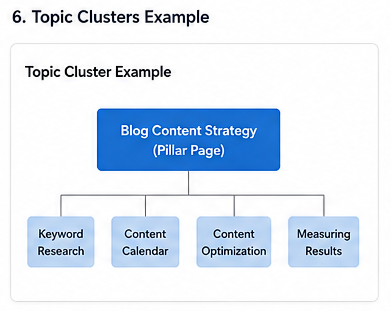
If you want your blog content strategy to work, stop publishing random blog posts. Instead, build blog topic clusters that cover one topic from every important angle.
Start with One Pillar Page
Choose one broad topic first: this becomes your pillar page. Then create supporting posts that answer smaller questions and link them back to the pillar page.
For example:
| Pillar Page | Supporting Posts |
|---|---|
| Blog Content Strategy | How to Find Blog Keywords |
| Blog Content Calendar Template | |
| How to Update Old Blog Posts | |
| Blog SEO Checklist |
This simple blog pillar content strategy helps both readers and search engines understand your website. As a result, your pages become easier to discover and easier to navigate.
Connect Every Post Together
Next, use a clear internal linking strategy. Link every supporting post to the pillar page, and also link the pillar page back to each supporting article.
For example:
- “How to Find Blog Keywords” → links to Blog Content Strategy
- “Blog SEO Checklist” → links to Blog Content Strategy
- “Blog Content Strategy” → links to every supporting guide
This creates a strong content hub instead of isolated pages. Search engines can follow these links and understand how every page relates to the same topic.
Think Like Your Reader
Many beginners ask, “What is a topic cluster?” The answer is simple: it is one complete learning path instead of many unrelated articles.
Your reader starts with the pillar page and then visits supporting posts to learn each step. Because every page answers a different question, visitors stay longer and find more helpful information.
Keep Building the Same Topic
Do not jump from SEO today to cooking tomorrow and travel next week. Instead, publish several related articles before moving to another topic.
Recent SEO guidance continues to show that scattered publishing weakens site structure, while well-connected cluster pages improve topical authority, strengthen SEO structure, and help search engines understand your expertise more clearly.
In short, a smart blog content strategy grows one complete topic at a time. That approach gives your readers a better experience and gives your blog a stronger chance to rank for many related searches.
Create a Simple Blog Content Calendar
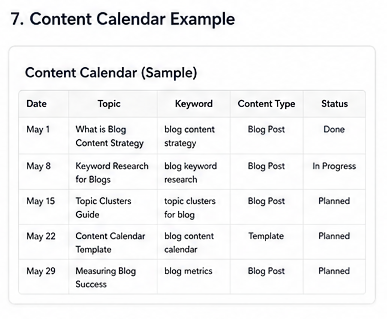
A simple blog content calendar helps you publish the right post at the right time. It also keeps your blog content plan clear, so you never wonder what to write next.
Don’t plan a full year if your niche changes fast. Instead, build a monthly blog content plan for the next 90 days, then review and update it every month.
Keep Only the Fields You Really Need
Your blog content calendar for beginners should stay short and useful. Add only the details that help you write, publish, and improve each post.
| Field | Why it matters |
|---|---|
| Topic | Keeps every post focused |
| Target keyword | Matches what people search |
| Search intent | Answers the right question |
| Content type | Guide, list, tutorial, review, or comparison |
| Publish date | Keeps your publishing schedule consistent |
| Internal links | Connects related posts |
| CTA | Guides readers to the next step |
| Update date | Refreshes old content when needed |
| Author | Shows who owns the task |
Build Your Calendar Step by Step
Start by collecting 15 to 30 keyword ideas from your keyword research. Next, group similar topics together and spread them across the next three months instead of filling every week with random posts.
After that, choose a realistic publishing schedule that you can maintain. For most beginners, one or two high-quality blog posts each week work better than publishing every day.
Keep Your Workflow Simple
Your editorial calendar should help you finish work, not create more work. Therefore, move every post through the same content workflow: research, writing, editing, publishing, and updating.
Industry guides also recommend adding SEO keywords, publishing dates, team responsibility, and promotion tasks in one place because it keeps the entire process organized and avoids missed deadlines.
Quick Checklist Before You Publish
- Topic is clear.
- Target keyword is assigned.
- Search intent matches the article.
- Internal links are ready.
- CTA is added.
- Publish date is fixed.
- Update date is scheduled.
A simple blog content plan saves time because you always know what comes next. More importantly, it helps you publish consistently, improve your SEO, and grow your blog without feeling overwhelmed.
Best Blog Content Types to Include in Your Strategy
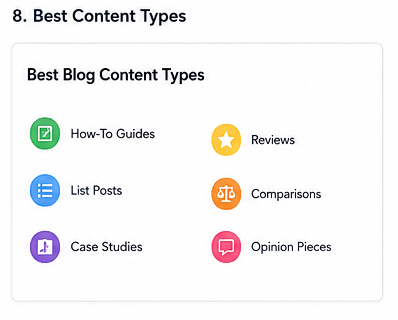
Your blog content strategy works better when every post has one clear job. So, write different types of posts because each one helps your readers at a different stage.
According to HubSpot’s 2026 marketing data, blog posts remain one of the top five content formats for ROI. That means useful blog content still brings steady search traffic when it matches what people want.
| Content Type | Best For | Share |
|---|---|---|
| How-to guides | Organic traffic | 40% |
| Beginner explainers | New readers | 20% |
| Comparison posts | Buying decisions | 15% |
| Templates and checklists | Quick value | 10% |
| Case studies and examples | Trust | 10% |
| Opinion or trend posts | Brand voice | 5% |
Write More How-To Guides
Start with how-to posts because they answer real questions people search every day. Also, target low-competition topics first because they are easier to rank on Google.
Examples:
- How to create a blog content strategy
- How to find low-competition keywords
- How to write SEO blog posts
Help Beginners First
Next, publish simple beginner guides because new readers want clear answers before they try advanced methods. As a result, they stay longer and visit more pages on your website.
Examples:
- What is keyword research?
- What is topical authority?
- What is search intent?
Publish Comparison Posts
Comparison posts help readers choose between two options. Therefore, they usually attract visitors who are ready to buy.
Examples:
- Ahrefs vs Semrush
- WordPress vs Blogger
- Rank Math vs Yoast SEO
Share Templates and Checklists
Templates save your readers time because they can use them immediately. Likewise, checklists reduce mistakes and make your content more useful.
Examples:
- Blog content calendar template
- SEO blog post checklist
- Content brief template
Add Real Case Studies
Case studies show what actually works instead of making promises. So, explain the starting point, the steps you followed, and the final result with real numbers whenever possible.
Write Only a Few Trend Posts
Industry news becomes old quickly, so publish trend posts only when they add fresh value. Instead, focus most of your time on evergreen content that keeps bringing visitors for months or years.
Choose the Right Content for Your Goal
| Your Goal | Best Content Type |
|---|---|
| Get traffic faster | Low-competition how-to guides |
| Build reader trust | Case studies |
| Increase affiliate income | Comparison posts |
| Build topical authority | Pillar guides with supporting articles |
| Improve AI search visibility | Clear, factual, well-structured answers |
Finally, keep your blog content strategy balanced instead of writing only one type of article. When every post solves one problem and supports the next post through internal links, your blog becomes more useful for readers and easier for search engines to understand.
Common Blog Content Strategy Mistakes
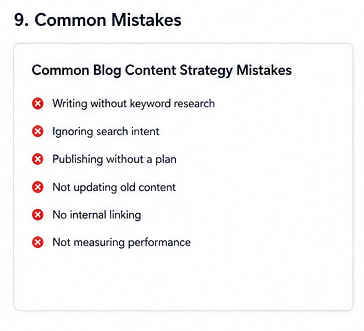
Many blog content strategy mistakes look small at first. However, they slowly reduce your rankings, traffic, and reader trust.
1. Writing Before Keyword Research
Do not write your article first and search for keywords later. Instead, find one main keyword, related topics, and reader questions before you start writing.
This helps you match real searches like “why my blog is not ranking”. As a result, your content solves a problem people already have.
2. Chasing Only High-Volume Keywords
High search volume looks attractive at first. Yet, new blogs often struggle to compete for those keywords.
Start with long-tail keywords that have clear search intent. Then, build authority before targeting broader topics.
3. Ignoring Search Intent
A good keyword alone cannot rank your page. Your content must answer exactly what the reader expects.
For example: someone searching “how to fix old blog content” wants practical steps, not a long history lesson. Google also recommends creating helpful, people-first content that satisfies readers instead of writing mainly for search engines.
4. Publishing Random Topics
Random publishing confuses both readers and search engines. Instead, choose one niche and build related topic clusters.
This creates topical authority over time. It also makes your blog easier to understand and navigate.
5. Forgetting to Update Old Posts
Old articles lose value when facts, screenshots, or links become outdated. Therefore, review your important posts every 6 to 12 months and refresh them with current information, examples, and dates.
6. Skipping Internal Links
Every new post should link to related articles on your website. This helps readers find more answers and helps search engines understand your content structure.
Weak internal linking is a common reason why blog traffic does not grow. Many experienced SEO professionals also recommend building clear topic clusters with strong internal links.
7. Hiding Your Real Experience
Readers trust people who have actually done the work. So, add your own examples, lessons, screenshots, or results whenever possible.
Real experience makes your content more useful. It also builds trust with readers and supports Google’s people-first guidance.
8. Publishing AI Content Without Human Value
AI can help you write faster. Still, never publish content without checking facts, adding your own experience, and improving the examples.
Your goal is not to sound like everyone else. Your goal is to solve the reader’s problem better than the other pages.
| Mistake | Better Approach |
|---|---|
| Writing before keyword research | Research keywords and search intent first |
| Targeting only high-volume keywords | Start with long-tail keywords |
| Ignoring search intent | Answer the exact reader question |
| Random publishing | Build topic clusters |
| Not updating old posts | Refresh content every 6–12 months |
| No internal linking | Link related articles naturally |
| No author experience | Add real examples and observations |
| AI-only writing | Edit, verify, and include personal insights |
Avoid these blog content strategy mistakes, and your blog will become more useful, easier to rank, and more valuable for every reader.
Blog Content Strategy Example for a New Website
If you need a simple blog content strategy example, start with one niche and one clear goal. This keeps your website focused and helps Google understand your expertise over time.
Imagine you launch a new personal finance blog in India during 2026. Your website has zero authority, so competing for broad keywords like “personal finance” is usually too difficult.
Instead, build your content plan around beginner questions with long-tail keywords. These keywords have clear search intent, lower competition, and attract readers who need practical help.
Start with One Pillar Topic
Your first pillar page should cover one broad subject well. Then, every supporting article should answer one small question and link back to the pillar.
| Content Type | Target Topic | Focus Keyword |
|---|---|---|
| Pillar Page | Personal Finance for Beginners | personal finance for beginners |
| Support Post | How to Budget Your Salary | how to budget salary |
| Support Post | Emergency Fund in India | emergency fund India |
| Support Post | Best Saving Apps | best saving apps |
| Support Post | How to Pay Off Debt Faster | debt payoff plan |
This simple topic cluster creates a clear keyword map for your website. It also makes internal linking much easier as your blog grows.
Publish in the Right Order
Do not write twenty random articles in your first month. Publish one pillar page first, then add one supporting article every week.
For example:
- Week 1: Personal Finance for Beginners
- Week 2: How to Budget Your Salary
- Week 3: Emergency Fund India
- Week 4: Best Saving Apps
- Week 5: Debt Payoff Plan
Each new article should link back to the pillar page and to one related article. This builds topical authority naturally and helps search engines understand your content structure.
Why This SEO Blog Strategy Example Works
A new website rarely wins against large finance brands in a few months. However, it can rank for specific beginner searches by answering them better and more clearly.
HubSpot reports that blogs remain one of the highest-return content formats for marketers in 2026. At the same time, successful blogs now depend more on useful topic clusters and real human experience than on publishing random articles.
This blog content strategy example for beginners gives you a practical roadmap instead of guessing what to publish next. As you repeat this process in every niche, your content roadmap becomes stronger, your organic traffic grows steadily, and your website earns trust one topic at a time.
Blog Content Strategy Tools
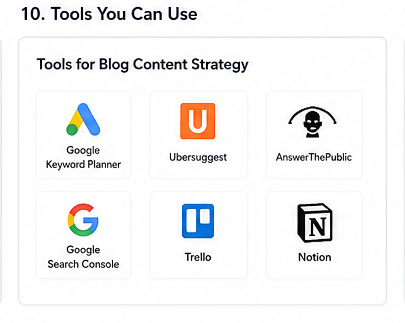
The right blog content strategy tools help you find topics, plan content, and improve SEO faster. You do not need expensive software first, because many free tools give enough data to grow a new blog.
Free tools you should start with
If your budget is zero, begin with these tools. They show what people search for and how your blog performs.
| Tool | Best use |
|---|---|
| Google Search Console | Find keywords, clicks, impressions, and indexing issues |
| Google Trends | Discover rising topics and seasonal searches |
| AlsoAsked | Find real questions people ask on Google |
| YouTube Search | Collect video search ideas and autocomplete keywords |
| Reddit Search | Discover real problems, opinions, and user language |
Google Trends is especially useful because it shows whether interest in a topic is growing or falling before you write. It uses live search data instead of fixed monthly averages.
Paid tools for faster blog planning
Paid tools save time when your blog grows. They also give competitor data that free tools cannot provide.
- Semrush: Keyword research, competitor analysis, site audit, and content planning.
- Ahrefs: Keyword ideas, backlink research, content gap analysis, and rank tracking.
- Notion: Organize your content workflow and writing tasks.
- Trello: Manage your publishing schedule with simple boards.
- Google Sheets: Build a free content calendar and keyword tracker.
- Canva: Create blog images, infographics, and featured images.
Semrush and Ahrefs now include AI search insights alongside traditional SEO data, which helps you plan content for both search engines and AI-powered search experiences.
A practical tool stack for beginners
You can build a strong blog content strategy without spending money at the start.
- Find keyword ideas with Google Trends and AlsoAsked.
- Check real search data in Google Search Console.
- Read Reddit discussions and YouTube comments for content ideas.
- Study the first page of Google before writing.
- Plan everything in Google Sheets or Notion.
Later, upgrade to Semrush or Ahrefs when you need deeper keyword research, competitor analysis, and faster blog planning. This simple workflow helps you create useful content instead of guessing what people want.
How to Measure If Your Blog Strategy Is Working
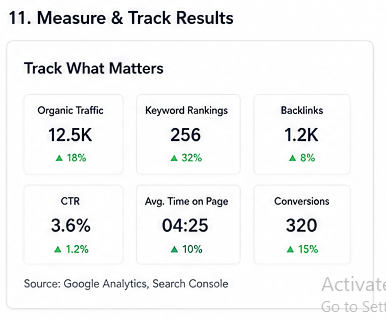
Your blog content strategy metrics tell you what is growing and what needs work. So, check your numbers every month instead of every day because Google Search Console shows trends better over weeks and months.
Start with Google Search Console and Google Analytics 4 because both tools are free. Then, track only the numbers that help you make better decisions instead of watching every report.
| Blog SEO KPI | What to Check | Why It Matters |
|---|---|---|
| Keyword impressions | Is your page appearing more often? | Shows growing visibility |
| Organic clicks | Are more people visiting? | Measures real search traffic |
| Ranking keywords | Are more keywords reaching the top 10? | Shows SEO growth |
| CTR | Are people clicking your title? | Finds weak titles and meta descriptions |
| Internal link clicks | Are readers opening related posts? | Shows content engagement |
| Email signups | Are visitors joining your list? | Measures audience growth |
| Affiliate clicks | Are readers clicking product links? | Tracks earning potential |
| Leads | Are visitors contacting you? | Measures business results |
| Returning visitors | Do readers come back? | Shows trust and content quality |
| Updated content performance | Did refreshed posts gain more traffic? | Confirms content updates are working |
Next, compare your results every 30, 60, and 90 days because SEO grows slowly. Also, review pages that gain impressions but few clicks because a better title and meta description can improve CTR.
Finally, do not judge your blog after only two weeks because a new website usually needs several months before search engines fully understand and trust its content. Keep publishing, improve older posts, and watch steady growth because consistent updates often produce better long-term results than chasing daily rankings.
Final Blog Content Strategy Checklist
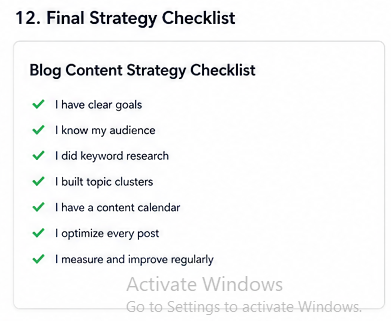
Use this blog content strategy checklist before you publish every post. It helps you publish useful content that matches what people search for and what search engines expect.
| Checklist | Why it matters |
|---|---|
| Know your audience | Write for one clear group of readers. |
| Choose one main keyword | Keep your page focused on one topic. |
| Match search intent | Answer the exact question your reader asks. |
| Write a helpful title | Make people understand the benefit at a glance. |
| Start with a strong introduction | Show readers they are in the right place. |
| Connect to a topic cluster | Link the post with related articles on your site. |
| Add internal links | Help readers and search engines find more useful pages. |
| Share original examples | Add your own experience to build trust. |
| Include an FAQ section | Answer common questions in one place. |
| Add a clear CTA | Tell readers what to do next. |
| Check updated facts and statistics | Use current information before publishing. |
| Show author experience | Share practical advice instead of copied ideas. |
| Keep formatting simple | Use headings, short paragraphs, lists, and tables. |
Finally, read your post once from your reader’s view. Then improve weak sentences, remove extra words, and fix small mistakes before you publish.
Google recommends creating helpful, reliable, people-first content instead of writing only for rankings. If your page solves a real problem with clear answers and simple formatting, it has a better chance to perform well in search results.
Use this blog content strategy checklist for beginners every time you write. As a result, you will publish, optimize, update, measure, and improve your content with confidence while building a stronger SEO blog checklist for long-term growth.
FAQs About Blog Content Strategy
What is a blog content strategy?
A blog content strategy is your plan for what you write, who you write for, and why each post matters. It helps you choose the right topics, target the right keywords, and publish content that supports your goals instead of writing random articles.
How do I create a blog content strategy?
Start with one clear goal: more traffic, leads, or sales. Then research your audience, group related keywords into topic clusters, create a simple content calendar, and track your results every month so you can improve over time.
How many blog posts should I publish per week?
Quality matters more than quantity, so publish only what you can maintain every week. For most new blogs, 1 high-quality post each week is a practical starting point, while larger websites with more resources can publish more often if quality stays high.
What is the best blog content strategy for beginners?
Focus on one niche before you expand into new topics. Then target low-competition long-tail keywords, answer real questions, connect related posts with internal links, and update older articles regularly.
How long does it take for a blog strategy to work?
Most blogs need 3 to 6 months before you see steady SEO growth, although competitive topics can take longer. Your results depend on content quality, keyword difficulty, website authority, and publishing consistency.
Can AI help with blog content strategy?
Yes: AI can help you research topics, build outlines, find keywords, and speed up your writing process. Still, you should always add your own experience, examples, and fact-checking because helpful human editing builds more trust than publishing raw AI content.
What is the difference between a blog content strategy and a content calendar?
The table below makes the difference easy to understand.
| Blog Content Strategy | Content Calendar |
|---|---|
| Explains why you create content | Shows when you publish content |
| Defines goals and target audience | Lists publishing dates |
| Includes keyword research and topic clusters | Lists article titles and deadlines |
| Guides long-term blog growth | Organizes daily and weekly work |
A blog content strategy gives your blog a clear direction, while a content calendar simply helps you stay organized. When you use both together, you build a stronger blog that grows steadily and serves your readers better.

Leave a Reply