You wake up early, while the air still feels cool, and sit down with a hot cup of coffee. Your ideas flow, and you tell yourself: content is king, so you only need to write well.
Then you open your website stats and see very little traffic. Your new blog has zero authority, almost no backlinks, and no clear sign that Google trusts it yet.
Soon, doubt enters your mind. Every SEO video, social post, and online seller seems to say that backlinks for new websites are the only way to rank.
So, should you focus on backlinks vs content? Can useful content rank without backlinks, or must you pay someone to build links?
This guide gives you clear and practical answers. You will learn whether backlinks are necessary, whether a zero-authority website can rank, and why your good content may still stay unseen.
You will also learn why buying backlinks can put your time, money, and website at risk. More importantly, you will see what high-value content means and how to make work that people choose to quote, share, and cite.
Google says links help it find new pages and understand their relevance. However, Google also advises site owners to create useful, reliable, people-first content instead of writing only for rankings.
Backlinks can improve discovery, trust, and competitive strength, but they cannot save content that fails the reader. To create high-value content to get backlinks naturally, build something useful first; then share it honestly so the right people can find it.
What Is a Backlink, in Plain English?
What is a backlink in SEO? A backlink is a link from another website to a page on your website.
For example, a food blogger may read your guide and link to it from an article. A person can then click that link and visit your page.
How Do Backlinks Work?
A backlink can send you real referral visitors. It can also help Google find a new page on your site.
Google says it uses links to find new pages and judge how well a page fits a topic. Still, one link alone does not promise a high rank.
A referring domain is the website that sends the link. So, five links from one blog still come from one referring domain.
Are All Backlinks Equal?
No; each backlink has a different value. A useful contextual backlink often matters more than many random links.
For example, a farming guide may link to your seed test report inside a related article. That editorial link makes sense because the reader needs the source.
Now think of one farmer who suggests a trusted seed seller. His honest advice means more than 100 fake people shouting the seller’s name.
Use the same rule for your blog: seek links from trusted and related pages. Avoid comment spam, weak directories, and links made only to fool search engines.
Google also says links from other websites can happen over time as people find and share useful work. So, when asking what is a backlink, remember this: trust and relevance matter more than noise.
Do Backlinks Still Matter for SEO?
Yes, backlinks still matter for SEO in 2026. However, they are only one part of Google’s ranking system.
Google uses many signals to find the best result for each search. A backlink can help Google discover your page and understand its topic through the linking page and anchor text.
Still, more backlinks do not always mean a higher rank. A useful page can beat a poor page that has many links.
Ahrefs studied link data in 2025 and found that links now matter less across many searches. Yet links still play a stronger role for some topics and keywords.
For example, you may rank for a simple local question with few backlinks. However, you may need more outside trust for loans, health, insurance, software, or other crowded topics.
Links Matter More When:
- The top pages already have strong content.
- Many websites give the same answer.
- Your website is new and unknown.
- The topic affects money, health, or safety.
- Your claims need proof from trusted sources.
- The keyword can bring sales or leads.
Do not treat every backlink as a good backlink. One relevant link from a trusted website may help more than 100 random links from weak pages.
Also, fix your content before you chase links. Match search intent, share original help, add internal links, and make the page easy to use.
Google reviews many signals across billions of pages. Therefore, no single backlink can promise you a top position.
The best plan is clear: create the most useful answer first, and then earn links from relevant websites. Backlinks still matter for SEO, but your content must give people a real reason to link.
Can You Rank on Google Without Backlinks?
Yes, you can rank on Google without backlinks. However, your chance depends on the search term, your content, and your site.
You may rank faster for a clear long-tail keyword with low competition. You may also rank for a new, local, or very narrow topic that few sites cover well.
For example, “best rice cooker” is hard for a new blog. Yet, “best small rice cooker for one person in India” gives you a better chance.
Google says it uses many signals to rank pages, not links alone. It aims to show the most useful and trusted answer for each search.
The Three Problems a New Blog Must Solve
A new blog first needs discovery: Google must find and crawl your page. Clear internal links from your home page and related posts can help.
Next comes value: your page must answer the search better than other pages. A backlink cannot save a weak, copied, or unclear post.
Last comes trust: readers need a reason to believe you. Add real steps, your own photos, test results, named sources, and honest limits.
Google uses links to find pages and judge their meaning. Still, Google also asks site owners to create helpful content for people first.
Try SEO Without Backlinks First When:
- The keyword is narrow and has low competition.
- The top pages are old, thin, or unclear.
- You can share real work or direct experience.
- You can build useful posts around the main topic.
Promote Your Content When:
- Strong brands control most top results.
- Your useful page gets no views after indexing.
- You made a free tool, study, chart, or template.
- Other writers could cite your work in their posts.
Ahrefs studied about 14 billion pages and found that most pages got no Google traffic. Its data also showed a link between stronger link signals and higher ranks, but this does not mean every page needs backlinks.
Start with the right keyword, a full answer, and strong internal links. Then promote your work with care when you need help to rank on Google without backlinks or earn links in a natural way.
White-Hat, Grey-Hat and Black-Hat Backlinks
White-hat backlinks help you build trust without trying to trick Google. However, the line between safe and risky links often depends on why and how you create them.
White-Hat Backlinks: Earn Trust
You earn a white-hat backlink when another writer links to your page because it helps their readers. The website owner chooses the link freely, and you do not pay for ranking power.
Safe examples include:
- Editorial links from useful articles.
- Links from real business partners.
- Expert quotes and contributions.
- Digital PR coverage.
- Relevant resource-page links.
- Original studies cited by journalists.
- Helpful guest posts written for real readers.
- Links from local trade groups or professional bodies.
For example, an Indian finance blogger may publish original data about UPI use in small towns. A journalist may then cite that study because it supports a news report.
Google uses links to discover pages and understand their relevance. Therefore, useful links from related pages can help both readers and search engines.
Grey-Hat Backlinks: Check the Real Purpose
Grey-hat methods sit between natural promotion and clear link spam. A tactic may look normal, but its main purpose may still be to change rankings.
Common grey-area tactics include:
- “You link to me, and I link to you” deals.
- Large guest-post exchange groups.
- Free products offered for reviews with links.
- Private networks that look like real news sites.
- Publishing fees paid mainly to gain a followed link.
A single link exchange between real partners may make sense. However, hundreds of planned exchanges made only for SEO can become risky.
Black-Hat Backlinks: Avoid the Shortcut
Black-hat SEO creates links mainly to manipulate search results. Google calls this link spam, and it may ignore the links or lower the site’s search visibility.
Avoid these methods:
- Bulk paid backlink packages.
- Automated profile links.
- Blog comment spam.
- Hidden links.
- Links placed on hacked websites.
- Private blog networks built for SEO.
- Paid sitewide footer links.
- Mass link exchanges.
Paid publicity is not always wrong, but you must label the link correctly. Google prefers rel="sponsored" for ads and paid placements, while nofollow also remains acceptable.
Use this simple test: would you still want the link if Google gave it no ranking value? When the answer is yes, you are more likely building useful, white-hat backlinks.
Should You Buy Backlinks?
You may want to buy backlinks when your new blog gets no traffic. Yet cheap links often create more risk than real growth.
Why Paid Links Look Tempting
A paid link can seem like a fast path to better ranks. You also avoid weeks of emails, guest posts, and outreach.
Some sellers promise 100 or even 1,000 links within days. However, a real editorial link rarely comes in a bulk package.
What Can Go Wrong?
Cheap backlink packages often use weak blogs, fake news sites, old domains, or pages with no real readers. The same sites may link to loans, gambling, software, health products, and local shops.
You may face these problems:
- The website removes your link after a few months.
- The link brings no visits, leads, or sales.
- The seller uses the same anchor text many times.
- Google may ignore the links, so your money gives no result.
- Your rank may fall when Google devalues the link network.
- A clear link-spam pattern may harm your site’s trust.
Google says that buying links for ranking purposes breaks its spam rules. A site that breaks these rules may rank lower or may not appear in search results.
When Is a Paid Placement Acceptable?
You can pay for an advert, sponsorship, or brand story when it reaches a real and useful audience. The publisher should mark the paid link with rel="sponsored" or rel="nofollow".
Before you pay, ask:
- Would I still pay if Google ignored the link?
- Does this site have real readers?
- Does its audience match my topic?
- Can the link send useful referral traffic?
- Does the page give readers real value?
- Does the publisher clearly disclose the payment?
- Does the site sell links to many unrelated businesses?
If your answer to the first question is no, keep your money. Do not buy backlinks just to raise a score; invest in useful content, real reach, and trusted industry ties instead.
What Does High-Value Content Actually Mean?
High-value content helps you solve a real problem or make a clear choice. It serves the reader first, not the search engine.
After reading it, you should be able to:
- Make a sound decision.
- Finish a task.
- Avoid a costly mistake.
- Compare two choices.
- Check if a claim is true.
- Save time or money.
- Explain the topic to another person.
- Find facts that other pages lack.
Google says its systems aim to reward helpful, reliable, people-first content. It also advises you to add unique, expert-led value beyond common facts.
Give People a Reason to Link
A useful post answers a question, but link-worthy content gives other writers something worth citing. That item should be hard to copy without doing real work.
You can add:
- Original research or survey data.
- A test with clear results.
- An expert interview.
- A case study with proof.
- A free calculator or template.
- A short checklist.
- A useful chart or diagram.
- A before-and-after example.
- A list of trusted sources.
- A clear definition worth quoting.
For example, imagine you review biryani prices across 30 restaurants in Hyderabad during July 2026. Your own price table, area map, serving-size test, and bills give local writers facts they cannot get from a common AI summary.
Do not add a long word count just to look complete. Add information gain: one useful fact, test, tool, or view that competing pages do not offer.
Use the SEED Test
Test each post with this simple SEED framework:
- S — Specific: Does it solve one clear problem?
- E — Evidence-based: Do facts support its main claims?
- E — Experience-rich: Does it show real work or observation?
- D — Distinct: Does it add something new?
A farmer cannot grow a crop by throwing fake seeds on dry soil. In the same way, copied paragraphs and bought links cannot turn a weak page into trusted content.
Before you publish, ask: “What can my reader now do better?” Your high-value content is ready only when you can give a clear answer.
Seven Content Formats That Naturally Attract Backlinks
The best content formats for backlinks give people a clear reason to mention your page. Your post must offer proof, a useful tool, or an idea that readers cannot find everywhere else.
1. Original Statistics and Small Research Studies
Writers need facts to support their points, so fresh data can become a strong linkable asset. You can survey 50 readers, study public data, track a 30-day test, or share anonymous business results.
Always show your method, date, sample size, location, and limits. Google also advises creators to publish original research, reports, and analysis instead of copying common facts.
2. Firsthand Case Studies
A case study shows what you tried, what failed, and what changed. Include your starting point, exact steps, cost, time, screenshots, mistakes, and final result.
For example, do not say, “I increased blog traffic.” Say, “I updated 12 old posts over 60 days, and eight gained more search views.”
3. Free Tools, Calculators, and Templates
A free tool helps people finish a task, so they may save and share it. You could create an SEO audit sheet, headline template, blog cost calculator, outreach tracker, or content update checklist.
Keep the tool simple and test every field before publishing it. Then, add a short guide that shows the reader how to use it.
4. Clear Visual Guides
Some ideas become easy when people can see each step. Create your own flowchart, process map, comparison table, diagram, or printable checklist.
For example, a “Should I build backlinks now?” decision tree can help a new blogger choose the next step. Use your own design; never copy an image from another website.
5. Focused Expert Roundups
Do not ask 50 people for a broad SEO tip. Ask five skilled people one useful question: “When should a new blog start link outreach?”
Next, group their answers by agreement and disagreement. This gives the reader a clear decision instead of a long pile of quotes.
6. Updated Resource Hubs
A resource hub brings trusted tools, terms, examples, templates, and official guides into one page. Add a clear “last checked” date, and test each link every three months.
Real updates matter more than changing the year in your title. A well-kept evergreen resource can earn links because it saves research time.
7. Evidence-Based Contrarian Views
A strong opinion can attract links, but you must support it with proof. For example: “High-value content does not earn backlinks by itself.”
Ahrefs reported sending 515 emails to gain 36 backlinks from 32 websites for one statistics page. This example shows that useful content still needs honest promotion and discovery.
Choose one format that fits your time, skill, and reader’s problem. The right content format for backlinks helps people learn, act, and cite your work without being pushed.
The Content Cultivation Method: From Zero Authority to Natural Links
A natural link-building strategy works much like growing a healthy crop. You choose a good seed, prepare the land, care for the plant, and give it time to grow.
Step 1: Select a Real Seed
Start with a problem that people still cannot solve with ease. Check Google suggestions, People Also Ask, Reddit posts, YouTube comments, customer emails, Search Console queries, and niche groups.
Look for the same question asked in many ways. Do not copy community answers; study the pain, test the advice, and write a safer or clearer solution.
Step 2: Prepare the Soil
Search your main keyword and study the top results. Note the search intent, post type, publish date, weak answers, missing points, and claims that lack proof.
Google asks site owners to create useful, reliable content for people rather than pages made only to gain rankings. It also advises writers to use the words that readers use when they search.
Step 3: Plant Something Worth Citing
Do not plant the same seed as every other blog. Add one asset that gives a writer a clear reason to link to your page:
- A real example
- Original data
- A free template
- A simple diagram
- A useful tool
- An expert interview
- A tested workflow
A plain article explains the topic. A link-worthy article helps the reader complete a task.
Step 4: Water It With Ethical Promotion
Share the post with your email readers, partners, cited experts, niche newsletters, journalists, and relevant professional groups. You can also answer a matching community question and disclose your link when it adds real value.
Never place your URL in an unrelated Reddit thread or Facebook group. That is spam, not ethical backlink outreach.
Step 5: Remove the Weeds
Review the page after 30 to 90 days. Check impressions, clicks, search queries, click-through rate, referral visits, new referring domains, reader questions, and weak sections.
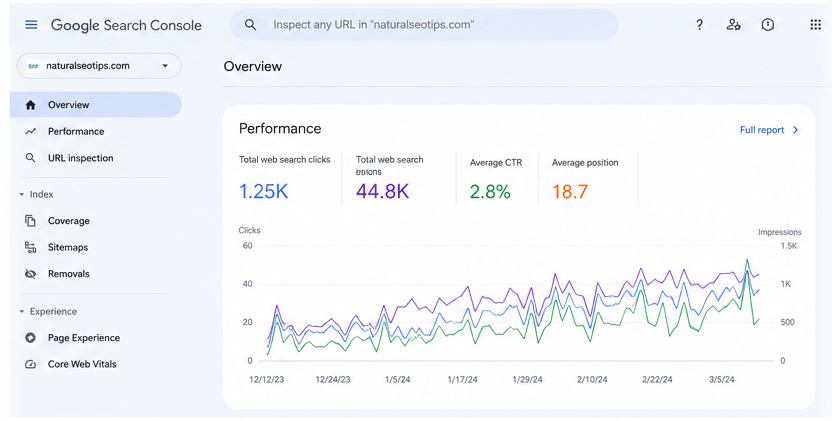
Google Search Console shows clicks, impressions, queries, pages, countries, and other search trends. Use that data to improve the page instead of guessing.
Step 6: Harvest and Replant
Turn a successful post into a video, visual guide, checklist, newsletter, presentation, or updated yearly report. One strong idea can support many useful formats.
Natural links rarely appear the day you publish. Keep improving and sharing your work; this natural link-building strategy helps a zero-authority blog grow roots before it expects a harvest.
How Many Backlinks Do You Need for Domain Authority 20?
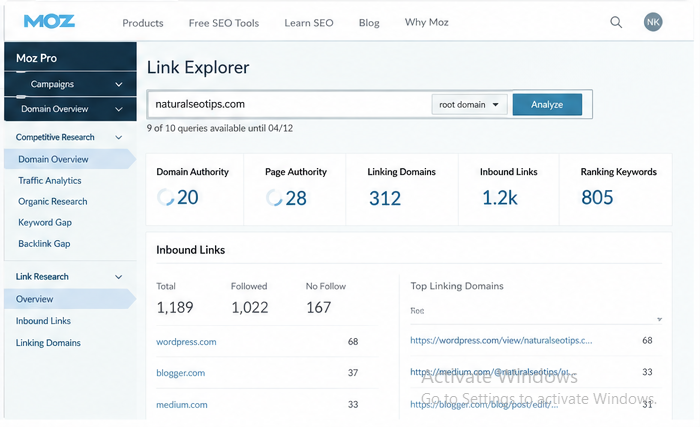
There is no fixed answer to how many backlinks you need for Domain Authority 20. Ten strong links may help one site, while 100 weak links may do almost nothing.
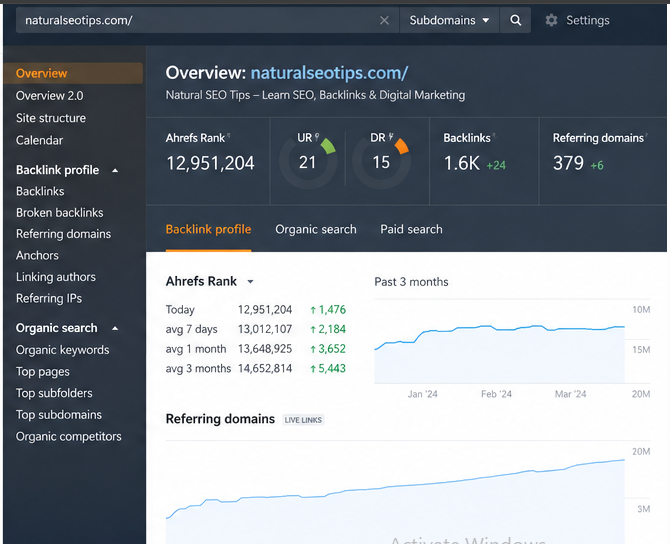
Domain Authority, or DA, is a score made by Moz; Domain Rating, or DR, is a score made by Ahrefs. Google does not use either score as its own ranking signal.
Why the backlink number changes
Your score depends more on the source of each link than on the total backlink quantity. One useful link from a trusted site can be worth more than many links from poor sites.
Ahrefs checks the number of unique referring domains, their strength, and how many other sites they link to. It then places the result on a scale from 0 to 100.
Your result may also change because:
- You gain links from new referring domains.
- You lose strong followed links.
- A linking site gains or loses strength.
- The SEO tool updates its link index.
- Other sites in the same index grow faster.
A second backlink from the same website may help, but a link from a new trusted domain often adds more value. Also, DR uses a logarithmic scale; moving from 10 to 20 is easier than moving from 70 to 80.
Ask a better question
Do not ask: “Will 20 backlinks give me DA 20?” No honest SEO expert can promise that result.
Instead, ask:
- Which trusted sites link to my competitors?
- Which competitor pages earn those links?
- Can I create a better guide, tool, study, or example?
- Are my search impressions and visits growing?
- Do my backlinks bring real readers?
- Are relevant websites citing my work?
Google uses links to find pages and understand their relevance, but it also uses many other page-level signals. So, focus on helpful content, relevant referring domains, real traffic, and steady rankings—not only on reaching Domain Authority 20.
Common Mistakes That Stop Good Content From Earning Links
Even a useful article may earn no links when you make basic link-building mistakes. Think of your post as a good shop: people cannot recommend it when they cannot find it.
- You choose a broad topic with no fresh angle. Solve one clear problem, and add a result, tool, test, or personal lesson.
- You call an ordinary post an “ultimate guide.” That label means little without original data, expert input, or real examples.
- You publish the post and simply wait. Share it with your readers, email list, partners, and relevant online groups.
- You email hundreds of unrelated sites. Contact only people whose readers will gain real value from your page.
- You ask for a backlink at once. First, explain how your guide can improve their article or help their audience.
- You track only DA or DR. Also track referral visits, search clicks, new referring sites, leads, and reader replies.
- You force the same keyword into every anchor text. Use clear and natural link text that describes the linked page.
- You buy links from unrelated websites. A random link from a betting, crypto, or coupon site may weaken trust.
- You hide the answer below a long introduction. Give the main answer early, and then support it with useful detail.
- You invent stories, figures, or expert quotes. One false claim can damage the trust that took years to build.
- You ignore internal links and crawl paths. Link to the post from relevant pages using short, helpful anchor text.
- You leave old facts and images unchanged. Review key pages every 6 or 12 months, and mark each real update.
- You treat every nofollow link as useless. Such a link can still send readers, build awareness, and lead to later mentions.
- You publish many AI pages with no original work. Google says mass AI content without added value may count as scaled content abuse.
Good content earns attention when it is useful, visible, honest, and easy to cite. Fix these link-building mistakes, and give each reader a strong reason to share your work.
Content or Backlinks: What Should You Prioritize First?
When you compare content vs backlinks, start with the real problem on your site. Backlinks cannot save a weak page, while great content may stay hidden without sound SEO and promotion.
Find What Your Site Needs
Use Google Search Console before you spend time or money. Check your impressions, clicks, click rate, search terms, and page position.
| Your situation | What to do first | Why |
|---|---|---|
| Thin or copied content | Improve the page | Links cannot make weak content useful |
| Good content with no impressions | Check indexing and keywords | Google may not see or understand the page |
| Impressions but few clicks | Rewrite the title and description | Your search result may not attract readers |
| Good rankings but no backlinks | Add a tool, chart, or template | Readers need something worth citing |
| Great content but no audience | Promote it in honest ways | Discovery is your main problem |
| A hard money keyword | Use content, trust, and good links | Strong rivals often have all three |
| Many links but poor rankings | Audit the links and search intent | Link count alone can mislead you |
Google says you should create useful, reliable, people-first content. It also advises you to offer unique, expert-led value instead of common information found everywhere.
Choose the Right Path
- Best long-term choice: Publish distinct content and promote it often.
- Cheapest choice: Share real experience, add internal links, and build honest ties.
- Fastest fair choice: Publish fresh research that news writers can cite.
- Safest choice: Earn links through useful work and clear partnerships.
- Best beginner choice: Target a small search term and offer one free template.
- Best expert choice: Build data studies, tools, tests, and digital PR campaigns.
In 2025, three of Ahrefs’ five most-read new posts were research studies based on its own data. This does not prove that every study will win, but it shows why original facts can bring both attention and links.
Your first task is simple: fix the page before chasing links. In the content vs backlinks choice, strong content comes first, and honest link earning helps the right people find it.
A 30-Day Natural Backlink Plan for a New Blog
This 30-day natural backlink plan helps you build one page that people may want to share. You will research, write, publish, promote, and improve it in four simple weeks.
Week 1: Find a Real Problem
Choose one small problem that your reader needs to solve now. Do not pick a wide topic such as “SEO tips”; choose a clear topic such as “how to find broken internal links in WordPress.”
Search Google and study the first-page results. Note what they explain well, what they miss, and what you can show in a better way.
Collect at least 10 questions from Google, Reddit, YouTube comments, support groups, or your own readers. Then choose one useful asset: a checklist, chart, template, test result, or simple tool.
Week 2: Build a Page Worth Citing
Give the clear answer near the top of the page. Then add steps, costs, risks, limits, and one real example.
Create one item that other writers can use or cite. For example, test five WordPress image tools on the same 1 MB photo and show the final file sizes.
Use official reports and primary sources for facts. Google says its systems aim to reward helpful content made for people, not pages made only to gain search traffic.
Week 3: Publish and Connect
Use a clear page title, short headings, useful images, and natural internal links. Google uses crawlable links to discover pages and understand their meaning.
Inspect the URL in Google Search Console and request a crawl when needed. Google allows this request, but it does not promise fast indexing or ranking.
Share a short answer in a relevant group, then link only when the page truly helps. My firm view is simple: dropping links into random groups is spam, not promotion.
Week 4: Measure and Improve
Check impressions, search terms, clicks, referral visits, and new referring domains. Improve weak titles, unclear steps, old facts, and unanswered reader questions.
Record which emails and community posts brought real visits. Then create one follow-up asset based on the questions people asked.
Do not expect a fixed number of links in 30 days. A good 30-day natural backlink plan gives you a stronger page, wider discovery, useful feedback, and a process you can repeat.
Grow Authority Like a Farmer Grows a Crop
To earn backlinks naturally, treat your blog like a farmer treats a field. You cannot throw fake seeds on dry soil and expect a rich crop.
Your ideas and real experience are the seeds; good SEO and clear search intent form the soil. Regular promotion brings water, while reader trust gives your work sunlight.
Then, you must give it time. Google says some useful site changes can take several months to show their full effect in search results.
Backlinks are part of the harvest, not bright signs placed in an empty field. Google also makes this clear: links matter, but Search uses many other ranking signals.
So, create something worth citing and show it to the right people. Next, use reader questions and real feedback to make it better.
Choose one old blog post today. Add one hard-to-copy item:
- Your own data or test result
- A real example with steps
- A free template
- A clear comparison table
- A useful image or chart
- Advice from a trusted expert
This is how you earn backlinks naturally: plant real value, care for it well, and let trust grow with time.
Frequently Asked Questions About Natural Backlinks
Can high-quality content rank without backlinks?
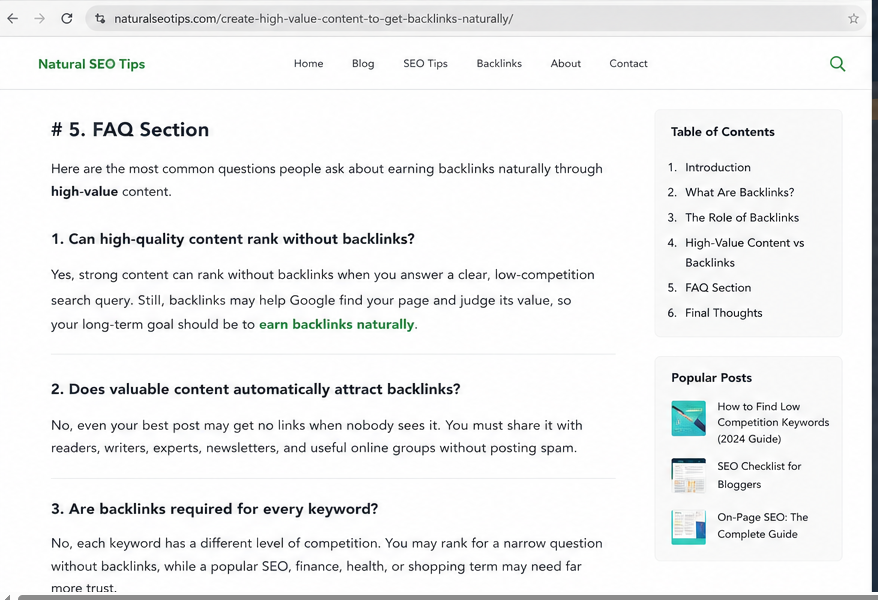
Yes, strong content can rank without backlinks when you answer a clear, low-competition search query. Still, backlinks may help Google find your page and judge its value, so your long-term goal should be to earn backlinks naturally.
Does valuable content automatically attract backlinks?
No, even your best post may get no links when nobody sees it. You must share it with readers, writers, experts, newsletters, and useful online groups without posting spam.
Are backlinks required for every keyword?
No, each keyword has a different level of competition. You may rank for a narrow question without backlinks, while a popular SEO, finance, health, or shopping term may need far more trust.
How many backlinks does a new website need?
There is no fixed number because one useful link can beat many weak links. First, study the pages that rank for your target keyword; then compare their relevant referring websites, content quality, and search intent.
How many backlinks are needed to reach Domain Authority 20?
No set number can guarantee a Domain Authority score of 20. Domain Authority is a Moz score, not a Google ranking score, and it changes based on your full link profile and competing websites.
Is buying backlinks illegal?
Buying a backlink is not normally a crime, but it may break Google’s spam rules when you buy it to control rankings. Paid links should use a clear tag such as rel="sponsored" so search engines know the link is an advert.
Can buying backlinks hurt a website?
Yes, paid links can hurt you when they come from spam sites, link farms, hacked pages, or unrelated blogs. Google may ignore those links, lower your rankings, or take action when it finds a planned link scheme.
What is the safest way to earn backlinks?
Solve a real problem better than the pages that already rank. You can publish original research, a free tool, a tested guide, a clear diagram, or a useful template that other writers will want to cite.
How long does it take to earn natural backlinks?
You may earn a link within days, but a new blog often needs several months to gain notice and trust. The time depends on your topic, content value, promotion, audience size, and the number of people who need your resource.
Are nofollow backlinks valuable?
Yes, a nofollow link may still send readers, build your name, and lead to later mentions. Google also treats nofollow as a hint, so you should not reject a useful link only because it may not pass the same ranking value.
What type of content earns the most backlinks?
Content earns more links when it gives people something worth using or quoting. Original facts, surveys, case studies, calculators, free files, expert views, local data, and step-by-step guides often give writers a clear reason to cite your page.
Should I focus on backlinks or topical authority?
Start with helpful content, clear site structure, and a strong group of related posts. Then promote your best pages to earn backlinks naturally, because topical depth and trusted links work better together than either one alone.
SEO note: Keep these questions and answers visible on the page for your readers. Google now shows FAQ rich results mainly for well-known government and health websites, so adding FAQ schema does not promise a special search result for a normal blog.

Leave a Reply