You can use Google AdSense to monetize your blog, but it takes patience and smart work. I learned this after years of trying, failing, and starting again.
For several years, I created blogs in different niches. However, none of them brought enough visitors, and I could not earn even a small monthly income.
Then I borrowed money from my bank and relatives. As a result, my debts grew, my confidence dropped, and many nights passed without proper sleep.
Even so, I never stopped blogging. Instead, I studied my mistakes, picked a better niche, and built one more blog with a clear plan.
Finally, one blog started ranking on Google. Soon after, real readers arrived every day, and my first Google AdSense payment crossed $100 per month.
That small income did not solve my problems. So, I calculated my debt, fixed a new target, and decided to earn $5,000 every month.
Next, I learned how AdSense really works: RPM, CPC, traffic quality, user intent, content depth, and ad placement all matter more than page views alone. Google also explains that publisher earnings depend on advertiser demand, visitor location, content topic, and many other factors, not traffic alone.
After that, every article had one purpose: help real people solve real problems. Because when your content truly helps readers, they stay longer, trust your advice, return again, and that steady traffic becomes the foundation for growing Google AdSense to monetize your blog into a real business.
What Is Google AdSense and Why Bloggers Still Use It?
You start Google AdSense monetization by placing ad space on your blog. Then Google finds matching ads, advertisers compete for that space, and you earn when people view or click those ads.
Many new bloggers think money starts on day one. However, you soon learn that good content and steady traffic matter much more than simply showing ads.
Google AdSense for bloggers is free to join. So, you do not need to find advertisers, send invoices, or collect payments because Google manages all of that for you.
The process is simple:
- You publish useful content.
- You add Google AdSense to your blog.
- Google fills your ad spaces.
- Advertisers bid in real time.
- The highest-paying ads appear.
- You receive your earnings every month after reaching the payment threshold.
Still, you should know one truth: AdSense is not a magic money machine. It rewards blogs that help real people solve real problems.
That is why many bloggers quit too early. They see only a few dollars after months of work, lose confidence, and stop publishing before traffic starts growing.
You should treat AdSense like a long-term business instead of quick income. One helpful article can keep bringing visitors for months or even years if it ranks well in Google Search.
| Your Part | Google’s Part |
|---|---|
| Write helpful content | Match relevant ads |
| Bring real visitors | Run the ad auction |
| Create ad spaces | Show the highest-paying ads |
| Follow AdSense policies | Handle billing and payments |
So, what is Google AdSense in real life? It simply turns your helpful blog posts into earning opportunities, but only when you consistently create content that real people search for, trust, and enjoy reading.
What Is Google AdSense?
If you want to monetize your blog with Google AdSense, this is one of the easiest places to start. You publish helpful content, and Google shows ads that match your visitors.
When someone views or clicks those ads, you earn a share of the advertising money. Your income depends on your traffic, topic, visitor country, advertiser demand, and ad quality.
When and Who Founded Google AdSense?
Google launched AdSense on June 18, 2003. It became possible after Google bought Applied Semantics, a company that built smart technology to match ads with webpage content.
Since then, millions of website owners from countries around the world have used AdSense. Today, it remains one of the most trusted ways to earn money from a blog.
How to Apply for Google AdSense
Applying is simple if your blog is ready. Follow these steps carefully:
- Create a Google account if you do not have one.
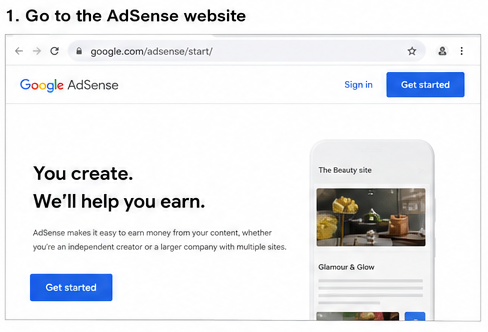
- Visit the AdSense website.
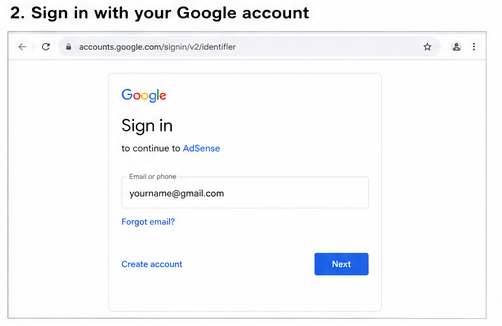
- Sign in with your Google account.
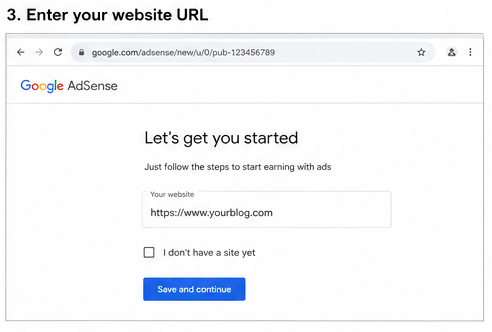
- Enter your website URL.
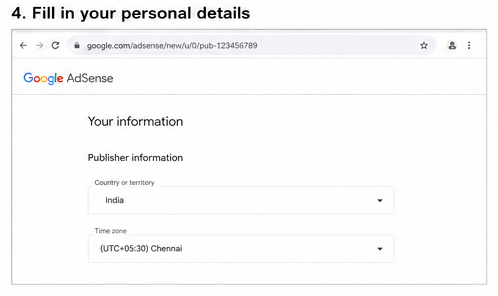
- Fill in your personal details.
- Add the AdSense code to your blog.
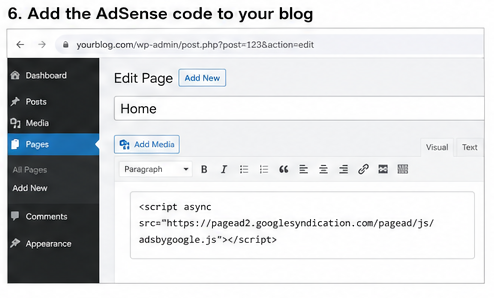
- Submit your website for review.
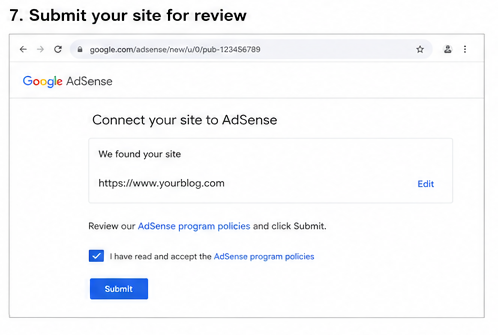
- Wait for Google’s approval email.
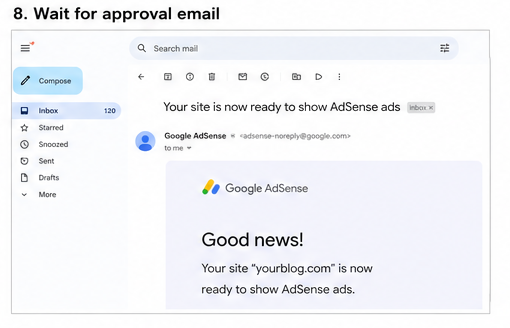
Before you apply, make sure your blog has original articles. Also add an About page, Contact page, Privacy Policy, and easy navigation.
How to Set Up Your Payment Method
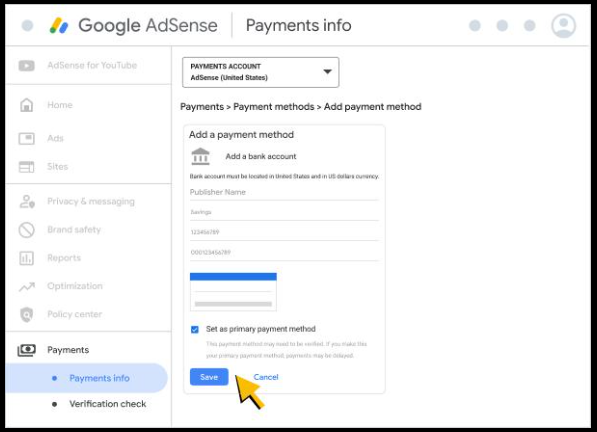
After approval, open your AdSense dashboard. Then complete your payment details before you reach the payment limit.
Follow these steps:
- Open Payments.
- Click Payments info.
- Add your name and address.
- Verify your identity if Google asks.
- Add your bank account.
- Complete PIN verification after Google mails it to your address.
- Check that your payment profile is active.
Google usually sends payments after your account reaches the payment threshold and all verification steps are complete.
Who Earns the Most from AdSense?
Google does not publish an official list of the highest AdSense earners. So, any website or YouTube list showing exact numbers should be treated as estimates.
However, many successful publishers earn large monthly income because they have millions of visitors. Most of them focus on finance, software, technology, health, education, and business because advertisers pay more in these topics.
Instead of chasing someone else’s income, focus on building useful content that solves real problems. That simple habit helps you grow your traffic first, and Google AdSense can then turn those visitors into steady monthly income.
The Hard Truth: AdSense Does Not Pay Just Because You Blog
Many bloggers expect AdSense earnings to start growing as soon as they publish more posts. The truth is different: publishing alone never brings real money.
You need helpful content that solves a real problem. Then you need people who find it through Google and stay to read it.
A real blogger shared his results on Reddit in March 2022. He received 76,000 page views in one month but earned only $135 from Google AdSense.
That example teaches one simple lesson: traffic alone does not decide your income. Your niche, visitors, country, search intent, and ad value matter just as much.
Why Your AdSense Earnings Stay Low
If you search “why my AdSense earnings are low”, these are the most common reasons:
- Your niche has low advertiser demand.
- Your visitors leave the page too quickly.
- Most traffic comes from low-CPC countries.
- Your pages answer simple questions with little buying intent.
- Your ad placement gets very few impressions.
Many bloggers in India also search “AdSense low CPC India”. That usually happens because advertisers pay less in some markets than in countries like the United States, Canada, or Australia.
High Traffic Does Not Always Mean High Income
| Situation | Result |
|---|---|
| High page views + low CPC | Low AdSense income |
| Low page views + high CPC | Better earnings |
| Helpful content + buying intent | Higher RPM potential |
| Weak content + random traffic | Poor monetization |
This is why some blogs earn more with fewer visitors. They attract readers who are ready to compare products, buy services, or make important decisions.
What Real Bloggers Are Saying
Many publishers now report similar blog monetization problems across Reddit. They mention low RPM, falling CPC, AI search reducing traffic, and AdSense alone not producing enough income for many niches.
That does not mean Google AdSense has stopped working. It simply means you must build content that attracts valuable visitors instead of chasing page views.
Think about one goal before writing every article: help one real person solve one real problem. That simple habit quietly improves your AdSense earnings much more than publishing dozens of average posts.
Who Should Use Google AdSense and Who Should Avoid It?
Before you ask is AdSense right for bloggers, first look at your traffic. Then check whether your visitors truly read and trust your content.
Google AdSense works best when you solve real problems every day. It rewards helpful pages that bring steady search traffic over time.
Use Google AdSense if You Have These Things
AdSense is a good choice when your blog gets regular visitors. It also works well when people stay, read, and visit more pages.
It fits these blog types:
- Informational blogs
- How-to and tutorial blogs
- Recipe blogs
- Tool and calculator blogs
- News and current events blogs
- Educational blogs
- Technology guides
These blogs usually publish many useful articles. As a result, they create more page views and more ad impressions.
Avoid Depending Only on AdSense if You Have These Problems
Do not expect AdSense to become your only income too early. Instead, fix these problems first.
| Situation | Better Decision |
|---|---|
| Very low traffic | Grow your content before chasing ad income. |
| Thin or copied content | Rewrite with original and useful information. |
| Low advertiser demand niche | Choose topics with stronger commercial value. |
| Mostly low-CPC countries | Add affiliate products or digital products. |
| Only a few blog posts | Build a larger content library first. |
AdSense vs Affiliate Marketing
Many beginners compare AdSense vs affiliate marketing. However, both work better together than alone.
| Google AdSense | Affiliate Marketing |
|---|---|
| Earn from ad views and clicks | Earn when readers buy products |
| Best for high traffic | Best for buying intent |
| Easy to start | Takes more trust and planning |
| Mostly passive income | Higher earning per conversion |
If your blog gets thousands of readers every month, AdSense is a smart starting point. If your readers search for product reviews or buying guides, affiliate marketing can often earn more from fewer visitors.
Practical Tip for Small Blogs
If you run a small blog, do not wait for one income source to change your life. Instead, use AdSense first, then slowly add affiliate links, digital products, or sponsored content as your traffic grows.
That is the best monetization for small blogs because it spreads your risk. It also helps you earn more even when ad rates fall or traffic changes.
Google AdSense Approval Requirements for Bloggers
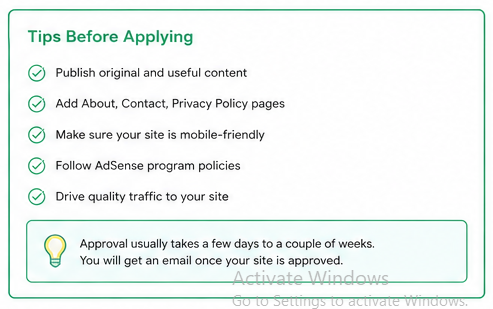
Getting Google AdSense approval 2026 starts with your content, not your theme. Google checks whether your website gives real value to real people before it places ads on your pages.
There is no official rule about how many posts are needed for AdSense approval. Instead, Google reviews your site’s quality, originality, navigation, and policy compliance as a whole.
Create Content That Helps Real People
Write every article from your own knowledge or research. Make each post useful enough that someone leaves your page with a clear answer instead of another question.
Stay in one niche whenever possible. This helps Google understand your website and also builds trust with your readers.
Build a Website That Looks Complete
Your blog should feel like a real website, not a collection of random posts. Every important page should work without broken links or empty sections.
Create these pages before you apply:
- About
- Contact
- Privacy Policy
- Categories
- Homepage
- Search page (optional)
- Sitemap
Make Your Blog Easy to Use
Your visitors should find any article within a few clicks. Keep your menu simple and use clear category names.
Also make sure your website:
- Loads fast
- Works well on mobile
- Uses HTTPS
- Has no malware or unwanted pop-ups
- Has clean internal links
- Has pages indexed in Google Search
Avoid the Most Common Rejection Reasons
Many bloggers search “why AdSense rejected my blog” after applying too early. In most cases, the problem is low-value content, copied material, poor navigation, or policy violations instead of the number of posts.
Do not publish copied articles, copyrighted images, misleading download buttons, or pages made only to show ads. Google reviews your entire website before making its decision.
Quick Google AdSense Approval Checklist
| Requirement | Ready? |
|---|---|
| Original and helpful content | ✅ |
| About page | ✅ |
| Contact page | ✅ |
| Privacy Policy | ✅ |
| Mobile-friendly design | ✅ |
| Easy navigation | ✅ |
| Indexed pages | ✅ |
| HTTPS enabled | ✅ |
| No copied content | ✅ |
| No misleading downloads or pop-ups | ✅ |
| Follow AdSense policies | ✅ |
If you complete this checklist before applying, your chances of meeting the AdSense approval requirements become much stronger. More importantly, you build a blog that both Google and your readers can trust for years to come.
How AdSense Earnings Really Work: CPC, CTR, RPM, and Traffic
Your AdSense earnings formula looks confusing at first. However, once you learn four simple numbers, you can predict your blog income with much better accuracy.
Every page view, ad click, and advertiser bid works together. So, instead of guessing your income, you can calculate it before you publish more content.
| Metric | What you should know | Simple formula | |
|---|---|---|---|
| CPC | Money you earn from one ad click | Earnings ÷ Clicks | |
| CTR | Percentage of people who click an ad | (Clicks ÷ Impressions) × 100 | |
| RPM | Estimated earnings for every 1,000 page views | (Estimated Earnings ÷ Page Views) × 1,000 | |
| Traffic | Total monthly page views on your blog | More quality visitors usually increase earnings | ([Google Help][1]) |
You can also estimate your income with two simple formulas. Both work well when you know your traffic and performance numbers.
- Earnings = Pageviews ÷ 1,000 × RPM
- Earnings = Pageviews × CTR × CPC
Think of AdSense RPM as your report card. It tells you how much your blog earns for every 1,000 page views, not how much Google pays for every visitor.
For example: if your RPM is $2, you need about 2.5 million monthly page views to earn around $5,000. If your RPM grows to $10, you need only about 500,000 monthly page views to reach the same goal.
Now look at the difference.
| Monthly Goal | RPM | Monthly Page Views Needed |
|---|---|---|
| $100 | $2 | 50,000 |
| $100 | $10 | 10,000 |
| $5,000 | $2 | 2,500,000 |
| $5,000 | $10 | 500,000 |
This example shows an important lesson: traffic alone does not decide your income. A blog with fewer visitors can still earn more when its AdSense CPC, AdSense CTR, and RPM stay higher.
So, focus on three things together: publish helpful content, attract visitors from countries with strong advertiser demand, and write topics that businesses pay more to advertise on. That simple strategy improves your AdSense earnings formula naturally and helps every new article earn more over time.
H2: The $100 to $5,000/Month AdSense Roadmap
Your make $5000 per month from AdSense goal starts with your first $100. That first payment proves your blog can earn real money, but it will not clear your debts.
Many bloggers stop after reaching $100. You should use that result as data, not as your final target.
First, calculate your blog numbers: RPM, monthly page views, niche value, and content count. These four numbers show how close you are to your income goal.
You can use this simple formula:
Monthly Income = (Monthly Page Views ÷ 1,000) × RPM
For example: if your average RPM is $10, you need about 500,000 page views every month to earn $5,000. If your RPM is only $2, you need about 2.5 million page views, so improving your niche and content becomes more important than chasing traffic alone.
Next, choose topics with better advertiser demand. Finance, software, business, web hosting, insurance, and AI tools often earn higher CPC than general entertainment because advertisers spend more in these markets.
Then, build an AdSense income plan instead of writing random posts. Publish around 150 helpful articles that answer low-competition search questions people already ask on Google.
Each article should solve one real problem. As your articles grow, your traffic grows, and your AdSense income becomes more stable.
After that, improve your ad layout carefully. Place ads where readers naturally pause, but never disturb their reading experience because happy readers stay longer and view more pages.
Finally, check your numbers every month. Remove weak pages, update old content, and publish more articles that already bring visitors.
| Monthly AdSense Income | What It Means |
|---|---|
| $100/month | Proof that your blog can earn money |
| $500/month | Helps cover small monthly expenses |
| $1,000/month | Becomes a serious blogging income |
| $5,000/month | Runs like a real online business |
Do not chase money first. Build helpful content, track your numbers, and improve one step at a time because that is the safest AdSense income plan to make $5000 per month from AdSense.
Best Blog Niches for Higher AdSense Earnings
Your high CPC blog niches decide how much advertisers may pay for your traffic. So, choose a topic where people search to solve an important problem and businesses are ready to spend money.
Not every visitor has the same value to advertisers. That is why the best AdSense niches usually earn better RPM and CPC than general entertainment or viral topics.
Why Some Niches Pay More
Advertisers bid higher when one customer can bring them long-term profit. Therefore, industries like finance, insurance, and software often receive stronger ad competition than hobby topics.
A high CPC does not guarantee high income. You still need helpful content, search traffic, and readers who trust your advice before clicking or buying.
Best AdSense Niches You Can Start
| Niche | Why It Pays Well | Beginner-Friendly Topic Ideas |
|---|---|---|
| Finance | Banks and lenders compete for customers. | Budgeting, saving money, credit score |
| Insurance | One customer can be worth thousands of dollars. | Health insurance guides, car insurance basics |
| SaaS | Companies pay well for software users. | CRM tools, project management apps |
| Web Hosting | Website owners compare paid hosting plans. | Hosting reviews, WordPress hosting |
| Legal | Law firms spend heavily on leads. | Legal rights, document guides |
| Education | Course providers advertise all year. | Online courses, certifications |
| Career | Recruiters and training companies advertise often. | Resume tips, interview guides |
| Cybersecurity | Security software has high demand. | VPNs, password safety, malware protection |
| Tech Tutorials | Software companies target active users. | AI tools, Windows guides, cloud tutorials |
| Health Information | Health services and products attract advertisers. | Healthy habits, fitness basics, nutrition |
| Business Tools | Businesses search before buying software. | Accounting tools, HR software, automation tools |
Pick a Smaller Topic First
Do not try to rank for broad words like insurance or finance on day one. Instead, target long-tail topics such as budget planner for students, best free password manager, or resume tips for freshers, because they are easier to rank and still attract commercial intent.
This simple approach helps your new blog build authority faster. Later, you can expand into bigger and more competitive keywords.
A Practical Warning
Many beginners chase only the highest CPC blog niches and ignore competition. As a result, they publish dozens of articles that never reach Google’s first page.
A smarter plan is to mix low-competition keywords with high-value topics. This gives you a better chance to rank, grow steady traffic, and increase your AdSense earnings over time.
How to Increase AdSense RPM Without Hurting Readers
I’ll keep this section practical and focused on actions you can apply today. Every tip below helps you increase AdSense RPM without making your blog feel crowded or annoying.
H2: How to Increase AdSense RPM Without Hurting Readers
Your goal is to increase AdSense RPM while keeping your blog easy to read. When readers stay longer and enjoy your content, Google usually gets better chances to show relevant ads.
Write Content That Matches Search Intent
Start with one problem and solve it completely. Then add examples, steps, tables, or checklists because readers stay longer on pages that answer their questions well.
Remove old pages that bring no traffic or have very little value. Instead, improve your best articles because strong pages usually earn more than hundreds of weak ones.
Place Ads Where They Feel Natural
Never place an ad before every paragraph because it breaks the reading flow. Instead, place one after the introduction and another inside a long section where it feels natural.
Leave enough white space around every ad so your page looks clean. A simple layout builds trust and also keeps visitors reading.
Use Auto Ads Carefully
Google Auto ads can show anchor ads, vignette ads, side rail ads, in-page ads, multiplex ads, and related search based on your settings and page layout. Test these formats one by one instead of turning everything on at once.
If one format makes readers leave quickly, turn it off. A better user experience often helps improve AdSense earnings over time.
Improve Website Speed
A slow page loses visitors before ads even load. Improve your Core Web Vitals by compressing images, using fast hosting, reducing unnecessary plugins, and enabling browser caching.
Google recommends fast and stable pages because they create a better experience for users. Faster pages can also increase ad viewability.
Target Better Traffic
Traffic quality matters more than traffic quantity. Visitors from countries like the United States, Canada, the United Kingdom, and Australia often attract higher advertiser bids than many other regions.
Do not chase random clicks from social media alone. Focus on organic Google traffic because people searching for solutions usually engage more with your content.
Quick AdSense Optimization Checklist
| Action | Why it helps RPM |
|---|---|
| Write content that matches search intent | Increases reader engagement |
| Keep a clean page layout | Improves user experience |
| Place ads after the introduction | Better visibility without distraction |
| Test Auto ads and manual placement | Finds the best-performing setup |
| Improve Core Web Vitals | Increases page speed and ad viewability |
| Remove low-quality pages | Raises overall site quality |
| Target high-value countries when possible | Often improves advertiser bids |
Do not chase more ads; chase better content and happier readers. That is the safest way to increase AdSense RPM, improve AdSense earnings, and build long-term blog income.
Common AdSense Mistakes That Keep Bloggers Poor
Many AdSense mistakes slowly reduce your income, even when your blog gets good traffic. So, if you want steady earnings, avoid these common mistakes from your first day.
Google treats invalid traffic very seriously because it protects advertisers and honest publishers. Invalid traffic includes any click or impression that increases earnings without real user interest, and it can even lead to ad limits or account closure.
Clicking Your Own Ads
Never click your own ads, even once, just to test them. Instead, use Google’s preview and testing tools because live ad clicks count as invalid traffic.
Asking Others to Click Ads
Do not ask friends, family, or social media followers to click your ads. Google can detect unusual click patterns, and this simple mistake may hurt your AdSense account.
Buying Cheap Traffic
Cheap traffic from bots, traffic exchanges, or paid click services rarely brings real readers. As a result, your AdSense low earnings problem becomes worse, and Google may limit ad serving if the traffic looks risky.
Publishing Copied or Low-Value Content
Write every article in your own words and solve a real problem. Original content builds trust, ranks better, and gives visitors a reason to stay longer.
Stuffing Keywords
Do not repeat the same keyword again and again. Instead, write naturally because Google understands helpful language much better today.
Ignoring Search Intent
Write the article your reader actually wants instead of writing only for search engines. Helpful answers usually keep visitors longer, increase page views, and improve ad opportunities.
Showing Too Many Ads
More ads do not always mean more money. Too many ads make your pages slow, reduce user trust, and increase accidental clicks.
Forgetting Mobile Users
More than half of website visitors now browse on mobile devices, so always check your pages on a phone before publishing. Fast loading, easy reading, and proper ad spacing create a better experience.
Quick Checklist
| Avoid this mistake | Better choice |
|---|---|
| Clicking your own ads | Use preview mode |
| Asking others to click | Get genuine visitors |
| Buying cheap traffic | Grow organic traffic |
| Copying content | Publish original articles |
| Keyword stuffing | Write naturally |
| Ignoring search intent | Solve one clear problem |
| Too many ads | Keep a clean layout |
| Poor mobile experience | Test every page on mobile |
If you avoid these AdSense mistakes, your blog becomes safer, your readers stay longer, and your AdSense low earnings can improve over time. Most importantly, protect your account from invalid traffic because losing your AdSense account is much harder to recover than growing your income.
AdSense Payments: When and How Bloggers Get Paid
You receive your Google AdSense payment only after your account reaches the AdSense payment threshold. So, you should first understand the payment rules before you expect your first payout.
For USD accounts, the minimum payment threshold is $100. If your balance stays below $100, Google simply carries your earnings to the next month until you reach the limit.
How the AdSense Payment Cycle Works
Google follows the same payment cycle every month. Therefore, you can easily know when your money should arrive.
| Time | What Happens |
|---|---|
| End of the month | Your earnings stop counting for that month. |
| Around the 3rd | Google finalizes your previous month’s earnings. |
| By the 20th | Your balance must reach the AdSense payment threshold, and your payment details must be complete. |
| Between the 21st and 26th | Google sends your payment if there are no payment holds. |
What You Need Before Google Sends Your Money
Complete these steps before your first payment:
- Reach the $100 AdSense payment threshold (USD account).
- Verify your identity if Google asks.
- Verify your address with your PIN, if required.
- Add your bank account or another supported payment method.
- Submit tax information if it applies in your country.
- Remove any payment holds from your account.
How to Receive AdSense Payment
Most bloggers receive money directly in their bank account through Electronic Funds Transfer (EFT). After Google issues the payment, your bank usually credits the amount within a few business days, although the exact time depends on your country, bank, weekends, and holidays.
Practical Tip: Open your AdSense → Payments page every month. It shows your payment status, payment date, and any issue that could delay your earnings.
If you understand the Google AdSense payment process from the beginning, you can avoid delays, fix problems quickly, and receive your earnings without surprises.
Google AdSense vs Other Blog Monetization Methods
You do not have to depend on only Google AdSense vs affiliate marketing. You can mix different income methods and grow your blog income step by step.
Some methods pay for traffic, while others pay for sales or your skills. So, choose the one that matches your blog, audience, and goals.
| Monetization Method | Best For | Income Style | What You Need |
|---|---|---|---|
| Google AdSense | Information blogs | Passive | Steady search traffic |
| Affiliate Marketing | Product reviews | High per sale | Buyers with purchase intent |
| Sponsored Posts | Trusted blogs | Fixed payment | Strong authority |
| Digital Products | Experts | Highest profit | Audience trust |
| Services | Freelancers | Fast income | Your time and skills |
Google AdSense
Google AdSense is the easiest way to start because you earn when people view or interact with ads on your pages. However, your income mostly depends on traffic, niche, visitor country, advertiser demand, and page RPM.
Affiliate Marketing
Affiliate marketing usually pays much more than AdSense because you earn a commission after someone buys a product. However, you need readers who are ready to purchase, not just read an article.
Sponsored Posts
Sponsored posts work well after your blog becomes popular in one niche. Companies pay you to publish honest reviews, tutorials, or product mentions for their brand.
Digital Products
Digital products give the highest profit because you keep most of the money from every sale. You can sell ebooks, templates, checklists, courses, or printable files after your readers trust your advice.
Services
Services help you make money the fastest because clients pay for your work directly. You can offer writing, SEO, web design, consulting, or coaching while your blog grows.
Which Option Should You Choose?
If your blog is new, start with Google AdSense because it is simple and passive. Then, add affiliate marketing after you publish helpful buying guides, and later introduce digital products or services to build a stronger and more stable blogging business.
Real Blogger Action Plan: What to Do in the Next 90 Days
Your blog monetization plan should stay simple from day one. Don’t chase quick money because your goal is to build steady Google AdSense income that grows every month.
Days 1–15: Build a Strong Foundation
Start by fixing your website first. Then give Google and your readers a clean experience.
- Improve page speed.
- Create About, Contact, Privacy Policy, and Disclaimer pages.
- Organize clear categories.
- Remove broken links.
- Make every page mobile-friendly.
- Install HTTPS if it is missing.
A slow and messy blog rarely performs well. A fast, trusted website keeps visitors longer and improves your AdSense strategy over time.
Days 16–45: Publish Helpful Content Every Day
Now focus only on writing. Publish 30 low-competition articles that answer one search question each.
Use this simple rule:
| Daily Task | Target |
|---|---|
| Articles | 1 |
| Internal links | 3–5 |
| Images | 1–2 |
| Search intent | 100% matched |
Write for real people, not search engines. Every article should solve one problem completely.
Days 46–70: Improve Your Best Pages
Next, open your analytics and find pages getting clicks. Then make those pages even better.
- Update old facts.
- Add new examples.
- Improve headings.
- Add internal links.
- Test Auto Ads and compare results.
Do not keep changing ads every day. Give each change at least 14 days before judging the results because AdSense needs time to collect enough data.
Days 71–90: Grow What Already Works
Finally, calculate your RPM every week. Then publish more articles around the topics bringing the highest traffic and earnings.
Remove or refresh pages with no impressions after several months. Spend more time on winners because they usually bring the fastest growth.
Your 90-Day Blogging Checklist
- ✅ Build a fast and trusted website.
- ✅ Publish 30 helpful articles.
- ✅ Update your best-performing pages.
- ✅ Improve internal linking.
- ✅ Test ad placement carefully.
- ✅ Track RPM instead of only page views.
- ✅ Create more content around successful topics.
This blog monetization plan will not make you rich overnight. However, if you follow it with patience for 90 days, you will build a stronger AdSense strategy and give your blog a much better chance to grow into a reliable source of income.
Final Checklist Before You Depend on AdSense Income
Before you depend on AdSense income, complete this AdSense checklist first. It helps you build steady earnings instead of hoping for lucky clicks.
| Check | What you should do |
|---|---|
| ✅ Real search traffic | Get visitors from Google Search, not paid or fake traffic. |
| ✅ Advertiser-friendly niche | Write about topics like technology, finance, education, health, business, or software where advertisers spend more. |
| ✅ Helpful pages | Answer one problem completely on every page and keep your content fresh. |
| ✅ Track your RPM | Watch your Page RPM every week and improve pages with low earnings. |
| ✅ Good user experience | Place ads naturally so readers can still enjoy your content without distraction. |
| ✅ Avoid invalid traffic | Never click your own ads, buy traffic, or ask others to click because Google may limit or disable your account. ([Google Help][1]) |
| ✅ Backup income | Add affiliate marketing, digital products, or services so your blog does not depend on one income source. |
Do one more check: review this blog monetization checklist every month. Then improve one weak area at a time, because a safe and growing blog always earns better AdSense income over the long run.
FAQ: Google AdSense to Monetize Your Blog
Can I monetize a new blog with Google AdSense?
Yes, you can monetize a new blog with Google AdSense if your website has original and helpful content. Your blog should also follow Google’s program policies and give visitors a good reading experience.
You do not need a fixed number of blog posts before applying. Instead, publish useful articles that fully answer real search questions and keep improving your site before you submit your application.
How much traffic do I need for AdSense?
Google does not set a minimum traffic requirement for AdSense approval. Even so, more quality visitors usually mean more chances to earn money from your blog.
Focus on search traffic instead of chasing page views. A blog with 10,000 targeted monthly visitors can earn more than another blog with 100,000 untargeted visitors because advertiser demand changes by niche and country.
Can I earn $100 per day from AdSense?
Yes, but your traffic, niche, and audience quality decide your income. Blogs in finance, software, insurance, and business usually earn a higher RPM than entertainment or general news.
Before setting your goal, calculate your expected earnings using your average RPM. For example:
| Daily Goal | Monthly Goal | What You Need |
|---|---|---|
| $100/day | About $3,000/month | High-quality search traffic and a strong RPM |
| Around $167/day | About $5,000/month | More traffic, higher RPM, or both |
Why is my AdSense CPC low?
A low CPC often means advertisers pay less in your niche or your visitors come from lower-paying regions. It can also happen when readers have low buying intent or your content targets very broad topics.
To improve your CPC:
- Write about higher-value topics.
- Target keywords with buying intent.
- Attract visitors from countries with strong advertiser demand.
- Keep your content useful and updated.
Is AdSense better than affiliate marketing?
AdSense works well when your blog gets steady traffic from search engines. Affiliate marketing usually earns more per visitor because you get paid for successful sales instead of ad clicks.
Many successful bloggers use both together. AdSense brings passive income, while affiliate marketing increases total earnings.
Can AI content get AdSense approval?
Yes, AI can help you write faster, but your content must still be original, helpful, and written for real people. Thin, copied, or low-value pages can lead to rejection even if they were created with AI tools.
Always edit AI drafts with your own experience, examples, screenshots, and practical tips. That makes your content more useful and trustworthy.
How do I avoid invalid traffic?
Never click your own ads or ask anyone else to click them. Google treats fake, repeated, automated, or encouraged clicks as invalid traffic and may limit ads or disable your account.
Keep your traffic natural and monitor unusual visitor sources. Also avoid misleading ad placements that can cause accidental clicks.
How long does AdSense take to pay?
Google pays after your finalized earnings reach the payment threshold, which is US$100 for accounts that use U.S. dollars. Payments are usually issued between the 21st and 26th of the following month if there are no payment holds or policy issues.
Keep publishing helpful content and growing your search traffic. Over time, Google AdSense can become a reliable part of your blog income instead of your only source of earnings.



Leave a Reply