AI SEO for website helps your pages become easier for Google AI Overviews, AI Mode, ChatGPT, Gemini, and Perplexity to understand, trust, and cite. In 2026, SEO still works, but your goal grows beyond rankings because AI search also looks for reliable answers, clear topics, and trusted sources.
Many website owners now notice fewer clicks even when their pages rank well. That happens because AI search often answers simple questions before people open a webpage, so your content must be useful enough to earn both visibility and citations.
Traditional SEO still builds the foundation for success. At the same time, AI SEO helps your content appear where more people now search:
- Google AI Overviews
- Google AI Mode
- ChatGPT
- Google Gemini
- Perplexity AI
- AI-powered search assistants
Google clearly explains one important point: you do not need a separate SEO strategy just for AI search. Instead, you should continue following strong SEO basics while creating original, helpful, and experience-based content that AI systems can confidently understand and reference.
| Traditional SEO | AI SEO |
|---|---|
| Improves search rankings | Improves rankings and AI citations |
| Focuses on keywords | Focuses on user intent and direct answers |
| Measures clicks | Measures clicks, mentions, and citations |
By the end of this guide, you will learn a practical AI SEO for website checklist that you can apply step by step. As a result, you can improve your chances of earning more search visibility, more AI citations, and better long-term traffic in 2026.
What Is AI SEO for a Website?
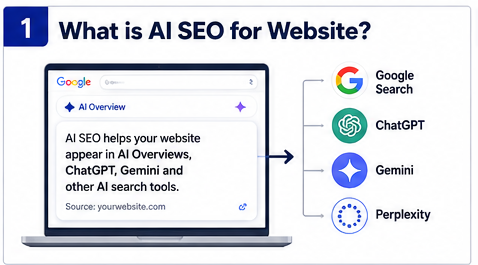
If you want better visibility today, AI SEO for website should become part of your SEO plan. It helps both search engines and AI tools understand your pages, so they can rank them, cite them, and recommend them to users.
Years ago, SEO mainly focused on getting higher rankings in Google Search. Today, AI SEO also helps your content appear in Google AI Overviews, AI Mode, ChatGPT, Gemini, and other AI search experiences that answer questions directly.
Google also explains one important point: you may hear terms like AEO (Answer Engine Optimization) and GEO (Generative Engine Optimization). From Google’s view, they are simply different names for improving visibility in AI search, and the core work is still good SEO.
In simple words: old SEO helped people find your page. AI SEO helps AI systems understand your page, trust your information, and use it when creating answers.
Here is what AI search optimization asks you to improve:
- Write clear and complete answers.
- Show real experience and trusted facts.
- Organize content with proper headings and lists.
- Keep pages easy to crawl and index.
- Update content with fresh information.
| Traditional SEO | AI SEO |
|---|---|
| Focuses on page rankings | Focuses on rankings and AI citations |
| Targets keywords | Targets user questions and intent |
| Measures clicks | Measures clicks, mentions, and AI visibility |
When you build helpful pages for real people, AI SEO for website naturally becomes stronger. That is why the same SEO basics continue to work in 2026, while AI search gives your content another chance to reach more readers.
Why AI SEO Matters More in 2026
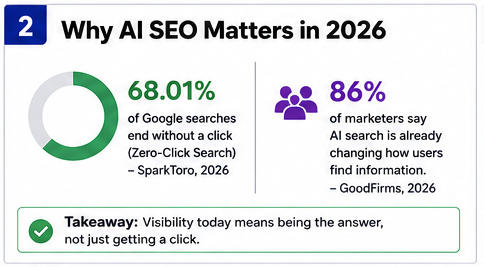
You may notice that your AI SEO for website work looks successful, yet your traffic still drops. This happens because many people now get their answers from Google AI Overviews, ChatGPT, Gemini, or other AI search tools without opening a website.
This change is called zero-click search: people search, read the answer, and leave. SparkToro reported that 68.01% of Google searches in the United States ended without a click during January to April 2026, mainly because AI answers appear directly on the results page.
If your rankings stay the same but your visitors fall, do not panic. Your content may still be visible, but users may already find the answer before they visit your website.
That is why SEO for AI search has become more important than ever. Your goal is no longer just ranking first, because you also want AI systems to trust, understand, and cite your content.
What changes for your website?
| Old SEO Goal | AI SEO Goal |
|---|---|
| Get more clicks | Become the trusted answer source |
| Rank on Google | Rank and earn AI citations |
| Measure clicks | Measure visibility and AI mentions |
| Focus on keywords | Focus on search intent and clear answers |
Another big challenge appears in how people measure success. A 2026 GoodFirms survey found that only 14% of marketers track AI visibility, even though AI search is changing how people discover websites.
So, start tracking more than rankings and traffic. Also check whether Google AI Overviews, ChatGPT, Gemini, or other AI tools mention your website when answering questions in your niche.
Key takeaway:
- Focus on AI search optimization, not only rankings.
- Write clear answers that AI can understand and cite.
- Build trust with helpful, accurate, and updated content.
- Track AI visibility along with clicks and impressions.
In 2026, AI SEO for website means winning trust before winning the click. When your content becomes the answer people and AI systems rely on, your website stays valuable even as search continues to change.
AI SEO vs Traditional SEO: What Changed?
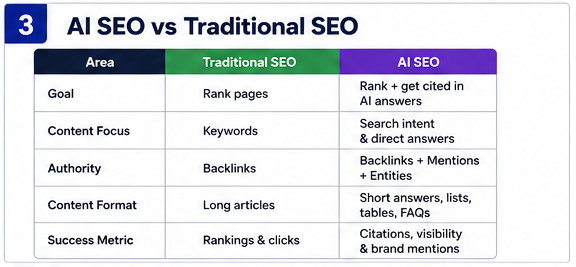
If you compare AI SEO vs traditional SEO, you will notice one big change: your goal is no longer only to rank high. Now, you also want your website to become a trusted source that AI tools can understand and cite.
Traditional SEO still works because Google AI Overviews use Google’s core Search systems. However, AI search also rewards pages that answer questions clearly, show real experience, and make information easy to extract.
| Area | Traditional SEO | AI SEO |
|---|---|---|
| Goal | Rank pages | Rank pages and get cited in AI answers |
| Content | Keyword-focused | Search intent and direct answers |
| Authority | Backlinks | Backlinks, brand mentions, and clear entities |
| Format | Long articles | Short answers, lists, tables, FAQs |
| Tracking | Rankings and clicks | Rankings, AI citations, and brand mentions |
Many people ask: Does backlink still matter for AI SEO? Yes, it does. Even so, backlinks alone are no longer enough because AI systems also look for trusted authors, helpful content, clear topics, and real-world experience.
Most blogs stop after explaining the old SEO vs AI SEO difference. Instead, you should improve your existing articles before writing new ones because this is often the fastest win.
Start with these practical updates:
- Rewrite the introduction with a direct answer.
- Add question-based headings.
- Include comparison tables and bullet lists.
- Add fresh examples and 2026 statistics.
- Improve internal links between related pages.
- Update outdated facts every few months.
- Track AI citations and brand mentions, not only keyword rankings.
Finally, remember this simple rule: traditional SEO helps search engines find your page, while AI SEO vs traditional SEO shows that AI SEO also helps AI systems understand, trust, and recommend your content.
How AI Search Engines Understand Your Website
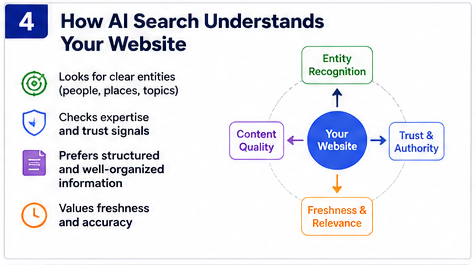
Your AI SEO for website work starts with one simple goal: help AI understand exactly who you are and what your page offers. Then your content becomes easier to trust, summarize, and cite in AI search results.
Google AI Overviews and other AI search engines first look for clear signals: helpful content, accurate facts, fresh information, and a page that people can easily understand. Your page must also be indexed and eligible to appear with a search snippet before it can appear in Google’s AI features.
Show Clear Website Entities
Entity SEO helps AI connect important details across your website. Therefore, make these details easy to find.
- Brand name
- Author name
- Main topic
- Product or service
- Business location
- Experience and expertise
- Contact information
When these details stay consistent across your pages, LLM visibility improves naturally. AI can also create more accurate AI citations because it understands your website better.
Organize Every Page Clearly
Keep your content simple and well arranged: use headings, short answers, tables, lists, and relevant images. Next, update important pages regularly so AI finds current information instead of outdated content.
Practical Example
Suppose you publish a recipe for vegetable biryani. Show the recipe name, ingredients, cooking time, nutrition facts, serving size, FAQs, step-by-step photos, and your cooking experience on the same page.
This structure helps both readers and AI understand the page quickly. As a result, your AI SEO for website strategy becomes stronger, your entity SEO improves, and your chances of earning AI citations increase over time.
Step-by-Step AI SEO Checklist for Your Website
If you want AI SEO for your website to work in 2026, start with the basics first. Then improve every page so both people and AI search systems can easily understand and trust your content.
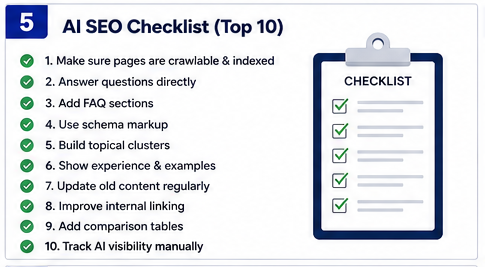
1. Make Every Page Crawlable and Indexed
Check that Google can crawl and index every important page. Use Google Search Console to fix indexing errors, blocked pages, broken links, and duplicate URLs before you create more content.
2. Answer the Main Question First
Write a clear answer directly below every H2 heading. Keep the first answer within two or three short sentences because AI search often looks for quick, complete answers.
3. Add FAQs That Real People Ask
Collect questions from Google Autocomplete, Reddit, Quora, YouTube comments, and your own readers. Answer each question briefly with practical advice instead of writing long paragraphs.
4. Use Schema Markup Where It Helps
Add Article, FAQ, HowTo, or Product schema only when it matches the page. Schema improves your eligibility for rich search results, although Google says it is not a special requirement for AI search.
5. Build Topic Clusters
Publish several related articles instead of random posts. For example:
- Pillar page: AI SEO for Website
- Supporting page: AI SEO Tools
- Supporting page: AI Overview Optimization
- Supporting page: AI SEO Checklist
- Supporting page: AI SEO Mistakes
This structure helps Google understand your expertise.
6. Show Real Experience
Share screenshots, test results, personal observations, or case studies from your own website. Original experience builds stronger E-E-A-T signals and gives readers a reason to trust you.
7. Refresh Old Content
Update older articles with fresh 2026 examples, statistics, tools, and screenshots. Small updates every three to six months usually work better than publishing hundreds of thin pages.
8. Improve Internal Linking
Link related articles together using natural anchor text. This helps readers discover more content and makes it easier for search engines to understand your website structure.
9. Add Comparison Tables and Decision Guides
Simple tables help readers choose faster and help AI understand key differences.
| Need | Best Choice |
|---|---|
| Beginner | Step-by-step guide |
| Save money | Free SEO tools |
| Save time | AI-assisted workflow with human editing |
| Better decisions | Comparison tables and checklists |
10. Track Your AI Visibility
Search your important keywords in ChatGPT, Gemini, Perplexity, and Google AI Overviews every month. Record whether your website appears, which pages get cited, and what information competitors provide better than you.
Quick AI SEO Checklist
- ✅ Keep pages crawlable and indexed.
- ✅ Answer the main question first.
- ✅ Add useful FAQs.
- ✅ Use relevant schema markup.
- ✅ Build topical clusters.
- ✅ Share real experience.
- ✅ Update old articles regularly.
- ✅ Strengthen internal links.
- ✅ Use tables and decision guides.
- ✅ Track AI search visibility monthly.
Finally, remember one simple rule: your AI SEO checklist should always focus on helping real people before trying to impress AI. Google clearly says unique, useful, people-first content performs better than mass-produced, low-value pages, and its spam policies now also apply to AI search experiences.
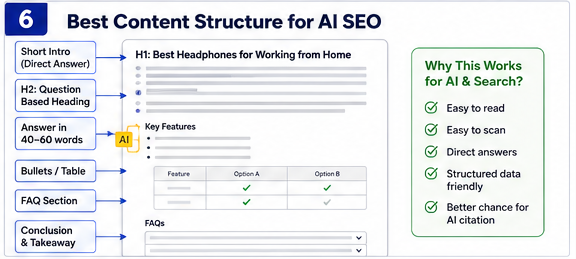
Best Content Structure for AI SEO
If you want better AI SEO content structure, make your answer easy to read in the first few seconds. Google AI Overview SEO works best when your page gives clear answers before long explanations.
Start with a Short Answer
Answer your main question in 40–60 words under the heading. Then explain the topic with examples, steps, or comparisons, because both readers and AI understand short answer blocks faster.
Build Every Section Around a User Question
Write each H2 as a real question that people search for. After that, give one direct answer first and add only useful details next.
Good examples include:
- What is AI SEO?
- How does AI SEO work?
- Does FAQ help AI SEO?
- How can you rank in Google AI Overview?
Follow This Simple Blog Format
| Section | Why it helps |
|---|---|
| Short introduction | Gives an instant answer |
| Question-based H2s | Matches search intent |
| 40–60 word answer block | Easy for AI to extract |
| Bullet points | Improves scanning |
| Comparison table | Helps quick decisions |
| Real example | Builds trust |
| FAQ section | Covers extra searches |
| Summary checklist | Improves usability |
| Updated date | Shows fresh content |
| Author bio | Supports experience and trust |
Add Helpful Content Elements
Include these only where they help the reader:
- Practical examples
- Step-by-step instructions
- Comparison tables
- Simple images or screenshots
- FAQ section
- Internal links
- Reliable statistics
- Summary checklist
Do Not Hide the Main Answer
Skip long stories before answering the question. Google recommends creating unique, helpful content with a clear structure instead of writing long introductions that delay the answer.
Finally, review your AI SEO content structure before publishing. If a reader finds the answer within the first minute, both people and AI search systems can understand your page more easily.
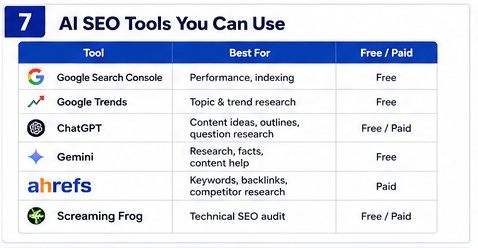
AI SEO Tools for Website Owners
Choosing the right AI SEO tools saves both time and money. You only need a few tools that solve real problems instead of buying everything at once.
Start with free tools because they show real data from your own website. Later, move to paid AI SEO software only when your website grows and you need competitor research or AI visibility tracking.
| Tool | Best Use |
|---|---|
| Google Search Console | Check indexing, clicks, impressions, and search queries |
| Google Trends | Discover rising topics and seasonal searches |
| Semrush / Ahrefs | Keyword research, competitor analysis, backlinks, and AI visibility |
| Screaming Frog | Find crawl errors, broken links, redirects, and technical SEO issues |
| OpenAI ChatGPT / Google Gemini | Plan content, group keywords, create FAQs, and research user questions |
| Schema tools | Add structured data that helps search engines understand your pages |
| Manual AI prompt tracking | Check whether ChatGPT, Gemini, and other AI tools mention your website or brand |
Next, choose your tool stack based on your budget and skill level. This simple plan works well for most website owners:
- Cheapest: Google Search Console + manual AI prompt checks.
- Fastest: Semrush or Ahrefs with AI visibility features.
- Beginner-friendly: Google Search Console + ChatGPT + Google Trends.
- Expert-level: Screaming Frog, server log analysis, and AI visibility tracking.
As of 2026, Google Search Console also provides better reporting for AI search performance, making it one of the first tools you should set up. At the same time, paid SEO suites now track brand mentions across AI search platforms, which helps you measure visibility beyond traditional rankings.
Finally, remember this simple rule: the best AI SEO tools never replace your knowledge. They simply help you make faster and smarter SEO decisions every day.
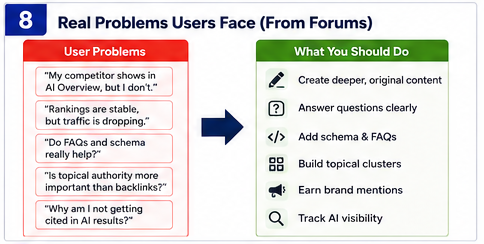
Real User Problems About AI SEO
If you face AI SEO problems, you are not alone. Many website owners ask why their pages do not appear in Google AI Overviews, even when they rank well in normal search.
Many users also notice that traffic drops while rankings stay almost the same. This happens because AI Overviews answer many questions before people click a website, and studies report lower click-through rates for pages when AI summaries appear.
Why Your Competitors Show Up Instead
Your competitor may answer one question more clearly than you. They may also build stronger topic clusters, add original examples, and show real experience throughout the page.
Traditional SEO still matters, but it is no longer enough by itself. Today, Google also looks for clear answers, trusted authors, helpful page structure, and strong topic coverage.
Do FAQs and Schema Help?
Yes: FAQs and structured data help search engines understand your page better. However, schema alone cannot improve AI Overview ranking issues if your content is weak or outdated.
Practical Fixes You Can Apply Today
| Problem | Practical solution |
|---|---|
| Competitor appears in AI answers | Build a complete topic cluster instead of one article. |
| Good rankings but fewer clicks | Answer the main question in the first few lines. |
| Weak authority | Add real examples, screenshots, comparisons, and fresh data. |
| Low trust | Show author experience, update dates, and reliable sources. |
| Technical issues | Improve indexing, page speed, internal links, and schema. |
| Measuring success | Track AI mentions, citations, and brand visibility along with rankings. |
Start by improving one important page before writing ten new ones. That simple habit solves many AI SEO problems because helpful, trustworthy, and well-structured content has a much better chance of appearing in AI search results.
Common AI SEO Mistakes to Avoid
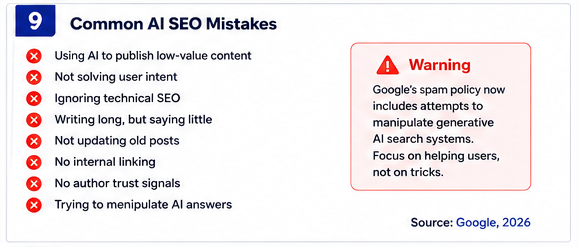
Many AI SEO mistakes happen because you publish content too fast. Instead, create useful pages that solve one real problem with your own tips, examples, or results.
Do not chase keywords alone: answer the question behind the search. When your page helps real people first, both Google Search and AI systems understand its value better.
Generic AI-written content rarely keeps readers on your page. Add your own screenshots, case studies, practical steps, or experience to make every article different.
Long articles do not always win. Write only what your reader needs, and remove every sentence that adds no value.
Technical SEO still matters: a slow website, broken links, poor mobile experience, or indexing issues can stop your page from performing well. Check your site regularly with an SEO audit and fix problems early.
Old posts lose value over time. Update facts, examples, screenshots, links, and statistics every few months to keep your content fresh.
Internal links help both readers and search engines. Connect related articles so visitors can learn more without searching again.
Show who writes your content and why readers should trust you. Add an author bio, real experience, sources, and the latest information whenever possible.
Never try to trick AI search results with fake reviews, hidden prompts, or recommendation poisoning. In May 2026, Google updated its spam policies to clearly state that attempts to manipulate generative AI responses, including AI Overviews and AI Mode, are considered spam and may lead to lower rankings or removal from Search.
Quick Checklist
- Create original content with real value.
- Solve search intent before targeting keywords.
- Fix technical SEO issues.
- Keep articles short and useful.
- Update old content regularly.
- Add internal links.
- Build author trust.
- Follow Google’s spam policies and avoid AI SEO mistakes.
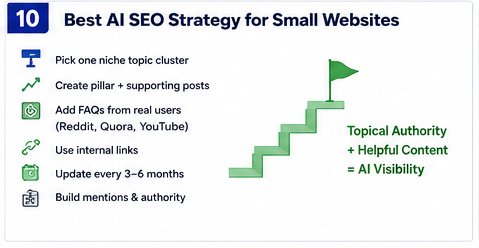
Best AI SEO Strategy for Small Websites
If you want AI SEO for small website success, focus on one topic before anything else. That simple step helps Google and AI search understand what your website does best.
Build One Topic First
Choose one niche that you know well. Then publish 8–12 helpful articles that answer different questions about that topic.
Next, create one detailed pillar page that links to every supporting article. This topic cluster builds topical authority, which is still one of the strongest SEO signals for AI search in 2026.
Create Content That Solves Real Questions
Do not guess what people ask. Instead, collect questions from:
- Google Autocomplete
- Reddit discussions
- Quora answers
- YouTube comments
- Google “People Also Ask”
Answer each question in simple words. Then add one real example from your own experience because unique content is easier for AI systems to trust.
Improve Every Page Before Writing More
Updating an old article usually costs less than creating a new one. Refresh your posts every 3–6 months by adding new facts, better examples, fresh screenshots, and current statistics.
Also, fix technical SEO issues, improve page speed, and add clear internal links between related articles. Google says strong technical SEO and helpful content remain the foundation of visibility in AI Search and AI Overviews.
Choose the Right Strategy for Your Goal
| Your Goal | Best Option |
|---|---|
| Best long-term growth | Build topical authority |
| Lowest cost | Update old articles |
| Fastest improvement | Fix technical SEO and write direct answers |
| Safest approach | Follow Google’s Helpful Content guidance |
| AI SEO for beginners | Publish question-based articles consistently |
Finally, grow your website beyond Google. Earn genuine mentions from niche communities, podcasts, guest posts, and trusted directories because natural recommendations strengthen your online authority over time, while fake AI manipulation can violate Google’s spam policies.
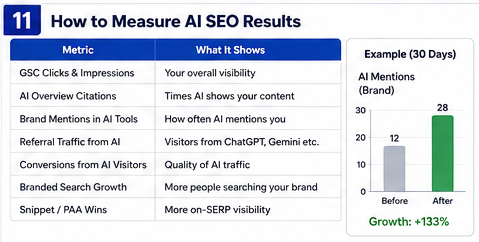
How to Measure AI SEO Results
You cannot improve AI SEO tracking unless you measure the right numbers first. Start tracking your AI visibility tracking today, and you will quickly see what brings real visitors.
First, open Google Search Console every week. Then check clicks, impressions, average position, and the search queries that bring visitors to your pages.
Next, search your main keywords in Google AI Overview, ChatGPT, Gemini, and Perplexity. Write down every page where your website appears or gets mentioned, because these AI citations show your growing visibility.
Use this simple checklist to measure your progress:
| Metric | Why it matters |
|---|---|
| Google Search Console clicks | Shows real organic traffic |
| Search impressions | Measures keyword visibility |
| AI Overview citations | Shows Google AI mentions |
| ChatGPT, Gemini, and Perplexity mentions | Tracks your brand visibility |
| AI referral traffic | Shows visits from AI tools |
| Conversion rate | Measures leads or sales from AI visitors |
| Branded searches | Shows growing trust in your website |
| Featured snippets | Increases visibility in Google Search |
Also, create a monthly spreadsheet. Compare every month’s numbers instead of checking your website every day, because SEO needs time to grow.
Finally, focus on conversions instead of traffic alone. AI visitors are still fewer than Google Search visitors, but many recent studies show they often convert better because they arrive with stronger buying or learning intent.
If your AI citations, branded searches, conversions, and impressions keep growing together, your AI SEO tracking strategy is moving in the right direction.
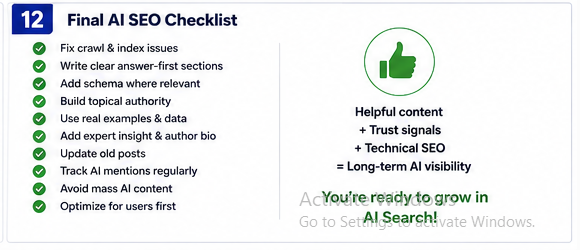
Final AI SEO Checklist
Start with this AI SEO checklist for website and keep every step simple. Google says AI search still depends on strong SEO, so fix the basics first.
| Checklist | What you should do |
|---|---|
| Crawl and index | Check Google Search Console and fix pages that are not indexed. |
| Answer-first writing | Give the direct answer in the first few lines under every heading. |
| Schema | Add relevant schema like Article, FAQ, or HowTo when it truly fits your page. |
| Topical authority | Publish related articles and connect them with internal links. |
| Real examples | Share your own screenshots, results, or practical steps instead of generic text. |
| Expert insight | Add your experience, lessons, and useful tips that readers cannot find everywhere. |
| Update content | Refresh old posts with new facts, examples, and 2026 information. |
| AI mentions | Search your brand in AI tools from time to time and improve pages that never appear. |
| Avoid mass AI content | Never publish large amounts of copied or low-value AI text. |
| Users first | Solve the reader’s problem before thinking about rankings. |
Google also explains that you do not need special AI markup or tricks. Instead, create useful content, keep your pages crawlable, and use normal SEO best practices because AI search builds on the same foundation.
Finally, review this AI SEO checklist for website every three to six months. Small updates made regularly usually work better than rewriting your whole site at once.
Frequently Asked Questions About AI SEO for Website
What is AI SEO for a website?
AI SEO for a website helps your pages appear in Google Search, AI Overviews, ChatGPT, Gemini, and other AI search tools. It still follows normal SEO, but you also make your content easy for AI to understand, trust, and cite.
Is AI SEO different from normal SEO?
Yes, but only a little: normal SEO helps your pages rank, while AI SEO also helps your content become a trusted answer inside AI results. Google says the same SEO basics still matter because AI search uses Google’s core Search systems.
How do you rank in Google AI Overview?
You should publish original content that solves one problem clearly and quickly. Also, keep your website crawlable, answer questions directly, add helpful images, build topical authority, and update your pages regularly because Google recommends these practices for AI search.
Can AI-written content rank on Google?
Yes: AI-written content can rank if it is helpful, accurate, original, and made for people instead of search manipulation. Google does not rank pages by who writes them; it evaluates the quality and usefulness of the content.
What are the best AI SEO tools?
You can start with these tools because they cover almost every AI SEO task:
| Tool | Best use |
|---|---|
| Google Search Console | Performance and indexing |
| Google Trends | Topic research |
| ChatGPT | Content planning |
| Gemini | Research and ideas |
| Ahrefs or Semrush | Keywords and competitors |
| Screaming Frog | Technical SEO audit |
Does schema help AI SEO?
Yes, but it is not a magic shortcut: schema helps search engines understand your content better and can improve rich results. Google also explains that structured data supports your overall SEO, although no special AI schema is required.
How long does AI SEO take?
Most websites start seeing early improvements in 3 to 6 months, while competitive topics often need 6 to 12 months. The exact time depends on your website age, competition, content quality, and backlink profile.
Is AI SEO good for small websites?
Yes, AI SEO for website works very well for small websites because helpful content can compete with large brands. If you focus on one niche, answer real user questions, and keep your content fresh, your pages have a better chance of earning citations in AI search results over time.

Leave a Reply