A few days ago, I was talking to a friend who wanted to switch careers in IT. He asked me a question that I’ve heard many times before:
“Should I learn SAP ABAP or DevOps?”
Honestly, it’s not a bad question. But there’s a small problem hiding inside it.
Many people compare SAP ABAP and DevOps as if they’re two programming languages competing with each other. They’re actually very different careers.
SAP ABAP is a programming language used mainly inside SAP systems. Companies use it to customize their business applications, create reports, build interfaces, and handle all kinds of SAP-related development work. If you’ve ever worked in a large company running SAP, you’ve probably seen how much businesses depend on ABAP developers behind the scenes.
DevOps, on the other hand, isn’t a language at all.
It’s more like a way of working. A DevOps engineer spends time automating tasks, managing cloud platforms, handling deployments, setting up CI/CD pipelines, working with Docker, Kubernetes, Linux, and a bunch of tools that help software move from development to production smoothly.
This is where many beginners get confused.
One path focuses heavily on enterprise business systems. The other touches almost every part of modern software development.
So which one is better?
Well… that depends on what you’re looking for.
If you’re searching for the skill with the widest job market in 2026, DevOps probably has the advantage. Cloud computing isn’t slowing down anytime soon, and companies everywhere need people who can automate, deploy, monitor, and manage applications.
But that doesn’t mean SAP ABAP is disappearing.
Not even close.
Large enterprises continue investing billions in SAP systems, and many are still moving to SAP S/4HANA. Because of that, skilled ABAP developers remain valuable, especially in consulting firms, implementation projects, and long-term enterprise support roles.
The truth is that both careers have opportunities. The difference is where those opportunities exist. DevOps offers a broader market across many industries, while SAP ABAP sits in a smaller but very specialized world where experienced professionals are often hard to replace.
Before choosing one, it’s worth understanding how each career works, what skills you’ll need, and where the future seems to be heading. That’s exactly what we’ll explore in this guide.
2. What is SAP ABAP?
If you’ve ever worked in a company that uses SAP, you’ve probably heard the term SAP ABAP. The first time I heard it, I honestly thought it was just another programming language with a strange name. Turns out, it’s much more than that.
ABAP stands for Advanced Business Application Programming. It’s the main programming language used inside SAP systems. Companies use it to build custom reports, create business applications, automate tasks, and connect SAP with other software.
Think about a large manufacturing company. They may want a special report showing daily production numbers, inventory levels, and sales data all in one place. SAP ABAP helps developers build that report exactly the way the business needs it.
Over the years, ABAP has grown far beyond simple reports. Today, ABAP developers work on custom enhancements, interfaces between systems, workflows, and modern SAP applications. They also build solutions for SAP S/4HANA, which is SAP’s latest ERP platform.
One thing many people ask is, “Is SAP ABAP still used in 2026?” The short answer is yes.
A lot of businesses around the world still run their operations on SAP. Even more interesting, many companies are currently moving from older SAP systems to S/4HANA. SAP has announced mainstream maintenance for SAP Business Suite 7 core applications until the end of 2027, with optional extended maintenance available until 2030. Because of that, S/4HANA migration projects are keeping SAP consultants and ABAP developers busy.
Modern ABAP isn’t the same as it was ten years ago either.
Today’s developers are expected to understand technologies such as CDS Views, which help retrieve data faster from HANA databases. They also work with OData services that allow SAP data to communicate with web and mobile applications. Then there’s SAP Fiori, the modern user interface that replaced many old SAP screens. Behind many Fiori apps, you’ll often find ABAP code doing the heavy lifting.
Another area getting attention is the RESTful Application Programming Model (RAP). It helps developers build cloud-ready applications using modern development practices. If you’re learning SAP ABAP today, RAP is something you’ll probably hear about sooner rather than later.
What I find interesting about ABAP is that it sits right in the middle of technology and business. You’re not just writing code. You’re helping companies manage purchasing, finance, sales, manufacturing, and countless other processes that keep the business running every day.
That combination of technical work and real business impact is one reason SAP ABAP continues to have a place in the IT industry, even as newer technologies keep appearing.
3. What is DevOps?
When I first heard the word DevOps, I honestly thought it was another programming language. A lot of people think that. But after spending time around software teams, I realized DevOps is something completely different.
In simple words, DevOps is a way of working that brings developers and operations teams together. The goal is pretty straightforward: build software faster, release it faster, and fix problems faster.
Years ago, developers would write code and then hand it over to another team for deployment. If something broke, fingers started pointing everywhere. Developers blamed operations. Operations blamed developers. Projects got delayed. Customers got frustrated.
DevOps was created to solve that mess.
Think of it like a cricket team. You can’t win matches if the batsmen, bowlers, and fielders refuse to work together. Everyone has to play as one unit. DevOps follows the same idea.
A DevOps engineer spends a lot of time automating repetitive work. Instead of manually deploying software every week, they create automated pipelines that do the job in minutes. This is where CI/CD (Continuous Integration and Continuous Deployment) comes in. Every time developers make changes to code, the system can automatically test and deploy those changes.
Pretty cool, honestly.
Modern DevOps also involves working with cloud platforms such as AWS, Azure, or Google Cloud. Companies are moving their applications to the cloud because it’s flexible and easier to scale when traffic suddenly increases.
You’ll also hear tools like Docker and Kubernetes mentioned almost everywhere. Docker helps package applications so they run the same way on every machine. Kubernetes manages those applications when they grow larger and need to run across multiple servers.
Then there is Terraform, which allows engineers to create infrastructure using code instead of clicking buttons manually. It saves a huge amount of time and reduces mistakes.
But DevOps isn’t only about deployments and cloud services.
Monitoring is a big part of the job too. If a website suddenly goes down at midnight, someone needs to know immediately. That’s why DevOps teams use monitoring tools to watch application health, server performance, and user activity.
Security has become a major responsibility as well. Modern DevOps engineers often work closely with security teams to make sure applications stay protected from attacks and vulnerabilities.
AWS describes DevOps as a combination of practices and tools that help organizations deliver applications and services at high speed. That’s probably one of the simplest ways to explain it.
So if you’re wondering what DevOps really is, think of it this way:
Development + Operations + Automation = DevOps.
It’s a career that combines coding, cloud computing, automation, problem-solving, security, and teamwork. That’s one reason why DevOps continues to be one of the most in-demand technology careers heading into 2026.
4. SAP ABAP vs DevOps: Quick Comparison Table
If you’re standing at a career crossroads and trying to choose between SAP ABAP and DevOps, I get it. I’ve seen many IT professionals struggle with this exact question. On the surface, both seem like good options. Both can pay well. Both have jobs available. But they are actually very different career paths.
One thing that often confuses people is that SAP ABAP is a programming language used mainly inside the SAP world, while DevOps is a broader field that combines development, operations, cloud platforms, automation, and infrastructure management.
Think of it this way. SAP ABAP is like becoming a specialist doctor. DevOps is more like becoming a general physician who works across many areas. Neither is wrong. It depends on what kind of work excites you.
| Factor | SAP ABAP | DevOps |
|---|---|---|
| Skill Type | SAP-specific programming and customization | Cloud, automation, infrastructure, deployment |
| Learning Curve | Moderate | Steeper because many tools are involved |
| Job Market | Smaller but stable SAP ecosystem | Large global market across industries |
| Salary Potential | Good, especially with S/4HANA skills | Very good, especially with cloud expertise |
| Future Scope | Strong demand in SAP projects and migrations | Growing demand with cloud and automation adoption |
| Common Tools | ABAP Workbench, Eclipse ADT, SAP BTP, Fiori | Docker, Kubernetes, Jenkins, Terraform, AWS, Azure |
| Coding Level | High coding focus | Mix of scripting, automation, and configuration |
| Fresher Opportunities | Limited but available through SAP projects | More openings but tougher competition |
| Experienced Opportunities | SAP Architect, Technical Lead, BTP Consultant | DevOps Engineer, SRE, Cloud Architect, Platform Engineer |
What I’ve noticed over the years is that SAP ABAP tends to attract people who enjoy working deeply within business systems. They like understanding finance, sales, logistics, and how large companies operate.
DevOps feels different. Some days you’re writing scripts. Other days you’re fixing deployment issues at midnight. Then you’re setting up cloud infrastructure the next week. It can be exciting, but honestly, it can also feel overwhelming at first because there are so many tools to learn.
If your goal is job stability within the SAP ecosystem, ABAP is still a solid choice, especially with S/4HANA, RAP, CDS Views, and SAP BTP becoming more important. If you want broader opportunities across startups, product companies, cloud providers, and enterprise organizations, DevOps usually offers a wider playing field.
The simple truth? SAP ABAP is narrower but steady. DevOps is broader, faster-moving, and often comes with a bigger learning curve. The better choice depends less on market trends and more on the kind of work you’ll enjoy doing every day.
5. Job Opportunities in 2026: Which Has More Demand?
This is probably the question most people care about.
You can learn a skill. You can spend months taking courses. But at the end of the day, you still want to know one thing:
Will companies actually hire me?
I had the same thought when I first started looking at different IT careers. A technology can sound exciting, but if there aren’t enough jobs, it becomes a tough road.
So, when we compare SAP ABAP and DevOps in 2026, which one has more opportunities?
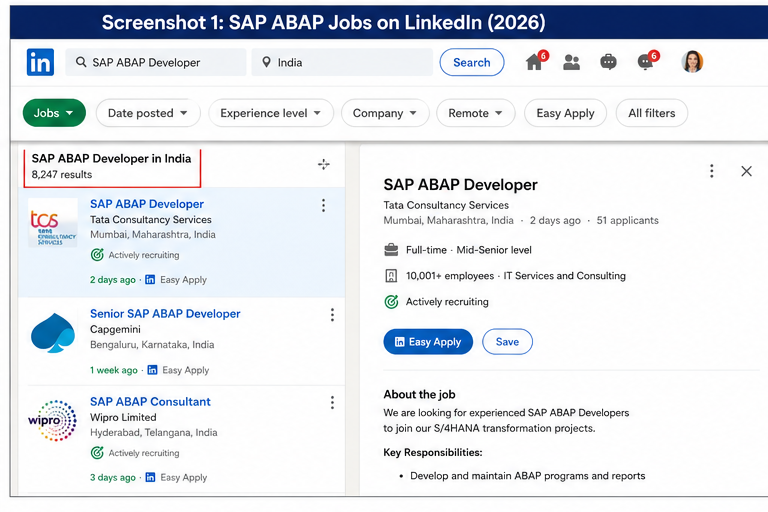
The honest answer is that DevOps currently has more overall job openings.
That doesn’t mean SAP ABAP is dying. Not even close. The job markets are simply different.
Think about it this way.
Almost every software company today uses cloud platforms, automated deployments, source control, monitoring tools, containers, and CI/CD pipelines. Whether it’s a startup with ten employees or a giant multinational company, they need someone who can help applications move smoothly from development to production.
That’s where DevOps comes in.
A company building a mobile app needs DevOps.
A fintech company needs DevOps.
An e-commerce website needs DevOps.
A healthcare platform needs DevOps.
The list keeps going.
Because DevOps skills are useful across many industries, the number of available positions is naturally larger. When you browse job portals, you’ll often see openings for DevOps Engineers, Cloud Engineers, Site Reliability Engineers (SREs), Platform Engineers, Automation Engineers, and Infrastructure Engineers. Many of these roles overlap and use similar skills.
That creates a pretty wide job market.
Now let’s talk about SAP ABAP.
SAP ABAP lives in a different world.
Instead of working across all kinds of software companies, ABAP developers mainly work in organizations that use SAP systems. These are usually large enterprises, manufacturing companies, retail chains, pharmaceutical companies, banks, logistics firms, and government organizations.
At first glance, that might sound limiting.
But here’s something many beginners don’t realize.
Large companies don’t switch ERP systems every few years like people switch smartphones. Some SAP systems stay in place for decades. Once a company invests millions of dollars in SAP, it needs skilled people to maintain, improve, customize, and integrate those systems.
That’s where SAP ABAP professionals come in.
And there is another factor pushing demand right now.
Many organizations around the world are still moving from older SAP environments to SAP S/4HANA. These migration projects require developers who understand modern ABAP development, CDS Views, RAP, OData services, SAP BTP, and enterprise customizations.
I’ve spoken with a few SAP professionals over the years, and one thing comes up again and again. Companies often struggle to find experienced ABAP developers who understand both traditional SAP systems and newer S/4HANA technologies.
That’s why good SAP talent still commands respect in the market.
The difference is that the SAP market is more specialized.
You may find fewer total job postings compared to DevOps, but many of those positions are tied to large long-term projects. In some cases, consultants stay with the same SAP customer for years because the business keeps evolving and requiring new enhancements.
For freshers, DevOps can sometimes feel easier to enter because cloud adoption continues to grow everywhere. Learning Linux, Git, Docker, Kubernetes, AWS, Azure, automation, and CI/CD can open doors across multiple industries.
With SAP ABAP, getting the first opportunity can occasionally take longer because companies often prefer candidates with SAP project exposure. Once you’re inside the SAP ecosystem, though, your career path becomes much clearer.
So which field has more demand in 2026?
If we’re talking about pure job volume, DevOps wins.
The need for cloud infrastructure, automation, security, deployment pipelines, and operational efficiency continues to expand. Businesses are building more applications than ever, and all those applications need reliable deployment and management.
But if we’re talking about specialized enterprise demand, SAP ABAP remains strong.
Companies running SAP aren’t disappearing. In fact, ongoing S/4HANA migration programs, SAP BTP adoption, enterprise integrations, custom developments, CDS Views, RAP applications, and support projects continue to create opportunities for skilled ABAP professionals.
My personal view?
If your goal is to maximize the number of opportunities available in the market, DevOps has the advantage.
If you enjoy business processes, ERP systems, enterprise software, and long-term consulting careers, SAP ABAP can still be a very rewarding path.
Neither choice is wrong.
The better choice is usually the one you’ll enjoy learning for the next five or ten years, because that’s what turns a job into a real career.
Read More: How to Prepare for Fresher Software Job Interview and Crack Your First Interview?
6. Salary Comparison: SAP ABAP vs DevOps in India
If we’re being practical, salary is usually one of the first things people look at when choosing a career. I know I did. You can love technology all day long, but at some point, you also want to know whether the effort you’re putting in will pay off.
The good news? Both SAP ABAP and DevOps can offer solid salaries in India. The difference is in how the market values each skill set and how much demand exists for them.
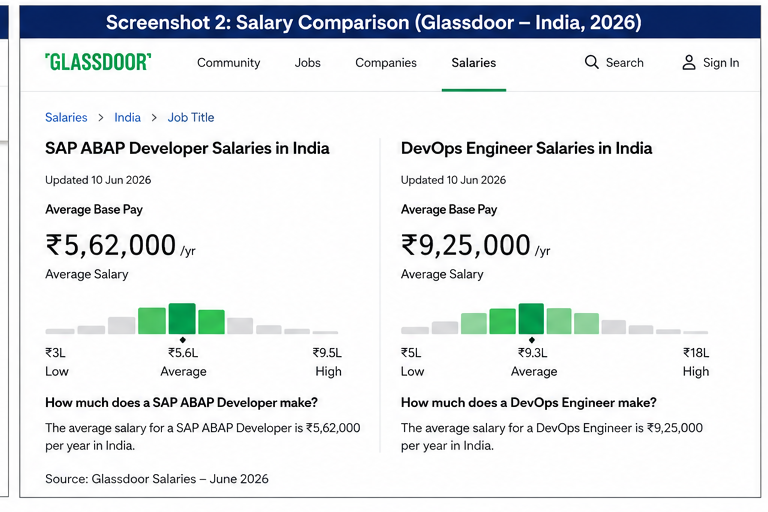
As of 2026, Coursera reports that the average DevOps engineer salary in India is around ₹9.3 lakh per year. On the other hand, Glassdoor data shows the average SAP ABAP developer salary at about ₹5.6 lakh per year based on salary submissions available in June 2026.
At first glance, DevOps seems like the clear winner. And honestly, in many cases, it is.
But salary numbers don’t tell the whole story.
I’ve seen SAP consultants earning far more than the average because they worked on large S/4HANA migration projects. I’ve also seen DevOps engineers struggle because they only knew a few tools and didn’t have hands-on cloud experience. The market rewards skills, not just job titles.
A fresher entering SAP ABAP might start somewhere around ₹3 lakh to ₹6 lakh per year depending on the company and training background. Meanwhile, a DevOps fresher with Linux, AWS, Docker, and CI/CD knowledge may land offers in a similar range, sometimes even higher in product-based companies.
Things become more interesting after a few years.
An SAP ABAP developer who learns modern technologies such as CDS Views, RAP, OData, Fiori, and SAP BTP often sees a noticeable jump in salary. Companies moving to S/4HANA are willing to pay experienced professionals who can solve real business problems instead of simply writing code.
DevOps follows a similar pattern, but the growth can be faster because the demand spreads across many industries. Banks, startups, healthcare companies, e-commerce businesses, and software firms all need cloud and automation specialists. If you gain experience with Kubernetes, Terraform, AWS, Azure, monitoring tools, and security practices, your salary can rise quickly.
Location matters too.
A DevOps engineer working in Bengaluru, Hyderabad, Pune, or Gurgaon will usually earn more than someone in a smaller city. The same goes for SAP professionals. Project type also plays a big role. Supporting an old SAP system won’t pay the same as leading an S/4HANA implementation project.
And then there’s something many people ignore—communication skills.
Two people may have the same technical knowledge, but the one who can explain solutions clearly, handle client discussions, and work confidently with teams often gets promoted faster. I’ve watched this happen more than once.
So, if your only question is, “Which field offers the higher average salary in 2026?” the answer is DevOps.
If your question is, “Which field can help me build a long-term, high-paying career?” then the answer is simpler than you might think: either one can, if you become really good at it.
The highest salaries don’t usually go to people who chase trends. They go to people who build deep expertise and keep learning year after year.
7. Which is Easier to Learn: SAP ABAP or DevOps?
This is probably one of the most common questions people ask when they’re trying to choose between SAP ABAP and DevOps.
The honest answer?
It depends on the kind of work you enjoy.
I’ve seen people learn SAP ABAP in a few months and feel comfortable pretty quickly. I’ve also seen others struggle with it because they found business processes and ERP systems boring. On the flip side, some people love working with servers, automation, and cloud platforms, so DevOps feels exciting to them even though it has a steeper learning curve.
If you’re asking, “Is SAP ABAP easy to learn?” I’d say yes, compared to DevOps.
ABAP is mainly focused on SAP systems. You learn reports, tables, data structures, debugging, enhancements, and business logic. The learning path feels more organized. You’re mostly working inside the SAP environment, so there are fewer moving parts to worry about.
Think of it like learning to drive a car on familiar roads every day. Once you understand the routes, things become predictable.
DevOps feels different.
When I first looked at a DevOps roadmap, honestly, it felt overwhelming. Linux. Networking. Git. Docker. Kubernetes. Cloud platforms. CI/CD. Monitoring. Security. Scripting. The list just kept going.
It’s a bit like being asked to learn driving, car repair, traffic rules, road construction, and GPS systems at the same time.
That’s why many beginners feel DevOps is harder.
The challenge isn’t that any single DevOps tool is impossible to learn. The challenge is the number of skills you need to connect together. One day you’re writing a simple shell script. The next day you’re troubleshooting a Docker container. Then you’re trying to understand why a CI/CD pipeline failed at 2 a.m.
That can be frustrating.
But here’s the interesting part.
Once you build a solid foundation, DevOps opens doors to many different career paths. You can move into cloud engineering, site reliability engineering (SRE), platform engineering, DevSecOps, or cloud architecture.
SAP ABAP is more specialized.
If you enjoy structured work, business applications, and solving ERP-related problems, ABAP may feel much easier and more comfortable. Many freshers who come from non-networking backgrounds find ABAP less intimidating because they don’t need to learn Linux administration or cloud infrastructure right away.
So, SAP ABAP or DevOps for freshers?
If your goal is to get into a niche enterprise technology and you like business-focused development, SAP ABAP can be a smoother starting point.
If you’re curious about cloud computing, automation, servers, and modern software delivery, DevOps may be worth the extra effort.
Neither path is wrong.
One is generally easier to learn in the beginning. The other offers a wider technical playground.
The best choice isn’t the one that looks easier on YouTube videos. It’s the one you’ll still enjoy learning six months from now when the excitement wears off and real work begins.
Read More: Can I Get a Fresher Software Job After 15 Years Career Gap?
8. Future Scope: ABAP on HANA vs Cloud DevOps
A few years ago, if someone told me they were learning SAP ABAP, I would’ve said, “Good choice. Big companies always need SAP developers.”
Today, my answer is a little different.
I’d still say SAP ABAP is a good career. But I’d also add something important: old-school ABAP alone isn’t enough anymore.
The SAP world has changed. Businesses are moving to SAP S/4HANA, cloud platforms, and modern applications. Companies aren’t looking for developers who only know traditional reports and classical programming techniques. They want people who can work with newer technologies too.
That’s where things like ABAP on HANA, CDS Views, AMDP, RAP, OData services, Fiori apps, and SAP BTP (Business Technology Platform) come into the picture.
Think of it like owning a mobile phone from ten years ago. It still works, but most people now expect smartphones with apps, cameras, internet, and all the extra features. ABAP is going through something similar.
A developer who understands modern SAP technologies has a much better chance of staying valuable in the coming years.
I recently spoke with a friend who works in an SAP implementation project. He told me that most of their new work isn’t focused on traditional ABAP reports anymore. Clients are asking for Fiori applications, cloud integrations, APIs, and faster analytics powered by HANA databases.
That’s a pretty clear signal about where SAP is heading.
Now let’s talk about DevOps.
Honestly, DevOps feels like it’s everywhere right now.
Almost every company building software needs some form of automation, cloud infrastructure, deployment pipelines, monitoring, security controls, or system management. That’s exactly where DevOps professionals fit.
Years ago, developers would write code and simply hand it over to operations teams. The process was slow and sometimes messy. Today, businesses want software released faster and with fewer problems.
That’s one reason DevOps became so popular.
According to Atlassian, DevOps focuses on bringing development and operations teams together through automation and collaboration. When you look at modern hiring trends, that definition makes a lot of sense. Companies want people who can help software move from development to production smoothly and safely.
And the scope keeps growing.
A DevOps engineer in 2026 may not spend all day working with just Jenkins or deployment pipelines. They could be dealing with cloud platforms, security automation, infrastructure as code, monitoring systems, containers, and even AI-powered operations tools.
You’ll hear terms like:
- Kubernetes
- Docker
- Terraform
- DevSecOps
- Site Reliability Engineering (SRE)
- Platform Engineering
- Cloud Automation
At first glance, that list can feel overwhelming. I remember seeing those names myself and wondering if I needed to learn everything at once.
You don’t.
Most professionals build their skills gradually. One tool leads to another. One project teaches something new. Before long, the puzzle pieces start fitting together.
The interesting part is how artificial intelligence is affecting both careers.
Many people ask, “Will AI replace DevOps engineers?”
Personally, I don’t think so.
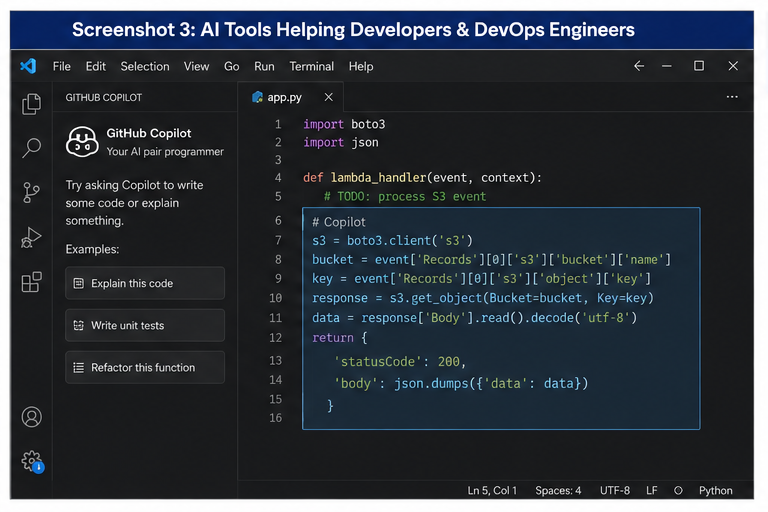
AI can automate repetitive tasks. It can suggest code, identify issues, and even help generate infrastructure scripts. But when production systems fail at 2 AM and thousands of users can’t access an application, businesses still need experienced people making decisions.
The same thing applies to SAP.
AI may help generate ABAP code or automate documentation, but understanding business processes, SAP architecture, integrations, compliance requirements, and customer needs still requires human expertise.
What I do think will happen is this: professionals who learn to work alongside AI will move ahead faster than those who ignore it.
So, will SAP ABAP survive in the future?
Yes. But modern SAP skills will matter much more than traditional ABAP knowledge alone.
Will DevOps continue growing?
Most likely, yes. As companies move deeper into cloud computing, automation, cybersecurity, and digital transformation, the need for DevOps-related skills is expected to remain strong.
If I had to summarize it in one simple sentence, I’d say this:
SAP ABAP offers strong opportunities inside the SAP ecosystem, while DevOps offers broader opportunities across almost every technology industry.
Neither path is disappearing anytime soon.
The real winner will be the person who keeps learning, adapts to new technology, and doesn’t get stuck using only the skills that worked ten years ago.
9. Best Choice for Freshers
This is probably the biggest question many freshers ask after finishing their degree.
I know because I’ve seen people spend weeks jumping between YouTube videos, Reddit discussions, and career advice from friends. One person says DevOps is the future. Another says SAP jobs are stable. After a while, it gets confusing.
The truth? There isn’t one perfect answer for everyone.
If you’re a fresher who wants more job options across different industries, DevOps is usually the safer bet in 2026. Almost every software company uses cloud platforms, automation tools, Git repositories, and deployment pipelines. That means DevOps skills can open doors in startups, product companies, service companies, and even large multinational organizations.
But don’t make the mistake of thinking DevOps is something you can learn in a weekend.
You’ll need to get comfortable with Linux, basic networking, Git, cloud platforms like AWS or Azure, and a little scripting. At first it can feel like you’re learning ten different things at the same time. Honestly, many beginners feel overwhelmed during the first few months. That’s completely normal.
SAP ABAP is a different story.
The number of SAP companies is much smaller compared to the overall IT market, but businesses that run SAP systems still need ABAP developers. Banks, manufacturing companies, retail giants, and global enterprises continue to invest heavily in SAP projects.
If you already have access to SAP training, a good mentor, or an opportunity to join a SAP implementation or support project, ABAP can be a very stable career path. Once you gain experience, companies often struggle to find skilled SAP professionals, especially those who understand modern technologies like S/4HANA, CDS Views, RAP, and Fiori.
A simple way to look at it is this:
DevOps gives you a wider highway with more traffic and more destinations.
SAP ABAP gives you a narrower road, but the people traveling on it are usually specialists.
If my younger brother or cousin asked me today, “What should I learn as a fresher?” I’d probably recommend DevOps first because it provides broader opportunities and flexibility. But if they already had a real SAP project waiting for them, I wouldn’t hesitate to suggest SAP ABAP either.
At the end of the day, the best career isn’t always the one with the most job postings. It’s the one you’ll enjoy learning long enough to become really good at.
10. Best Choice for Experienced Professionals
If you’ve already spent 10 years or more in IT, choosing between SAP ABAP and DevOps feels very different compared to someone just starting their career.
At this stage, you’re probably not asking, “Which technology is easier?” You’re asking, “Where can I grow from here?” That’s a much smarter question.
I’ve seen many experienced developers reach a point where they feel stuck. The salary grows slowly. The work starts feeling repetitive. The excitement they had during their first few years in IT just isn’t there anymore. That’s usually when people begin looking at new directions.
For SAP ABAP professionals, the good news is that there is still a strong path forward. The old days of only creating reports and enhancements are fading, though. Companies moving to S/4HANA need people who understand modern SAP technologies such as CDS Views, RAP, Fiori, OData services, and SAP BTP.
A developer with 10+ years of ABAP experience can move toward roles like SAP Technical Architect, S/4HANA Consultant, SAP Solution Architect, or SAP BTP Developer. These positions involve much more than coding. You’ll be discussing business requirements, designing solutions, and helping companies make important technical decisions.
One of my former colleagues followed this path. He spent nearly twelve years working in ABAP. Instead of switching completely out of SAP, he learned S/4HANA and SAP BTP. Today, he spends less time writing code and more time guiding project teams. His salary increased, but more importantly, his work became much more interesting.
Now let’s talk about DevOps.
DevOps attracts many experienced software engineers because it opens doors to cloud technologies. If you enjoy automation, problem-solving, Linux systems, and infrastructure, DevOps can be a very rewarding move.
A successful DevOps engineer can grow into roles such as Cloud Architect, Site Reliability Engineer (SRE), Platform Engineer, DevOps Lead, or even DevOps Manager. These jobs are becoming more common as companies move their applications to cloud platforms like AWS, Azure, and Google Cloud.
That said, switching from SAP ABAP to DevOps isn’t a small jump. You’ll need to learn Linux, cloud platforms, containers, CI/CD pipelines, monitoring tools, networking basics, and automation scripting. The learning curve can feel steep at first. There were times when I looked at a Kubernetes dashboard and wondered if I had accidentally opened a spaceship control panel.
So which path is better?
Honestly, there isn’t one answer for everyone.
If you enjoy business processes, enterprise systems, and working inside the SAP ecosystem, staying with SAP and moving toward S/4HANA, BTP, or architecture roles makes a lot of sense.
If cloud computing, automation, and infrastructure excite you more than ERP systems, DevOps can create a wider range of opportunities.
The best career move usually isn’t the one that’s trending on YouTube this month. It’s the one that matches what you genuinely enjoy doing every day. Because after ten years in IT, job satisfaction starts mattering almost as much as salary.
Read More: What Coding Languages Should Freshers Learn in 2026 for Software Jobs?
11. Learning Roadmap for SAP ABAP in 2026
If you’re thinking about becoming an SAP ABAP developer in 2026, the good news is that the learning path is much clearer than it was a few years ago. The bad news? You can’t stop at learning only traditional ABAP anymore.
I’ve seen many people spend months learning old ABAP reports and then wonder why companies aren’t calling them for interviews. The SAP world has changed quite a bit. Businesses are moving toward SAP S/4HANA, cloud solutions, and modern application development. So your roadmap needs to match what companies are actually using.
Start with the basics. Learn Core ABAP first. This is your foundation. Get comfortable with internal tables, loops, modularization, data types, function modules, and database operations. Don’t rush this stage. Every advanced topic later depends on how well you understand these fundamentals.
After that, spend time learning DDIC (Data Dictionary). Tables, views, domains, data elements, and search helps are things you’ll use almost every day as an ABAP developer. It may not sound exciting, but trust me, you’ll be glad you know it when working on real projects.
Next, learn how to create different kinds of reports. Start with simple reports and then move to ALV reports. Most SAP projects still use ALV because it gives users clean and organized data displays. I remember spending hours fixing report layouts during my early SAP days. It wasn’t glamorous work, but it taught me a lot.
Once you’re comfortable there, move into Object-Oriented ABAP (OO ABAP). Many modern SAP developments use classes and objects instead of old procedural coding. If you’ve worked with Java or C#, the concepts will feel familiar.
Then comes a skill every ABAP developer needs but nobody gets excited about—debugging. At first, debugging can feel frustrating. You’re staring at hundreds of lines of code wondering what went wrong. But over time it becomes almost like detective work. Companies value developers who can quickly find and fix issues.
The next step is understanding SAP integrations. Learn BAPIs, BADIs, IDocs, and RFCs. These tools help SAP systems communicate with other applications and allow developers to extend standard SAP functionality. Many real-world SAP projects rely heavily on these concepts.
Now you can start moving into the modern SAP world.
Learn CDS Views and AMDP. These are important for SAP HANA performance optimization. Companies working on S/4HANA projects often expect ABAP developers to understand them.
After that, explore OData services because they connect backend SAP systems with modern applications. This knowledge becomes even more valuable when you start learning SAP Fiori basics. Fiori is the user interface many organizations use today instead of traditional SAP screens.
One of the newest and most promising skills is RAP (RESTful Application Programming Model). RAP is becoming a preferred way to build modern SAP applications. If you’re targeting future SAP development roles, don’t skip it.
Finally, spend time learning SAP BTP (Business Technology Platform). More companies are adopting cloud-based SAP solutions, and BTP sits right in the middle of that transformation. Developers who understand both ABAP and BTP are becoming increasingly valuable.
If I were starting from scratch in 2026, I’d follow this order:
Core ABAP → DDIC → Reports → ALV → OO ABAP → Debugging → BAPI/BADI → IDoc/RFC → CDS Views → AMDP → OData → Fiori → RAP → SAP BTP
Don’t try to learn everything in one month. That’s usually where people burn out. Take one step at a time. Build small projects. Break things. Fix them. That’s honestly how most of us learned.
SAP ABAP is still a strong career path, but the developers getting the best opportunities today are the ones who combine traditional ABAP skills with modern S/4HANA, cloud, and SAP BTP knowledge.
12. Learning Roadmap for DevOps in 2026
If you’re thinking about becoming a DevOps engineer in 2026, you might be wondering where to start. I get it. When I first looked at a DevOps roadmap, it felt like someone dumped fifty different technologies onto one page and said, “Good luck.”
The truth is much simpler.
You don’t need to learn everything at once. In fact, trying to learn everything together is one of the biggest mistakes beginners make. DevOps is more like building a house. You start with the foundation and then add one layer at a time.
Start with Linux
Almost every DevOps job touches Linux in some way. Servers run on Linux. Cloud systems run on Linux. Containers often run on Linux.
You don’t have to become a Linux wizard overnight.
Learn how to navigate directories, create files, check logs, manage users, and understand permissions. Get comfortable with commands like ls, cd, grep, find, and chmod.
At first, the black terminal screen might look scary. After a few weeks, you’ll probably spend more time there than in a graphical interface.
Learn Basic Networking
Many people skip networking and regret it later.
Imagine a website is down. How will you fix it if you don’t know how computers talk to each other?
Learn IP addresses, DNS, HTTP, HTTPS, ports, load balancers, and firewalls. You don’t need a networking degree. Just understand how requests travel from a user’s browser to a server.
That knowledge saves hours of confusion later.
Get Comfortable with Git
Every development team uses Git.
Learn how to clone repositories, create branches, commit changes, merge code, and resolve conflicts.
The first merge conflict can feel like a disaster. Trust me, everybody breaks something at least once. It’s almost a rite of passage.
Learn Shell Scripting and Python
Automation is the heart of DevOps.
If you’re manually doing the same task every day, you’re wasting time.
Start with Bash shell scripting. Write simple scripts to automate file cleanup, backups, or system checks.
Then move to Python. You don’t need to become a software developer. Just learn enough to automate repetitive tasks, work with APIs, and process data.
Understand Containers with Docker
Docker changed how software is built and deployed.
Instead of saying, “It works on my machine,” developers package applications into containers that run the same everywhere.
Learn how to create Docker images, run containers, manage volumes, and use Docker Compose.
This is where DevOps starts feeling really practical.
Learn Kubernetes
Once companies have hundreds or thousands of containers, managing them manually becomes impossible.
That’s where Kubernetes comes in.
Honestly, Kubernetes can feel overwhelming at first. Most beginners stare at Pods, Deployments, and Services and wonder what planet they’re on.
Take it slowly.
Understand the basic concepts before worrying about advanced topics.
Build CI/CD Pipelines
One of the main goals of DevOps is releasing software faster and more safely.
Learn tools like Jenkins and GitHub Actions.
Create simple pipelines that automatically build, test, and deploy applications whenever code changes are pushed.
The first time you click “Push” and watch everything deploy automatically, it’s a pretty satisfying moment.
Learn Infrastructure as Code with Terraform
Many companies no longer create cloud servers manually.
Instead, they write code that creates entire environments automatically.
Terraform is one of the most popular tools for this.
Learn how to create virtual machines, networks, storage, and cloud resources using configuration files.
It feels strange at first, but it’s incredibly powerful.
Learn Cloud Platforms
Most modern DevOps jobs involve cloud computing.
AWS is still the most widely used platform, but Azure and Google Cloud are also growing quickly.
Start with one cloud provider. Don’t try to master all three at the same time.
Learn virtual machines, storage, networking, IAM, monitoring, and security basics.
Once you understand one cloud platform, learning another becomes much easier.
Monitoring, Security, and Incident Management
A DevOps engineer’s job doesn’t end after deployment.
You also need to know when things break.
Learn monitoring tools such as Prometheus and Grafana. Understand logging, alerts, and performance metrics.
Spend time learning security too. Basic vulnerability scanning, access control, secrets management, and secure configurations are now expected skills.
And yes, systems will fail sometimes. That’s normal.
Good DevOps engineers don’t panic during incidents. They investigate calmly, find the root cause, fix the issue, and document what happened so the same problem doesn’t happen again.
Read More: How to Get DevOps Software Job in 2026?
The Real Secret
A lot of people search for the perfect DevOps roadmap in 2026.
Honestly, there isn’t one.
The best roadmap is the one you actually follow.
Learn Linux. Add networking. Learn Git. Pick up scripting. Move into Docker, Kubernetes, CI/CD, Terraform, and cloud platforms. Build projects along the way.
Don’t spend six months watching tutorials without touching a keyboard.
Break things. Fix them. Make mistakes. That’s how real learning happens.
And before you realize it, you’ll stop feeling like someone studying DevOps and start feeling like a DevOps engineer.
13. Final Verdict: SAP ABAP vs DevOps — Which Has More Opportunities?
If someone asked me this question over a cup of tea, my answer would be pretty simple.
DevOps has more overall opportunities in 2026. There are thousands of companies moving their applications to the cloud, automating deployments, improving security, and managing complex infrastructure. Because of that, DevOps skills are needed almost everywhere—from startups with 20 employees to global companies with thousands of workers.
SAP ABAP is a little different.
The demand is definitely there, but it’s more specialized. Companies that run SAP systems still need ABAP developers to customize applications, build reports, create integrations, and support large business processes. On top of that, many organizations are still working on SAP S/4HANA migration projects, which keeps experienced ABAP professionals busy.
So does that mean DevOps is automatically the better choice?
Not really.
I’ve seen people chase a popular technology simply because everyone else was doing it. A year later, they were frustrated because they didn’t enjoy the work. That’s something many beginners don’t think about.
If you enjoy business processes, ERP systems, and working closely with finance, sales, supply chain, or HR teams, SAP ABAP can be a very rewarding career. The competition is often lower because it’s a niche field, and experienced SAP professionals are usually valued highly by companies.
On the other hand, if you get excited about cloud platforms, Linux, automation, containers, scripting, and solving infrastructure problems, DevOps may feel much more interesting. The learning curve can be steeper, but the job market is wider.
For freshers, DevOps often provides access to a larger number of openings across different industries. For experienced SAP professionals, staying in the SAP ecosystem and upgrading skills in S/4HANA, RAP, CDS Views, Fiori, and SAP BTP can be a smart move.
At the end of the day, there isn’t one perfect answer for everyone.
Choose DevOps if you want broader opportunities and don’t mind learning many tools. Choose SAP ABAP if you prefer a specialized enterprise career with deep business knowledge.
The best career isn’t always the one with the most job postings. It’s the one you can see yourself working on five years from now without waking up every morning thinking, “I really don’t want to do this today.”
That’s usually the choice that works out best in the long run.
FAQs
Is SAP ABAP better than DevOps in 2026?
Honestly, there isn’t one answer that fits everyone.
If you enjoy working with business applications, ERP systems, and large enterprise companies, SAP ABAP can still be a solid career. Many companies are moving to SAP S/4HANA, and they need skilled ABAP developers to customize and maintain those systems.
DevOps, on the other hand, opens doors to a much wider technology world. Cloud computing, automation, containers, CI/CD, and infrastructure management are being used almost everywhere.
From a pure job numbers perspective, DevOps has more opportunities in 2026. But if you already have SAP experience or love working in the SAP ecosystem, ABAP can be a very rewarding path too.
I usually tell people this: don’t choose based only on job counts. Choose something you’ll actually enjoy learning every day.
Is DevOps a programming language?
No. This is one of the biggest misunderstandings beginners have.
DevOps is not a programming language like ABAP, Python, Java, or C#.
Think of DevOps as a way of building, testing, deploying, and managing software more efficiently. A DevOps engineer uses many tools and technologies together.
For example, a DevOps professional may work with:
- Linux
- Git
- Docker
- Kubernetes
- AWS or Azure
- Jenkins
- Terraform
- Python or Shell scripting
So when people compare SAP ABAP and DevOps, they are actually comparing a programming language and enterprise platform with a technical career path.
Is SAP ABAP still in demand?
Yes, absolutely.
Every few years, people start saying SAP ABAP is dead. Then companies continue hiring ABAP developers and consultants.
The reality is that thousands of large organizations around the world still run their businesses on SAP. Banks, manufacturing companies, retail giants, telecom companies, and government organizations depend heavily on SAP systems.
What has changed is the type of ABAP skills companies want.
Today, employers look for developers who understand:
- S/4HANA
- CDS Views
- RAP Model
- OData Services
- SAP Fiori
- SAP BTP
Traditional ABAP alone may not be enough anymore. Modern ABAP skills are where the opportunities are.
Can an ABAP developer learn DevOps?
Definitely.
In fact, many experienced ABAP developers successfully move into cloud and DevOps-related roles.
The good thing is that ABAP developers already understand programming logic, debugging, deployments, transports, and enterprise environments. That experience helps more than people think.
The learning curve comes from areas like:
- Linux
- Networking
- Cloud platforms
- Containers
- Automation tools
I’ve seen professionals with 8–10 years of SAP experience start learning AWS and Docker on weekends and gradually build a second career path. It takes effort, but it’s completely possible.
Which is better for freshers, SAP ABAP or DevOps?
For most freshers, DevOps usually provides more flexibility.
A DevOps learner can apply for roles in startups, software companies, cloud teams, product companies, and consulting organizations.
SAP ABAP jobs are often tied to companies running SAP projects, so entry opportunities can be more limited.
That doesn’t mean ABAP is a bad choice. If you get access to proper SAP training, a real SAP project, or an internship, ABAP can still lead to a stable and long-term career.
For someone starting from zero with no specific direction, DevOps often offers more paths to explore.
Which has better salary, SAP ABAP or DevOps?
Salary depends on much more than the technology itself.
Experience, communication skills, certifications, project exposure, location, and company size all play a role.
That said, DevOps professionals often command higher salaries because cloud infrastructure and automation skills are in high demand across industries.
A skilled SAP ABAP consultant working on S/4HANA projects can also earn an excellent income.
I’ve personally seen people in both fields earn very well. The common factor wasn’t the technology. It was expertise.
Someone who becomes really good at what they do almost always earns more than someone who only knows the basics.
Will AI replace SAP ABAP or DevOps jobs?
I don’t think AI will completely replace either role anytime soon.
AI can already generate code snippets, suggest scripts, and automate repetitive tasks. That’s true.
But businesses don’t hire people just to write code.
They hire people to solve problems.
A company migrating a billion-dollar SAP system isn’t going to hand everything over to AI. The same applies to cloud infrastructure, security, production incidents, and business-critical deployments.
What AI will do is change how people work.
Developers and DevOps engineers who learn to use AI tools will probably become faster and more productive. Those who ignore AI may find themselves struggling to keep up.
Which career is better for India in 2026?
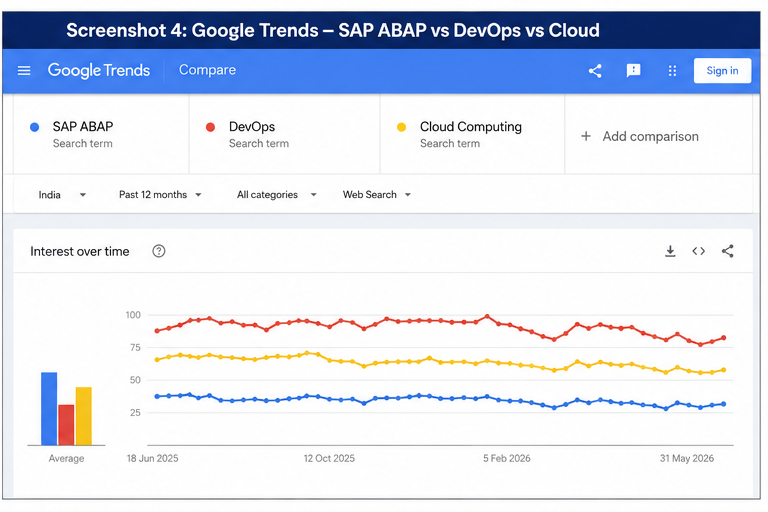
If we’re looking purely at market size, DevOps probably has the edge.
India continues to see strong growth in cloud computing, SaaS companies, digital transformation projects, and startup ecosystems. All of these need DevOps professionals.
At the same time, SAP remains deeply rooted in many large Indian enterprises and multinational companies. SAP consultants and ABAP developers are still needed, especially for S/4HANA migration projects.
My personal view?
If you want the broadest range of opportunities, DevOps is hard to ignore in 2026.
If you prefer enterprise systems, business processes, and long-term consulting careers, SAP ABAP remains a strong and reliable option.
Neither choice is wrong. The best career is usually the one you can stay interested in for the next five or ten years.




Leave a Reply