You can increase topical authority without backlinks when your site becomes clear, useful, and deep on one subject.
Backlinks still help, but they are not your only road to Google.
Topical authority means this: Google sees your site as a strong source for one topic, not just one keyword.
So, do not write random posts; build a small topic library that answers every real question around your niche.
Start with one main guide, then add supporting posts, clear internal links, simple examples, and fresh updates.
Also, use related words, tools, names, steps, and FAQs so Google can understand your topic map better.
AI search makes this even more important now.
Google says AI Overviews help people understand complex questions faster and explore useful links, so your content must be complete enough to cite.
Key point: you can increase topical authority without backlinks, but only if your content proves depth, trust, and real usefulness.
What Is Topical Authority?
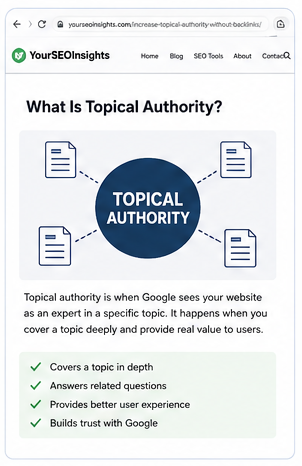
Topical authority in SEO means your site looks strong in one clear subject.
In simple words: Google can see that you do not write one random post and leave.
You cover the topic from many useful angles: basics, how-to guides, mistakes, tools, examples, and common questions.
So, when someone searches many related terms, your site feels like a trusted place.
Topical Authority vs Domain Authority
| Term | Simple meaning | What it shows |
|---|---|---|
| Domain authority | A third-party SEO score | How strong a whole website may look |
| Topical authority | Topic-level trust | How deeply your site covers one subject |
Here is the key point: domain authority is broad, but topical authority is focused.
For example, a small site only about technical SEO for SaaS can beat a big marketing blog on that exact topic.
Why? Because the small site may answer the topic better, deeper, and with more useful internal links.
How Google Understands Topic Depth
Google does not judge one page alone.
It uses automated ranking systems and many signals to find useful, relevant results from hundreds of billions of pages.
So, your job is simple: make your pages connect like a clean map.
One main guide should link to smaller guides, and each smaller guide should link back.
Key Points
- Topical authority means expertise around one subject.
- It is not the same as domain authority.
- A focused small site can beat a broad large site.
- Google looks at relevance, usefulness, and many signals.
- Strong internal links help Google understand your topic map.
In short, topical authority in SEO grows when you cover one topic so well that both readers and Google know what your site is truly about.
Why Backlinks Are Not the Only Authority Signal
Backlinks still help, but topical authority vs backlinks is not a one-way fight. You can rank faster when your site answers one topic better than scattered, bigger sites.
Google says its systems aim to reward helpful, reliable, people-first content. So, your page must solve the search, not just collect links.
Here is the simple truth: a backlink is a vote, but content depth is proof. If you cover a narrow topic with clear answers, examples, and internal links, Google gets stronger context.
Many SEOs still say backlinks are essential. And yes, Ahrefs found that 96.55% of pages get no Google traffic, with backlinks being one useful factor.
But I have seen small sites win long-tail searches without big links. They win because they answer every small question in one tight topic.
Use this simple rule:
| If your niche is | What matters more |
|---|---|
| Low competition | Topical depth and internal links |
| Local service | Clear pages, proof, reviews |
| SaaS blog | Use cases and comparison pages |
| Finance, health, legal | Brand trust, experts, links |
So, do not treat backlinks as a magic button. First, build a clean topic cluster, link pages together, and answer real user questions.
Then, earn links naturally with useful assets: checklists, templates, data, case studies, and original examples. This is safer than buying weak links.
But be careful in YMYL niches like health, money, and law. There, topical authority vs backlinks is not enough; you also need expert proof, brand trust, and strong citations.
Build a Topical Map Before Writing Anything
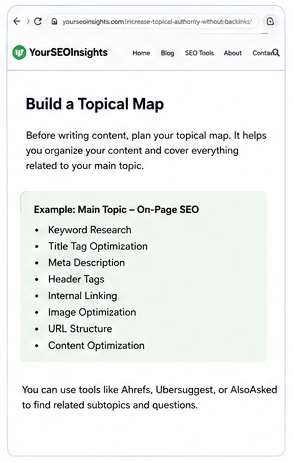
A topical map helps you build topical authority without backlinks before you write a single post. It gives your site a clear path: one topic, one main page, and many useful support pages.
First, choose one narrow topic. Do not start with “SEO”; start with “topical authority for new blogs.”
Then, break that topic into real search needs. Use subtopics, questions, comparisons, tools, mistakes, examples, and buyer-intent pages.
Here is a simple topical map:
| Page type | Page idea | Search intent |
|---|---|---|
| Core topic | Topical authority | Learn the topic |
| Pillar page | How to build topical authority | Step-by-step guide |
| Cluster page | Topical authority vs backlinks | Compare options |
| Cluster page | Topical authority checklist | Take action |
| Cluster page | Internal linking for topical authority | Improve site structure |
| Cluster page | Semantic SEO for topical authority | Cover related meaning |
| Cluster page | How many blog posts to build topical authority | Plan content volume |
| Cluster page | Topical authority for new websites | Start from zero |
| Cluster page | Topical authority mistakes | Avoid failure |
| Cluster page | Topical authority case study | See proof |
This structure works because Google does not see only one page. It sees how your pages connect and how deeply you cover one subject.
Ahrefs says topic clusters should group related pages by search intent. It also recommends keyword research, pillar pages, cluster pages, internal links, freshness, and performance tracking.
Here is the practical rule: write the pillar page first. Then write 8 to 15 cluster pages that answer smaller questions around it.
Do not chase every keyword you find. Pick keywords that support the same topic, the same reader, and the same end goal.
Use these Google searches while building your map:
- how to create a topical map
- topical map example
- topic cluster keyword research
- how many pages for topical authority
My strong opinion: a small, tight topical map beats a huge random blog. If your site feels like a neat notebook, Google and readers understand it faster.
So, before writing, draw the map on paper. This one step makes topical authority without backlinks easier, cleaner, and much less risky.
Create Pillar and Cluster Content
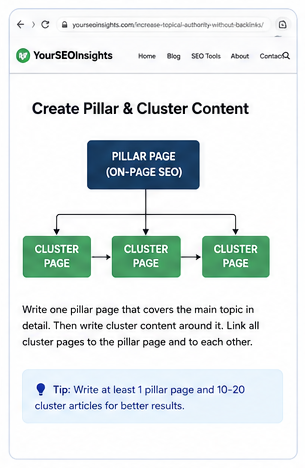
You build pillar and cluster content when you want Google to see your site as a real guide, not a random blog.
Think of it like a small library: one main shelf, then many useful books under it.
What Is a Pillar Page?
A pillar page explains the big topic in one place.
It gives the reader the full map, but it does not answer every small question deeply.
Example: “How to Build Topical Authority” can be your pillar page.
Then, each small question becomes a separate cluster page.
What Are Cluster Pages?
Cluster pages answer one clear question very deeply.
For example: “internal linking for topical authority” or “how many articles for topical authority.”
Each cluster page must support the pillar page.
Also, each cluster page must link back to the pillar page with clear anchor text.
Simple Content Hub Plan
| Page type | Job | Example |
|---|---|---|
| Pillar page | Covers the broad topic | How to Build Topical Authority |
| Cluster page | Answers one narrow question | Topic Cluster SEO Example |
| Internal link | Connects related pages | Link cluster back to pillar |
Google says helpful content should serve people first, not just search engines. So, your cluster pages must solve real problems, not just repeat keywords.
My Practical Rule
Start with 1 pillar page + 10 to 20 cluster articles.
Do not judge results after 3 posts, because Google needs a clear pattern.
HubSpot also describes topic clusters as a model where focused pages link back to one broad pillar page. This helps search engines understand the full topic better.
Key Points
- Pick one main topic first.
- Write one strong pillar page.
- Add 10 to 20 deep cluster pages.
- Link every cluster page back to the pillar.
- Link related cluster pages to each other.
- Track results after 60 to 120 days.
In simple words, pillar and cluster content helps you build topical authority without chasing backlinks first.
Use Semantic SEO Instead of Keyword Stuffing
Semantic SEO for topical authority means you do not repeat one keyword again and again.
Instead, you cover the full topic in a natural way.
Google wants helpful content made for people, not pages made only to trick search rankings.
So, write like you are helping one real reader solve one real problem.
What to Add Around Your Main Keyword
Do not stop with one phrase like “topical authority.”
Add the words, ideas, and steps that belong around it.
Use these naturally:
- Content clusters
- Internal links
- E-E-A-T
- Search intent
- Topical maps
- Schema
- Content freshness
- AI Overviews
- Entity SEO
- Semantic keywords
For example, if you write about topical authority, show how a pillar page connects with 10 small cluster posts.
Then show how internal links guide Google and readers through the full topic.
A Simple Way to Use Semantic Keywords
Think like a teacher, not like a keyword tool.
Ask: “What must the reader know before they can use this?”
| Add this | Why it helps |
|---|---|
| Related tools | Shows practical use |
| Examples | Makes the idea clear |
| Questions | Matches real searches |
| Steps | Helps readers act |
| Mistakes | Adds real experience |
| Timelines | Sets clear expectations |
This is how topical relevance SEO works in real life.
You build meaning around the topic, not noise around one keyword.
Add Information Gain
Here is my strong view: most SEO posts fail because they sound complete but teach nothing new.
They define the term, add five tips, and leave the reader stuck.
Add something your competitor missed: a 30-day plan, a before-and-after example, a mistake list, or a small use case.
For example: “I updated one weak post by adding FAQs, internal links, and missing entities; impressions started moving after 21 days.”
Final Takeaway
Use semantic SEO for topical authority by writing around the full problem, not just the keyword.
When your page answers the topic better, cleaner, and deeper, both readers and search engines understand why it deserves trust.
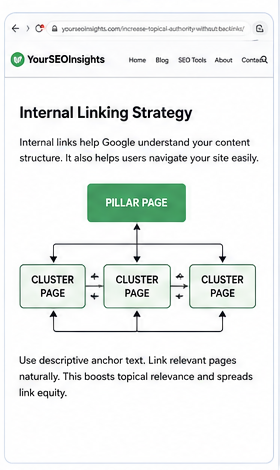
Strengthen Internal Linking Like a Topic Graph
Internal linking for topical authority is simple: you help Google and readers see how your pages connect. Think of your site like a small village, not a pile of loose papers.
Start With One Pillar Page
Your pillar page is the main road. It should link to every useful cluster page on the same topic.
For example, your page on “topical authority” can link to pages about content clusters, semantic SEO, anchor text, and ranking without backlinks.
Link Every Cluster Back
Each cluster page must link back to the pillar page. This tells Google: “This page belongs to this main topic.”
Do not use weak words like “click here.” Use clear anchor text like “topical authority checklist” or “internal linking for topical authority.”
Connect Related Cluster Pages
Next, link cluster pages to each other. This helps readers move to the next useful answer.
Use this simple rule:
| Page type | Link to |
|---|---|
| Pillar page | All cluster pages |
| Cluster page | Pillar page |
| Related cluster | Next helpful cluster |
Place Links Where They Help
Add links when the reader may ask the next question. Do not force links at random places.
SpyFu says topical authority helps build a better internal link structure across related pages, and strong structure can help visitors explore deeper. Google also recommends using clear anchor text that helps users understand the linked page.
Key Points
- Link pillar pages to cluster pages.
- Link cluster pages back to the pillar.
- Link related pages together.
- Use clear anchor text.
- Add links where they help the next step.
Internal linking for topical authority works best when every link feels useful, natural, and planned.
H2: Add E-E-A-T Without Backlinks
You can build E-E-A-T without backlinks by showing real proof. Google says content should help people first, not trick search engines.
First, add a short author bio under each post. Say who wrote it, what they have done, and why the reader can trust them.
Next, show real work. Add your own screenshots, test notes, small case studies, and lessons learned.
For example, do not just say “internal links help.” Show how you added 12 internal links to 5 old posts and tracked clicks for 30 days.
Also, cite trusted sources. Use Google Search Central, official studies, known SEO experts, and fresh data from the current year.
Then, add a “Last updated” date. This tells readers you care about accuracy, not just traffic.
| E-E-A-T Signal | What You Should Add |
|---|---|
| Experience | Real tests, screenshots, results |
| Expertise | Clear steps and correct advice |
| Authority | Trusted sources and expert quotes |
| Trust | Honest limits and update date |
Be honest about limits too. If a method takes 3 to 6 months, say that clearly.
My strong view is simple: fake authority dies fast. Real proof, clear writing, and useful examples last longer than cheap links.
So, use E-E-A-T without backlinks as your trust engine. Help the reader solve one real problem, and Google has more reason to trust your page.
Answer Real User Questions From Communities
Your topical authority without backlinks grows faster when you listen before you write. Real users on Reddit, YouTube, Facebook, and X do not ask perfect SEO questions; they ask messy, honest questions.
What People Ask on Reddit
Reddit users now ask one clear thing: “How do I build topical authority when AI Overviews and LLMs answer so much?” Many also ask if they should write blogs, how-to guides, or support pages first.
So, start with pain-based content. Answer the exact question, then link it to your main topic page.
What YouTube Creators Teach
YouTube SEO creators focus on 2026 content systems. They talk about one authority zone, then topic clusters around beginner, expert, mistakes, fixes, and frameworks.
Use this same idea on your blog. Pick one small topic, then cover every useful angle.
What Facebook SEO Groups Discuss
Facebook SEO groups often discuss ranking with few backlinks. The common pattern is simple: narrow topic, long-tail keywords, and strong internal links.
That means you should not chase broad keywords first. Go after small questions that real buyers search.
What X Debates Show
On X, SEO people still fight over backlinks vs topical authority. Some say backlinks are still needed; others say deep niche content can reduce backlink pressure.
The smart move is this: do not ignore backlinks, but do not wait for them. Build topical authority without backlinks first, then let useful content earn mentions naturally.
Key Takeaway
Real communities tell you what keyword tools miss. Use their questions as your content map, and your site starts sounding like a real expert.
Update and Expand Existing Content
Content refresh SEO is not “change the date and pray.”
You update the page because the reader needs a better answer now.
Old posts decay fast; facts change, tools change, and search pages change.
So, check your key posts every 3 to 6 months.
Start with pages that lost clicks, rank lower, or get fewer calls, leads, or sales.
Then open Google Search Console and compare the last 3 months with the 3 months before.
Add what is missing:
- New FAQs from Google, Reddit, Quora, and YouTube comments
- Fresh examples from your own work
- New stats from 2025 or 2026
- Better tools, steps, screenshots, and use cases
- Strong internal links to related cluster pages
Also, remove weak parts.
Thin content hurts topical authority because it makes your site look half-built.
Merge two weak posts when they answer the same search intent.
For example, combine “content decay SEO” and “how often to update blog posts for SEO” if both repeat the same advice.
Use this simple refresh table:
| Page problem | Best fix |
|---|---|
| Old facts | Add fresh data |
| Low clicks | Rewrite title and intro |
| Thin answer | Add examples and FAQs |
| Duplicate posts | Merge and redirect |
| No next step | Add internal links |
Do not chase only rankings now.
Ahrefs reported that AI Overviews reduced clicks to top-ranking content by 34.5% in 2025, and newer 2026 data shows even sharper CTR pressure on AI-heavy queries.
So, optimize for visibility too.
Make your page useful enough to be quoted, linked, saved, shared, and mentioned.
My rule is simple: update old content before writing new content.
That is the cleanest content refresh SEO habit for growing topical authority without backlinks.
Measure Topical Authority Without a Fake Score
There is no official Google topical authority score. So, do not chase one magic number.
Instead, measure topical authority without backlinks by watching clear signs. These signs show if Google sees your site as useful for one topic.
Track the Right SEO Signals
Start with Google Search Console. It shows your clicks, impressions, queries, and average position in Google Search.
Check these numbers every 30 days:
| Metric | What it tells you |
|---|---|
| Cluster keyword impressions | Google is testing your pages for that topic |
| Ranking pages in one topic | Your topic coverage is growing |
| Internal link coverage | Your pages support each other |
| Long-tail keyword growth | You are winning small, clear searches |
| AI Overview visibility | Your content may appear in AI search results |
| Branded searches | People remember your site name |
| Engagement and conversions | Readers trust your answer |
Use a Simple Topic Cluster Sheet
Make one sheet for each topic cluster. Add the pillar page, support pages, target queries, internal links, impressions, clicks, and conversions.
For example, if your topic is “topical authority SEO,” track all pages around it. Then, compare growth after 30, 60, and 90 days.
Watch Keyword Positions, Not Just Traffic
Semrush recommends tracking the exact keywords you care about with Position Tracking. This helps you see if your topic cluster is moving up, even before traffic grows.
This matters because new pages often get impressions before clicks. First Google tests you, then users decide if your title deserves the click.
Check AI Search Visibility
In 2026, Google added separate Search Console views for generative AI features, such as AI Overviews and AI Mode. Use them to check if your content appears in AI-led search.
Still, do not depend only on AI Overview clicks. Publishers and SEO teams now report that AI answers can change traffic patterns, so your real goal is visibility plus trust.
Key Takeaway
To measure topical authority without backlinks, ignore fake scores. Track topic impressions, ranking pages, internal links, long-tail growth, AI visibility, branded demand, and real reader actions.
How Long Does It Take to Build Topical Authority?
You may ask: how long does topical authority take if you do not build backlinks?
For most new sites, you need 2 to 18 months; it depends on your niche, content depth, and trust.
Simple Timeline
| Niche level | Time needed | What you may see |
|---|---|---|
| Low competition | 2–4 months | Long-tail keyword movement |
| Medium competition | 4–9 months | More pages start ranking |
| High competition | 9–18 months | You may need PR, mentions, or backlinks |
What This Means in Real Life
In a small niche, you can see early signs in Google Search Console after 60–120 days.
But in a hard niche like finance, health, or legal, content alone may not be enough.
Ahrefs found that only 1.74% of new pages reach Google’s top 10 within one year. Also, 72.9% of top 10 pages are more than 3 years old.
So, do not judge your site after five posts. Five random articles do not build topical authority.
Practical Rule
Start with one main topic; then publish 1 pillar page and 10–20 support posts.
Next, link them together, update them often, and answer real user questions clearly.
Google says helpful content should serve people first, not search engines first.
So, the real answer to how long does topical authority take is simple: give Google enough useful pages, enough time, and enough proof that your site knows the topic.
Best, Cheapest, Fastest, and Safest Strategies
If you want topical authority without backlinks, do not chase every SEO trick. Pick the path that fits your time, money, and skill.
Quick Strategy Table
| Goal | Best strategy |
|---|---|
| Cheapest | Write focused long-tail cluster posts yourself |
| Fastest | Update old pages and add smart internal links |
| Safest | Build helpful content, E-E-A-T, and clean site structure |
| Beginner-friendly | Start with 1 pillar page and 10 question posts |
| Expert-level | Build entity-rich topic maps and strong internal links |
| Best long-term | Mix topical authority with natural digital PR |
Cheapest Strategy: Write Long-Tail Cluster Posts
The cheapest SEO strategy without backlinks is simple: write answers to small, clear questions. For example, write “topical authority vs backlinks” before you try “SEO strategy.”
This works because low-volume keywords are often easier to win. Also, they help Google see your site as focused.
Fastest Strategy: Refresh What You Already Have
The fastest way to build topical authority is not always new content. First, update old pages, add missing examples, and link them to the right cluster pages.
Semrush says internal links help users move through your site and help search engines crawl your pages. That makes internal linking a fast win when your site already has content.
Safest Strategy: Build Trust First
The safest SEO path is helpful content, real experience, and a clean site. Google says its systems aim to reward helpful, reliable, people-first content.
So, do not fake authority with thin AI posts or fake author bios. Show real tests, dates, screenshots, mistakes, and clear advice.
Beginner-Friendly Strategy: Use One Pillar and 10 Posts
Start with one strong pillar page. Then write 10 short posts that answer real questions around that topic.
This is easy because you do not need a big team. You only need one topic, one simple map, and steady writing.
Expert-Level Strategy: Build a Topic Graph
If you are advanced, build an entity-rich topical map. Connect people, tools, steps, terms, problems, and use cases inside your niche.
For example, in topical authority SEO, link “content clusters,” “semantic SEO,” “E-E-A-T,” “internal links,” and “search intent.” This makes your site feel like a full guide, not a loose blog.
Best Long-Term Strategy: Add Natural PR
The best long-term move is topical authority plus natural digital PR. Publish data, strong opinions, small studies, or local examples that people want to quote.
Backlinks may come later, but do not beg for them first. Build something worth citing, and your topical authority without backlinks becomes much stronger.
Common Mistakes That Stop Topical Authority
Focus keyphrase: topical authority mistakes
Many topical authority mistakes look small at first. But slowly, they stop your blog from ranking.
1. You Pick a Topic That Is Too Broad
Do not start with “SEO” or “digital marketing.” Start with one small lane: “SEO for local plumbers in India” or “topical authority for SaaS blogs.”
A broad topic makes Google confused. A clear topic helps Google understand your site faster.
2. You Publish Random Posts
One day you write about SEO. Next day you write about AI tools, then crypto, then fitness.
That breaks your topic signal. So, stay close to one main subject until you cover it well.
3. You Write Thin AI-Style Summaries
A short, flat summary is not enough now. Google says helpful content should serve people first, not search engines.
So add your own test, example, warning, or opinion. That is what makes the page feel real.
4. You Ignore Internal Links
Topic clusters fail when pages sit alone. Each post must link to the main guide and related posts.
Use clear anchor text: “internal linking for topical authority” is better than “read more.”
5. You Hide the Human Behind the Content
No author name, no proof, and no real experience hurt trust. Add a short author bio, examples, screenshots, or field notes.
For example: “I updated 12 old posts in March 2026 and saw impressions rise after adding missing FAQs.” That feels more real than a generic SEO tip.
6. You Never Update Old Content
Old content becomes weak fast. Update key posts every 3 to 6 months.
Ahrefs reported in 2026 that AI Overviews can reduce clicks to top-ranking pages. So fresh, useful, citation-worthy content matters more now.
7. You Chase Only Big Keywords
High-volume keywords look sweet. But they are often too hard without backlinks.
Start with long-tail queries like “why my blog is not ranking” or “SEO mistakes without backlinks.” These bring clearer readers.
8. You Ignore Real Community Questions
Reddit, Quora, YouTube comments, and Facebook groups show real pain. Use those questions in your headings and FAQs.
If people keep asking the same thing, that is not noise. That is your content plan.
Quick Fix Table
| Mistake | Better Action |
|---|---|
| Broad topic | Pick one narrow niche |
| Random posts | Build one topic cluster |
| Thin summaries | Add examples and tests |
| No internal links | Link every related page |
| No updates | Refresh every 3–6 months |
| Big keywords only | Start with long-tail queries |
Key Takeaway
Topical authority is not one article. It is a full system of useful pages, clear links, fresh updates, and real human proof.
Avoid these topical authority mistakes, and your blog has a better chance to rank without backlinks.
Final 30-Day Action Plan
Use this 30-day SEO content plan to build topical authority without backlinks. Keep it narrow, useful, and easy to finish.
Day 1–3: Choose One Narrow Topic
Pick one small topic, not a huge niche. For example, choose “topical authority without backlinks,” not “SEO.”
Your goal is simple: own one small lane first. Then Google can understand what your site is about.
Day 4–7: Build Your Topical Map
List one pillar page and 10 to 20 support posts. Use Google Search, Reddit, YouTube, and Quora questions for real wording.
Use this simple map:
| Page type | What to create |
|---|---|
| Pillar page | Complete guide |
| Cluster posts | Questions, mistakes, tools, examples |
| FAQ posts | Short answers users search daily |
| Comparison posts | Method vs method |
Day 8–14: Write the Pillar Page
Write one strong pillar page first. Cover the main topic, steps, tools, mistakes, and next actions.
Google says helpful content should serve people first, not rankings first. So write like you are helping one real person solve one real problem.
Day 15–25: Publish 5–8 Cluster Articles
Now publish small support articles. Each post should answer one clear search query.
Good cluster topics include:
- topical authority checklist
- SEO content cluster plan
- how to build topical authority step by step
- internal linking for topical authority
- how many posts build topical authority
Day 26–28: Add Internal Links and Schema
Link every cluster post to the pillar page. Also link related cluster posts to each other.
Add simple schema where it fits: Article, FAQ, Breadcrumb, or HowTo. Google recommends JSON-LD for structured data.
Day 29–30: Submit, Track, and Plan
Submit your sitemap in Google Search Console. Google says Search Console can show indexing, impressions, clicks, and position data.
Then check impressions after 2 to 4 weeks. If one post gets impressions but few clicks, improve the title, intro, and answer.
End the month with your next 10 article ideas. That is how this topical authority checklist turns into a real system.
FAQ Section
Can I rank without backlinks?
Yes, you can rank without backlinks, mainly for low-competition and long-tail keywords. But for hard niches, backlinks still help a lot.
Google says it wants helpful, reliable, people-first content. So, your first job is to answer the search better than weak pages.
How many articles do I need for topical authority?
Start with one strong pillar page and 10 to 20 support posts. This gives Google a clear topic pattern.
For example: write one main guide, then answer small questions around it. Keep each post useful and linked.
Is topical authority better than backlinks?
No, it is not always better. It is a different trust signal.
Topical authority helps Google see your site as focused. Backlinks help show outside trust.
Do internal links count as authority signals?
Internal links help Google understand your site structure. They also guide readers to the next useful page.
Semrush says orphan pages often stay unindexed or get no traffic. So, link every key page from another useful page.
Can a new website build topical authority?
Yes, a new site can build topical authority. But it must stay narrow at first.
Do not write about everything. Pick one topic and cover it deeply.
Does AI content hurt topical authority?
AI content does not hurt by itself. Bad, copied, thin, or lazy content hurts.
Use AI only as a helper. Add your own examples, tests, screenshots, and opinions.
How do AI Overviews affect topical authority?
AI Overviews can reduce clicks, even when you rank. Ahrefs reported AI Overviews reduced clicks to top-ranking pages in its studies.
So, write clear answers, facts, and examples. Make your page easy to cite.
What is the fastest way to increase topical authority?
The fastest way is to improve old pages first. Add missing answers, internal links, FAQs, and fresh examples.
Then publish new support posts. This works faster than writing random new content.
Should I build backlinks after topical authority?
Yes, but only after your content base is strong. A backlink to a weak site does not fix weak content.
First build trust on your site. Then earn links through useful guides, data, tools, or case studies.
How do I know if my site has topical authority?
You will see more impressions across one topic. You will also rank for more related long-tail keywords.
Simple signs are: more pages ranking, better internal traffic, more branded searches, and more mentions. That is how topical authority without backlinks starts to show.

Leave a Reply