What type of blog content AI cannot replace? You may ask this because ChatGPT gives fast answers, while Google AI Overviews can answer many simple searches before a reader clicks.
That fear is real: a 2025 Pew study found people clicked normal search results 8% of the time when an AI summary appeared, versus 15% without one. Yet blogging is not dead; weak, copied information is simply easier to replace.
AI works best with knowledge that already exists. Your edge starts when you test something, make mistakes, collect proof, share real results, or find something new.
Google also recommends unique, helpful, expert-led, non-commodity content. So, this guide shows you how to create blog content AI cannot replace: real experience, fresh evidence, useful judgment, and ideas worth visiting the source for.
Meanwhile, starting a blog in the AI era is a big challenge that you should remember.
Key idea: Don’t try to write what AI can write faster; create something AI could not know until you did the work.
What Kind of Blog Content Is Most Vulnerable to AI?
Some blog content is more vulnerable to AI because it only repeats facts that already exist online. If your post gives the same answer as hundreds of other pages, AI can sum it up fast.
Generic “What Is” Articles
Posts like “What is blogging?”, “What is SEO?”, or “What is affiliate marketing?” give basic facts. AI tools can answer these simple questions in seconds, so you need real examples, proof, or fresh insight to add value.
Generic Listicles and Rewritten Advice
Articles like “10 Blogging Tips” or “7 Ways to Make Money Blogging” are also easy to copy. AI can build similar lists fast because most points already appear across the web.
Content That Adds Nothing New
Use this simple test: Could one AI prompt recreate most of your article without real work, testing, or experience? If yes, your blog content is highly vulnerable to AI; add something only you can know, test, prove, or explain.
Google also advises creators to make helpful, original, people-first content rather than produce many pages that add little value.
1. First-Hand Experience Content AI Cannot Personally Live
First-hand experience content is hard for AI to replace because AI cannot live your real life. It can explain an experience, but it cannot truly have that experience itself.
AI cannot use a product for six months, lose money on a bad idea, build a blog from zero, or fix a real problem at 2 a.m. It also cannot visit a place, grow a newsletter, test a business model, or feel the stress when something fails.
That difference matters because readers often want more than a clean answer. They want to know: What really happened when someone tried it?
Google also asks creators to think about whether their content shows first-hand expertise and whether it gives readers clear value. Its current guidance says creators should focus on unique, useful, people-first content instead of simply repeating common knowledge.
Turn Your Real Experience Into Searchable Content
You do not need to be a famous expert to create useful experience-based content. You can simply document what you did, what went wrong, and what you learned.
For example:
- I Published 100 Blog Posts in 12 Months: Here’s What Actually Happened
- I Used AI to Write Blog Posts for 90 Days: My Traffic Results
- What I Wish I Knew Before Starting My First Blog
These titles work because they promise something a generic AI answer cannot honestly claim: a real outcome from a real process.
Even your learning journey can become valuable content. A beginner who records every mistake may sometimes help another beginner more than an expert who has forgotten what those early problems felt like.
Keep a Simple Problem-and-Experience Journal
Each time you test, build, fail, or solve something, write this down:
Problem → What I tried → What failed → What worked → Result → Lesson
For example, say your blog traffic drops after you change 50 article titles. Record the date, old titles, new titles, clicks, rankings, what you changed next, and what happened after 30 or 90 days.
Now you do not have another article saying, “Write better titles.” You have evidence showing what you changed, what happened, and what another blogger can learn from it.
That is the real strength of first-hand experience content: you stop repeating the web and start adding something new to it.
2. Real Experiments and “I Tested It” Content
Real experiments are one type of blog content AI cannot easily replace because you create new facts through real action. AI can tell you what might happen; you can test it and show readers what actually happened.
You could follow ChatGPT’s blogging advice for 30 days, update 50 old posts, or publish daily versus weekly for 90 days. You could also test five AI writing tools on the same article and compare time, cost, edits, rankings, and results.
Turn Your Test Into Proof
Start with one clear question: “Will updating old posts increase my Google traffic?” Record your traffic before the test, make the changes, set a fixed time, and track the same numbers after it ends.
Use this simple flow:
Hypothesis → Method → Starting Point → Actions → Evidence → Results → Failures → Conclusion
Show screenshots, dates, Search Console data, costs, and mistakes wherever possible. Also explain limits; a 30-day test on one blog does not prove that everyone will get the same result.
Google recommends bringing first-hand experience and unique viewpoints to content, rather than simply restating information already online.
The key is simple: do not write “this should work”—test it, measure it, and show what happened. That proof makes your real experiment content harder to copy, more useful to readers, and far more trustworthy.
3. Original Research, Surveys, and Proprietary Data
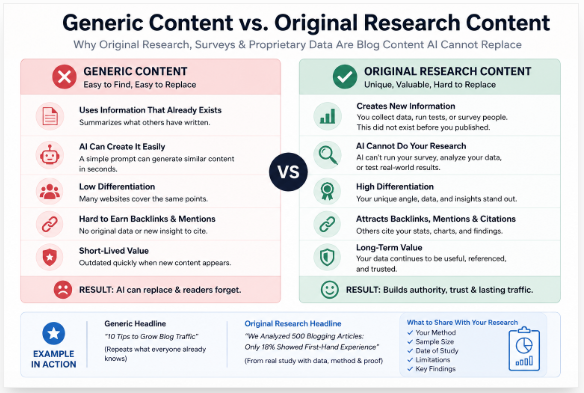
Original research is blog content AI cannot easily replace, because you create the facts yourself. AI can explain what is already known, but your own survey, test, or data can add something new to the web.
Google now advises site owners to create unique, non-commodity content that adds value beyond common knowledge. That makes your own data, tests, and expert findings more useful in both normal Search and AI search.
Research You Can Do on a Small Budget
You do not need a big team or thousands of dollars. Start with one clear question, collect real data, and show how you got the result.
- Survey 100 bloggers about how they use AI.
- Study 500 Google search results for one topic.
- Compare answers from 100 AI prompts.
- Track rankings before and after updating old posts.
- Study real reader questions, comments, or anonymous customer data.
For example: “We Analyzed 500 Blogging Articles: Only 18% Showed First-Hand Experience.” Use such a headline only when your real study proves that number.
Also, publish your method, sample size, date, and limits. Your own useful statistics can earn backlinks, mentions, citations, and trust because other writers finally have an original source to refer to.
Key point: Do not just repeat available facts; collect a fact that did not exist before your research.
4. Real Case Studies With Verifiable Results
Real case studies with verifiable results give readers something AI cannot create on its own: proof of what really happened. A good case study shows your starting point, goal, actions, problems, changes, final results, and lessons.
Do not just say, “My traffic grew.” Show the numbers: for example, 5,000 monthly visits to 8,000, 30 posts published, ₹20,000 spent, and six months of work.
Show the Failure, Not Just the Win
Your failed steps may be more useful than your success. Tell readers what you tried, why it failed, what you changed, and what happened next.
For example, Google published a case study showing that Saramin increased organic traffic by 15% after fixing crawling issues and improving its SEO work. This type of measured result makes a case study easier to trust.
Use real proof such as:
- Search Console screenshots
- traffic and ranking changes
- revenue or conversion data
- dates, costs, and time spent
AI can summarize a success story, but your real case study owns the evidence behind it.
5. Hands-On Product Reviews and Long-Term Testing
Hands-on product reviews are hard for AI to replace because AI can read specs and sum up public reviews, but it cannot personally use your product for six months. You can give readers what a quick AI answer often lacks: proof of what happens after real use.
Google also advises reviewers to show first-hand evidence, explain how they tested products, share results, and use proof such as original photos. It also recommends explaining why you call one product the best for a certain use.
Show Readers That You Really Used It
Do not just say, “I tested this.” Show your work with:
- Original photos and screenshots
- Real test dates and usage time
- Speed, cost, battery, traffic, or other useful measurements
- Problems you found after weeks or months
- Side-by-side tests with the same task
- Receipts when they help prove a real purchase
For example, test seven blogging tools with the same 2,000-word draft instead of comparing feature pages. Record setup time, errors, editing time, final cost, and the tool you stopped using.
Long-Term Reviews Tell the Better Story
A first-day review shows features; a six-month review shows regret, hidden costs, support issues, limits, and daily pain. That is why formats such as “6 Months Later: Would I Still Buy It?” or “What Nobody Tells You After Using X for a Year” can give readers far more useful detail.
Also, do not only tell readers what won. Tell them what you rejected and why, because honest trade-offs make recommendations easier to trust.
If you earn affiliate money or receive a product from a brand, disclose that link clearly. FTC guidance says endorsements must be truthful, and material connections that may affect credibility should be disclosed.
The best hands-on product reviews do not repeat what a sales page says; they show what you saw, measured, liked, disliked, kept, and finally rejected. Your real proof becomes the part that no generic AI summary can simply invent.
6. Troubleshooting, Edge Cases, and Real-World Problem Solving
Some of the best blog content AI cannot replace starts when the usual fix fails. A reader does not need another page that repeats the same five steps; they need the missing step that actually solved the problem.
Find Problems After the Common Fix Fails
Take a WordPress critical error as an example: most guides say to disable plugins, change the theme, or check PHP. WordPress itself suggests disabling plugins and turning them back on one by one, but real problems can still involve odd plugin conflicts, hosting limits, or failed updates.
So, do not write “How to Fix a WordPress Error.” Write: “I Tried 7 Fixes for This WordPress Error—Here Is What Finally Worked.”
Search Reddit, support forums, YouTube comments, Google autocomplete, People Also Ask, and customer questions. When you see “I tried everything, but nothing worked,” stop: you may have found a real content gap.
Test the fixes, record each failed step, take screenshots, and explain the final result. This is blog content AI cannot replace easily because you add fresh proof, real context, and a solution born from actual testing—not another summary of what already exists online. Google also recommends useful, non-commodity content that adds unique value instead of simply repeating common knowledge.
7. Expert Judgment, Opinions and Decision-Making Content
Expert judgment is one type of blog content AI cannot easily replace. AI can list facts fast, but facts alone do not always help you make the right choice.
You often need someone who has done the work and seen what goes wrong. That person can tell you about hidden costs, risks, trade-offs, and cases where the common advice fails.
Facts Tell You What; Experience Tells You What to Choose
Suppose you search for the best blogging platform. AI can compare WordPress, Ghost, and Substack by price, features, themes, and ease of use.
But that list may still leave you stuck. You really want to know: Which one fits my goal, budget, skills, and future plan?
A weak article says:
“Best Blogging Platforms: WordPress vs Ghost vs Substack.”
A stronger article says:
“I’ve Built Sites on WordPress, Ghost, and Substack: Here’s Who Should Avoid Each One.”
The second title gives you something more useful: judgment based on real use.
Share the Reasons Behind Your Choice
An expert should not just say, “Choose WordPress.” They should explain why they chose it, what they gave up, and when they would choose something else.
For example:
- Choose WordPress if: you want more control, plugins, and room to grow.
- Choose Ghost if: you want a clean publishing setup with fewer moving parts.
- Choose Substack if: your main goal is to grow an email-first audience with a simple setup.
Also explain who should not choose each option. This is where real decision-making content becomes far more useful than a basic feature list.
Strong Opinions Are Useful When You Can Prove Them
You do not need to sound neutral all the time. In fact, a clear opinion can help your reader when you back it with real reasons, tests, results, and limits.
For example, say: “I would not use this tool for a large site because I faced these three problems.” That is more useful than saying every tool is “great for different needs.”
Google’s own people-first content guidance asks creators to show first-hand expertise and make content useful to people. It also points creators toward original value rather than content made mainly to attract search traffic.
Use the “Choose X If, Choose Y If” Pattern
This simple format works well for searches that need human judgment:
Choose X if your situation is A; choose Y if your situation is B.
Then explain the cost, risk, limit, and reason behind each choice. Your goal is not to give your reader more options; your goal is to help them make a better decision.
Key point: AI can compare facts, but your real value comes from explaining what you would choose, who should choose it, who should avoid it, and why.
That kind of expert judgment, opinion, and decision-making content gives readers something a simple AI summary often cannot: a trusted decision based on real context and real-world experience.
8. Human Stories, Failure, Transformation and Personal Perspective
Human stories are blog content AI cannot replace in the same way you can. AI can copy a story style, but it cannot live your past, make your mistakes, face the loss, or carry the result.
So, do not just tell readers how to stay strong; show them where you almost gave up. Write, “I Nearly Quit Blogging After 18 Months With No Traffic—Here’s What Changed,” and share the bad choice, hard day, turning point, and real lesson.
Your writing voice also grows from what you notice and believe. Share an unpopular view, admit when you were wrong, and explain why your mind changed.
People may find your blog through Google or AI search, but they return when they trust your perspective. That is why human stories are hard for AI to replace: AI can retell facts, but only you can show what those facts cost you and how they changed your life.
The AI-Resistant Content Formula
AI-resistant content gives people something a quick AI answer cannot fully replace. It adds your real work, proof, judgment, and useful details.
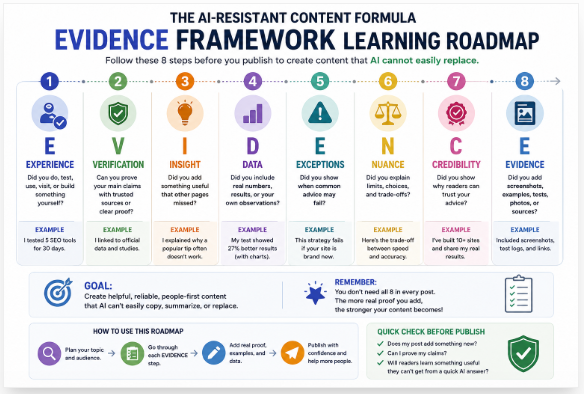
Google also says creators should make helpful, reliable, people-first content. So, before you publish, use this simple EVIDENCE Framework to check your post.
The EVIDENCE Framework
- E — Experience: Did you do, test, use, visit, or build something yourself?
- V — Verification: Can you prove your main claims with trusted sources or clear proof?
- I — Insight: Did you add something useful that other pages missed?
- D — Data: Did you include real numbers, results, or your own observations?
- E — Exceptions: Did you show when common advice may fail?
- N — Nuance: Did you explain limits, choices, and trade-offs?
- C — Credibility: Did you show why readers can trust your advice?
- E — Evidence: Did you add screenshots, examples, tests, photos, or sources?
You do not need all eight points in every post. But the more real proof you add, the harder your AI-resistant content becomes to copy, summarize, or replace.
How to Turn a Generic AI-Replaceable Article Into Irreplaceable Content
Irreplaceable blog content does more than answer a question; it shows what happened when you tried the answer in real life. So, instead of writing “10 Ways to Grow Blog Traffic,” test those 10 methods for six months and write “I Tested 10 Blog Traffic Strategies for 6 Months—Only 3 Worked.”
Show your starting traffic, each method, cost, time spent, screenshots, failures, and final results. Also share the surprise: which popular tip failed, which small change worked, and who should or should not try it.
Do the same with “Best AI Writing Tools.” Test seven tools with the same article, then compare editing time, errors, cost, weak points, and final quality.
Google now recommends unique, expert-led, non-commodity content that adds value beyond common knowledge.
My rule is simple: do not just give the answer; create the proof behind it. That proof turns generic advice into irreplaceable blog content readers can trust, use, and verify.
Where to Find Blog Topics AI Still Answers Poorly
You can find blog topics AI still answers poorly by looking past the first question. Search Google Autocomplete, People Also Ask, Reddit, Quora, forums, YouTube comments, your Search Console queries, and AI tools for real gaps people still struggle with.
Find the “Second-Question Gap”
Look for words like: “I tried this, but,” “this did not work,” “what about my case?” and “why does this still happen?” These clues show missing steps, old advice, mixed answers, edge cases, or a need for real human experience.
Google itself says useful content should give people original value and show first-hand expertise.
Ask one simple question: “What would this person search next after trying the current answer?” That next search often reveals better long-tail keywords and blog topics AI still answers poorly.
What Bloggers Should Stop Doing in the AI Era
If you want to create blog content AI cannot replace, stop rewriting definitions, copying common listicles, and publishing AI summaries with no new value. Also, avoid mass-made keyword pages, product reviews without real use, and advice with no proof.
Use AI, But Add Something Real
Use AI for research, ideas, outlines, editing, and data review. Then add what only you can bring: real experience, tests, screenshots, results, mistakes, expert judgment, and fresh insights.
Google says AI use itself is not the issue; creating many pages without added value may break its spam rules.
Key point: Use AI to help you create; never let it become the reason your content has nothing new to say.
Conclusion: Become the Source AI Has to Learn From
The best blog content AI cannot replace starts with one thing: something real that came from you. Your test, your data, your mistake, your result, or your view gives readers something new.
Do not race AI by writing more basic facts. Instead, become the source: run tests, share case studies, show real proof, give honest advice, and tell stories only you can tell.
That is where your edge lives. AI can sum up what already exists, but it cannot live your day, make your choice, or create your real result.
The safest blog content is not content AI cannot write; it is content AI could not know until you created it.
Before you publish, ask: What new thing will exist online because I wrote this?




Leave a Reply