You publish a few blog posts, check your traffic each morning, and see almost no clicks from Google. Then you try Instagram, Pinterest, Facebook, TikTok, or Reddit, but posting every day soon feels like a second job.
So, should a new blogger focus on Google SEO or social media first? Google can take time to show results, and even useful site changes may need days or months to make an impact.
Do not try to be everywhere at once: build helpful, search-friendly blog content as your long-term base. Google itself recommends creating helpful, reliable, people-first content rather than content made mainly to chase rankings.
Then choose one social platform where your readers already spend time and use it to share your work, learn what people ask, and bring early readers to your blog. In the Google vs social media choice, think of Google as your long-term traffic engine and social media as the road that helps your first readers find you.
Google vs Social Media for Bloggers: What’s the Real Difference?
Google vs social media for bloggers comes down to one simple difference: Google meets demand, while social media creates discovery. You use Google to reach people looking for an answer, while social media helps new people notice you.
Google Captures Existing Search Demand
When someone searches “how to start a food blog on WordPress,” they already have a clear need. Your blog can appear at the right time and give them the exact answer they want.
This is called high-intent traffic: the reader is already looking for help, a guide, a review, or a solution. Google search traffic can also keep bringing visits over time when your useful content stays visible in search results.
Google works well for tutorials, how-to guides, reviews, comparisons, and problem-solving posts. Still, write for people first; Google clearly recommends helpful content made for readers, not content created only to gain rankings.
Social Media Creates Discovery
On Instagram, TikTok, Facebook, Pinterest, or Reddit, people may find your content while scrolling or joining a discussion. They may not be searching for your blog at all, but a useful post can make them stop, read, and discover you.
This can give you faster exposure, direct feedback, audience talks, topic ideas, and stronger brand recall. Social platforms also let you see what people share, save, question, or discuss, which can guide your next blog post.
Key takeaway: In Google vs social media for bloggers, think of Google as “I need this answer now” and social media as “I did not search for this, but I need to see it.” Use that difference to choose where and how you promote each blog post.
Should New Bloggers Focus on SEO or Social Media First?
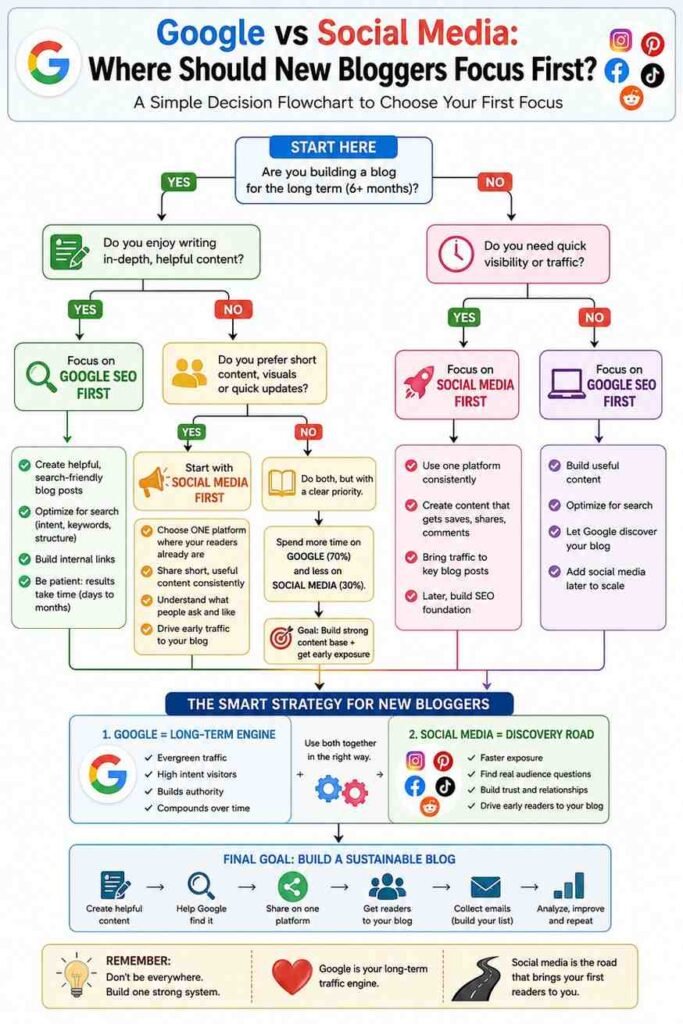
If you are a new blogger, focus on SEO first and use one social media platform to support it. This gives you a clear path: build useful blog content for search, then share it where your readers already spend time.
A simple starting split is 70% content and SEO, and 30% promotion and audience building. This is not a Google rule; it is a practical way to stop yourself from trying to do too much at once.
Why SEO Should Be Your Main Focus
SEO helps people find your blog when they search for a real problem, question, or need. Google also says SEO can help when you use it with helpful, people-first content.
For example, you may write a useful post on “how to start a travel blog with no audience.” That page can keep bringing search visitors if it answers the query well and earns good visibility.
Social media works in a different way: it helps people discover your work while they scroll, watch, or join a discussion. Search is still a major discovery channel, while social media also reaches a huge and growing audience worldwide.
Do Not Try to Be Everywhere
A common beginner mistake is trying to run Google SEO, Instagram, TikTok, Facebook, Pinterest, LinkedIn, and YouTube at the same time. You soon spend more time feeding platforms than building the blog you own.
Use this rule instead: one main traffic engine + one support channel. Your blog and SEO become the base; one social or community platform helps you find readers, test ideas, and share new posts.
Here are practical matches:
- Travel blog: Google + Pinterest
- Business blog: Google + LinkedIn
- Tech blog: Google + Reddit
- Lifestyle blog: Google + Pinterest or Instagram
- Personal brand blog: Google + LinkedIn or YouTube
Your best platform still depends on where your real audience spends time. For example, Pew’s 2025 U.S. data shows that platform use differs widely across YouTube, Facebook, Instagram, Pinterest, TikTok, LinkedIn, and Reddit.
Use the “Build Once, Share Smart” Method
Say you have 10 hours a week for your new blog. Spend about seven hours researching, writing, updating, and improving useful search content; then use the other three hours to promote it and talk with readers.
Do not create five new pieces of social content from scratch every day. Take one strong blog post, turn its best idea into a useful social post, answer related questions, and send interested readers back to the full guide.
Key Point
For most new bloggers, SEO vs social media is not an either-or choice. Focus first on SEO and strong blog content, then use one social channel to help the right people discover it.
That simple setup keeps your work focused: build an asset you own, then use a platform you do not own to distribute it.
Why Google SEO Should Be Your Long-Term Foundation
If you are building a new blog, Google SEO should be your long-term foundation. Social media can give you quick reach, but search traffic can keep finding your useful pages long after you publish them.
That does not mean SEO gives you fast results. Google says some changes may show results in days, while others can take several months to show a clear effect.
SEO Content Can Keep Working After You Publish
Think of a social post like a street poster: people may notice it today, but its reach can drop fast. A useful blog post is more like a small shop beside a busy road; people can keep finding it when they search for the same need.
For example, you write “How to Start a Blog With No Money.” Your Instagram post may bring a burst of visits, while the blog page can keep getting found if it earns a useful place in Google Search.
Google says its systems aim to show content that is relevant and useful for each search. So, one strong article can serve new readers again and again when the same question keeps coming up.
Search Visitors Often Have a Clear Need
Now compare two people: one is scrolling Instagram for fun, while another searches “best blogging platform for beginners.” The second person already knows what they need and is actively looking for an answer.
That clear need can make Google traffic useful for:
- Product reviews and comparisons
- Affiliate content
- Step-by-step tutorials
- Service leads
- Email signups
But do not expect SEO to work like a switch. You need to publish helpful content, cover your topic well, improve weak pages, and make it easy for Google to find and understand your site.
Google also recommends creating helpful, reliable, people-first content, rather than pages made only to gain rankings.
Key point: social media may give you attention now, while Google SEO can become a long-term traffic foundation that keeps working as your blog grows.
Why Social Media Still Matters for New Bloggers
Social media for new bloggers can bring early readers while you wait for Google traffic to grow. It also helps you learn what real people want before you spend hours writing the wrong topics.
Social Media Can Give Your New Blog Early Exposure
A new blog may not rank on Google right away, so do not just publish and wait. Share each useful post where your readers already spend time: Reddit, Pinterest, LinkedIn, Facebook, Instagram, or another niche community.
Social media can help you get your first readers, comments, shares, feedback, and email subscribers. More importantly, those early reactions show which topics people care about and which ones they ignore.
You do not need to post on five platforms at once. Pick one platform that fits your niche, help people there, and link to your blog only when your post truly answers their question.
Social Communities Show You What People Really Need
Here is a simple example: you see new bloggers asking, “Why is my blog indexed on Google but getting no traffic?” That question is more useful than guessing your next keyword from a long list.
You can study the replies, find what still confuses people, and write a better guide with clear steps. Google also recommends creating helpful, people-first content that gives readers real value, rather than writing mainly to influence search rankings.
Use this simple loop:
Real question → Useful blog post → SEO → Social sharing → Feedback → Better next post
Can you grow a blog without social media? Yes, you can, but social communities can speed up learning, topic research, and early exposure while your search traffic is still small.
So, use social media for new bloggers as a listening tool first and a traffic tool second. Listen to real problems, solve them on your blog, and let SEO turn those answers into long-term search traffic.
Google vs Social Media: Which Gives Faster Blog Traffic?
For most new bloggers, social media can bring faster blog traffic, while Google SEO often takes more time. However, Google can build a steadier traffic source because people can keep finding your useful posts through search.
| Factor | Google SEO | Social Media |
|---|---|---|
| Initial traffic | Usually slower | Can be faster |
| Long-term potential | Strong | Depends on the content |
| User intent | Usually higher | Varies |
| Posting need | Lower once you rank | Needs regular posting |
| Reader interaction | Limited | Strong |
| Algorithm risk | Yes | Yes |
| Evergreen traffic | Strong | Depends on the platform |
Google says some SEO changes may show results in hours, while others can take several months. So, do not expect a new blog post to rank and bring traffic at once.
Social media works in a different way: one useful post, pin, video, or community reply can put your blog in front of people much faster. But that traffic may fall when people stop sharing, viewing, or engaging with the post.
Here is the key point: fast traffic is not always lasting traffic. A viral post may give you a traffic spike today, while one strong Google ranking may send you useful search traffic again and again.
So, use social media to get seen now, and use SEO to build traffic for later. When you compare Google vs social media, ask yourself one simple question: Are you just getting visitors, or are you building a traffic system you can repeat?
Which Social Media Platform Should a New Blogger Choose?
The best social media platform for new bloggers is where your readers already spend time. Do not pick Instagram or TikTok just because everyone talks about them.
Pinterest: Best for Helpful Visual Ideas
Use Pinterest if you blog about food, travel, home, DIY, fashion, blogging, or lifestyle. People use Pinterest to find, save, and plan ideas, so useful posts can fit well with how people use the platform.
For example: turn a “7-day budget meal plan” into simple Pins that lead readers to the full guide. This works better than posting random images with no clear reason to click.
LinkedIn: Best for Work and Business Topics
Choose LinkedIn for business, SaaS, careers, B2B, marketing, or professional advice. LinkedIn is built around professional audiences, so your work tips and expert views can reach people already interested in those topics.
Reddit: Best for Real Problems and Questions
Use Reddit for tech, gaming, blogging, finance discussions, and problem-solving topics. First, help people in the community; then share your blog only when it truly answers the question.
Reddit itself tells users to join communities honestly and avoid spam. That rule matters: one useful answer can build more trust than dropping your link into ten unrelated threads.
Instagram or TikTok: Best for Visual Stories
Use Instagram or TikTok if your topic is easy to show: fitness, beauty, food, travel, lifestyle, or a personal brand. TikTok also works as a discovery tool, where people explore creators, how-to content, and topics through search and recommendations.
Key point: choose one social media platform first and test it with real content for a set period. Follow your reader, not platform hype; the best social media platform for new bloggers is the one that sends the right people to your blog, not the one that gives you the most views.
A Practical 90-Day Google + Social Media Strategy for New Bloggers
Your 90-day Google and social media strategy should stay simple: build useful content for search, then use one social platform to reach real people. Do not try to win Google, Instagram, Pinterest, LinkedIn, Reddit, and TikTok at the same time.
Days 1–30: Build Your Search Base
First, pick one clear niche and list 20 real questions people ask in Google, Reddit, forums, and social groups. Then choose long-tail keywords that solve one small problem at a time.
Do not target a broad word like “blogging” first. Target a clear query like “how to get traffic to a new blog with no backlinks.”
Next, publish 6–10 useful posts and connect related posts with internal links. Set up Google Search Console, submit your sitemap, and check that Google can crawl and index each key page.
Google says your content should help people first and use the words people use when they search. It also says clear technical structure still matters for discovery and indexing in Google Search and its AI features.
Your first 30-day goal:
- Pick one niche.
- Find 20 real problems.
- Publish 6–10 strong posts.
- Set up Search Console.
- Pick only one social channel.
Days 31–60: Publish Once, Use It Many Times
Now, stop treating each blog post as one piece of content. Write one strong article, then break its best ideas into small posts for the platform your audience already uses.
For example, one article may become 3 LinkedIn posts, 5 Pinterest pins, or one useful Reddit discussion. You do not need all three; pick the one that sends the right people back to your site.
Each article should answer one clear search need fast. Add your own screenshots, steps, examples, mistakes, results, or views whenever you truly have them.
Then link the post to other useful pages on your blog. This helps readers move from one answer to the next instead of leaving after one page.
Days 61–90: Follow Proof, Not Hype
After 60 days, let your data guide your next move. In Search Console, check queries, impressions, clicks, and average position to see what Google is already testing your site for.
Also check which social posts bring link clicks, saves, shares, and real visits. A post with 50 clicks to your blog may be worth more than a Reel with 50,000 views and no action.
Here is the rule I would use: do more of what shows signs of life. If one topic gains Google impressions or one social format brings real readers, make the next useful piece around that signal.
Your 90-day traffic loop is simple:
Listen → Publish → Share → Measure → Repeat.
Do not expect 90 days to prove that your blog has failed or won. Real blogger experiences vary widely, and many report slow early search growth, which is why your first goal should be finding repeatable signals—not chasing viral traffic.
By day 90, your Google and social media strategy should feel clearer: keep building search content that solves real problems, while using one social channel to find people, learn what they need, and bring the right readers back.
Common Mistakes New Bloggers Make With Google and Social Media
When you start blogging, Google and social media can both bring readers. But a few simple mistakes can waste your time and slow your blog growth.
1. Trying Every Social Media Platform
Do not try Instagram, Facebook, TikTok, Pinterest, LinkedIn, and Reddit at once. You will spend more time feeding platforms than building your blog.
Pick one platform where your readers already spend time. Learn what works there first; then add another traffic source when you have a clear system.
2. Waiting for Google to Send Traffic
Publishing a post and waiting for Google is not a traffic plan. Share your useful posts where real people already ask about that topic.
For example: if you write about blogging, find real questions on Reddit, Facebook groups, or niche communities. Help people first; share your article only when it truly answers their question.
3. Chasing Views Instead of Useful Traffic
A video with 100,000 views may look great, but views alone do not grow your blog. Even 1,000 right visitors can matter more when they read, subscribe, click, or buy.
Track what happens after the click: blog visits, engaged readers, email sign-ups, and sales. Do not let a big view count fool you.
4. Writing Only for Google
Do not stuff a page with keywords just because a tool tells you to. Write for the person who searched the question, and use SEO to help that person find your answer.
Google says its ranking systems aim to reward helpful, reliable, people-first content, not pages made mainly to manipulate rankings.
5. Depending on One Traffic Source
Never build your whole blog on one algorithm. Google can change, and social platforms can change what they show overnight.
Build your traffic like a small safety net: your blog + Google search visibility + one useful social audience + an email list. This makes your Google and social media strategy stronger because one traffic drop does not stop your whole blog.
What Should You Do If You Only Have 2 Hours a Day?
If you have only 2 hours a day for blogging, do not try to be everywhere. Build your blog first, then use social media to bring the right people to it.
Use Your 10 Hours a Week Like This
- 6 hours: Write or improve useful blog posts.
- 2 hours: Find keywords and real questions your readers ask.
- 1.5 hours: Share your posts on one social platform.
- 30 minutes: Check clicks, search queries, and traffic in Google Search Console.
Google says Search Console can show how people find your site through queries, pages, clicks, and other search data. Use those numbers to decide what to improve next.
Build Before You Promote
Do not spend four hours making Instagram posts when your blog has only five useful articles. Your content library is your main asset, so make it strong first.
Social media should send people to useful content, not take all your time away from creating it. With only 2 hours a day for blogging, build helpful content first, promote it second, and check what works each week.
Google vs Social Media: Final Verdict
When you compare Google vs social media for new bloggers, do not pick one and drop the other. Build your blog for Google first, then use one social platform to help the right people find it.
Think of it this way:
- Google = long-term discovery: Write useful posts that answer what people search for.
- Social media = reach and trust: Share your work, join talks, and build real ties.
- Email = your own audience: Bring readers back without waiting for an app to show your post.
Google says you should create helpful, reliable, people-first content, while good SEO helps search engines find and understand it. Also, search growth can take days or even months, so do not expect fast results from every new post.
Use this simple path:
Create → Optimize → Share → Capture → Check → Improve
So, stop asking, “SEO or social media?” Ask, “Which one will build my base, and which one will help it grow?”
For most new bloggers, Google vs social media is not a fight: build useful search content as your base, then use one social channel to bring people to it.
Frequently Asked Questions About SEO vs Social Media for New Bloggers
Is SEO or Social Media Better for New Bloggers?
For most new bloggers, SEO is better for long-term blog traffic, while social media can help you get seen faster. A smart plan is simple: build useful posts for Google, then use one social platform to bring the right people to them.
Google says SEO helps search engines understand your content and helps people find your site through Search. Still, SEO takes time, so social media can help while your Google traffic grows.
Key point: Use SEO as your base; use social media to spread your work.
How Long Does It Take for a New Blog to Get Google Traffic?
There is no fixed number of days for a new blog to get Google traffic. You may see some search views early, but strong and steady traffic can take weeks or months.
Google says some search changes may show results in a few days, while others may take several months. So, keep writing useful posts, check Google Search Console, improve weak pages, and do not judge SEO after only two or three weeks.
Key point: Give SEO time; track progress by impressions, clicks, and search queries.
Can I Grow a Blog Without Social Media?
Yes, you can grow a blog without posting on social media every day. You can get readers from Google Search, email, direct visits, links from other sites, online groups, and word of mouth.
Still, do not depend on one traffic source for life. Build Google traffic first if it fits your niche, then slowly add email or one useful community where your readers already spend time.
Key point: Social media is useful, but you do not need five social accounts to grow a blog.
Which Social Media Platform Drives the Most Blog Traffic?
There is no single social platform that sends the most traffic to every blog. The best choice depends on your niche, your content, and what people do on that platform.
For example, Pinterest can fit food, home, DIY, travel, fashion, and other visual topics because people use it to find ideas and plan what to do next. LinkedIn may fit career or business blogs, while Reddit can work well when you give useful answers inside topic-based groups.
Key point: Do not chase the biggest app; choose the place where your real readers already look for help.
Should I Promote Every Blog Post on Social Media?
Yes, you should promote most useful blog posts, but you do not need to post the same link on every social site. Pick one strong idea from the post and shape it for the platform you use.
For example, turn a 2,000-word guide into a short LinkedIn tip, a Pinterest Pin, or a useful Reddit answer. Give value first; then link to your full post when the link truly helps the reader.
Key point: Do not just drop links; give people a reason to click.
How Much Time Should Bloggers Spend on SEO vs Social Media?
If you are new, try spending about 70% of your blog time on content and SEO and 30% on promotion. This is a working rule, not a fixed law, so change it when your own traffic data tells you to.
For example, if you have 10 hours each week, spend about seven hours on research, writing, updates, and SEO. Use the other three hours to share posts, talk with readers, study results, and grow one main channel.
Key point: Build the blog more than you feed social apps.
Is Pinterest Better Than Google for New Bloggers?
Pinterest can bring early clicks in some niches, but Google may give you a wider long-term search path. So, the better choice is often not Pinterest vs Google; it is Google plus Pinterest when both fit your readers.
Think of it this way: write a useful search-based post, then make Pins that lead people to that post. Pinterest itself says people use the platform to discover ideas, plan, and shop, which makes it useful for content with strong visual or planning intent.
Key point: Use Google for search demand; use Pinterest for discovery when your niche fits.
Should New Bloggers Start an Email List Right Away?
Yes, start an email list early, even if only five people join at first. You do not need thousands of readers before you start building a direct link with people who like your work.
A simple example is enough: offer a useful checklist, template, short guide, or weekly tip in return for an email signup. Email gives you a direct way to reach readers again instead of hoping Google or a social app shows your next post to them.
Key point: Google can bring the visitor, social media can introduce you, and email can bring that person back.
The Simple Answer: Where Should You Focus First?
For SEO vs social media for new bloggers, start with useful search-based blog posts and one social channel that fits your niche. Then, build an email list from day one so each new visitor has a clear way to return.
Do not try to win Google, Pinterest, Instagram, TikTok, Facebook, LinkedIn, and Reddit in the same month. Build one strong system instead: create useful content → help Google find it → share it where your readers gather → collect emails → study what works → do more of it.


Leave a Reply