In the previous post, we have learnt what is On-Page SEO for your blog. From this post you will learn Off-page SEO checklist and instructions to reach your newly created blog to top.
If your website publishes helpful content but still struggles to rank, off-page SEO is often the missing factor. It improves your site’s authority, trust, and reputation through signals that occur beyond your website, especially high-quality backlinks, brand mentions, reviews, and digital PR. This guide explains what off-page SEO is, why it matters in 2026, how it works, and which strategies produce sustainable Google rankings.
Quick Overview
| Factor | Details |
|---|---|
| Primary Goal | Build website authority and trust |
| Focus | External ranking signals |
| Strongest Signal | High-quality, relevant backlinks |
| Benefits | Better rankings, organic traffic, credibility, referral traffic |
| Works With | On-page SEO and Technical SEO |
| Key Metrics | Referring domains, backlink quality, organic traffic, branded searches |
What Is Off-Page SEO?
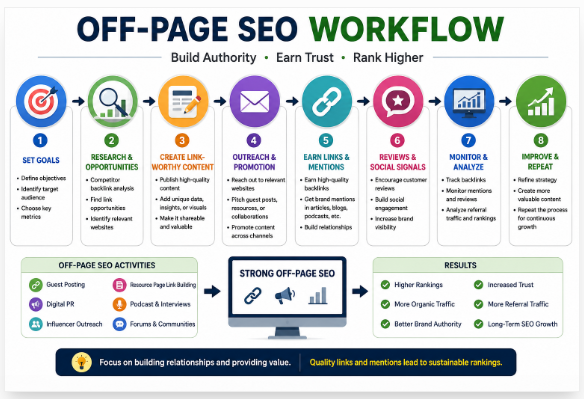
Off-page SEO is the practice of improving a website’s authority through activities that happen outside its pages. While on-page SEO optimizes content and technical SEO improves performance, off-page SEO builds trust by earning recommendations from other websites and online communities.
Google evaluates these external signals to estimate whether a page deserves higher rankings. A website consistently referenced by reputable sources is generally considered more trustworthy than one with little independent recognition.
Why Off-Page SEO Matters
Google’s ranking systems evaluate hundreds of signals, but they largely fall into three areas:
- Helpful, relevant content
- Strong technical performance
- Website authority and trust
Off-page SEO strengthens the third pillar.
Benefits include:
- Higher rankings for competitive keywords
- Increased organic traffic
- Greater brand credibility
- More referral visitors
- Stronger topical authority
- Better visibility in competitive industries
Without authority, even well-written content often struggles to outrank established competitors.
How Off-Page SEO Works
Every quality backlink acts as a recommendation. Google evaluates the credibility of that recommendation rather than counting links alone.
Important ranking factors include:
- Authority of the linking website
- Topic relevance
- Anchor text
- Link placement
- Diversity of referring domains
- Natural backlink profile
- Spam indicators
One editorial backlink from a respected industry publication can outweigh hundreds of low-quality links.
Off-Page SEO vs. On-Page SEO
| Feature | On-Page SEO | Off-Page SEO |
|---|---|---|
| Location | Inside your website | Outside your website |
| Focus | Relevance | Authority |
| Examples | Content, keywords, internal links, metadata | Backlinks, brand mentions, reviews, digital PR |
| Controlled By | Website owner | External websites and users |
| Primary Goal | Help Google understand content | Help Google trust content |
Strong SEO requires both. Relevant content without authority rarely ranks for competitive searches, while authority alone cannot compensate for poor content.
Core Off-Page SEO Ranking Factors
1. High-Quality Backlinks
Backlinks remain among Google’s most influential ranking signals.
The most valuable links come from:
- Industry publications
- Trusted blogs
- News websites
- Government (.gov) websites
- Educational (.edu) institutions
- Authoritative niche resources
Editorial, relevant backlinks carry far more value than purchased or spammy links.
2. Brand Mentions
Google increasingly recognizes brands mentioned across reputable websites, podcasts, forums, and news publications—even when those mentions do not include hyperlinks. Consistent brand recognition strengthens trust signals.
3. Online Reviews
Reviews influence both local SEO and customer trust.
Focus on authentic reviews across platforms such as:
- Google Business Profile
- Trustpilot
- Yelp
- Industry-specific review sites
4. Digital PR
Publishing original research, surveys, industry reports, or expert commentary attracts coverage from journalists and publishers, earning natural backlinks that are difficult to replicate.
5. Social Visibility
Social media is not a direct ranking factor, but it increases content discovery. Popular content often earns backlinks from bloggers, journalists, creators, and businesses.
Effective Off-Page SEO Strategies in 2026
| Strategy | Difficulty | Long-Term Value |
|---|---|---|
| Guest posting | Medium | High |
| Digital PR | High | Very High |
| Original research | High | Excellent |
| Resource page outreach | Medium | High |
| Broken link building | Medium | High |
| Expert contributions | Medium | High |
| Podcast interviews | Medium | High |
| Brand partnerships | Medium | High |
The most successful strategy is earning links through valuable content rather than building links artificially.
Evolution of Off-Page SEO
| Year | Milestone |
|---|---|
| 1998 | Google introduced PageRank, making backlinks a core ranking signal. |
| 2012 | Penguin update penalized manipulative link-building practices. |
| 2018 | E-A-T principles gained importance in quality evaluation. |
| 2022 | Helpful Content updates prioritized people-first content. |
| 2024–2026 | Google increasingly rewards trusted brands, expert content, and naturally earned authority while reducing the value of manipulative link schemes. |
Common Off-Page SEO Mistakes
Avoid practices that violate Google’s spam policies:
- Buying backlinks
- Private Blog Networks (PBNs)
- Large-scale link exchanges
- Automated backlink software
- Spam blog comments
- Low-quality directory submissions
- Over-optimized anchor text
- Ignoring toxic backlinks
Short-term link manipulation can lead to ranking losses or manual actions.
Measuring Off-Page SEO Success
Track these metrics regularly:
| Metric | Why It Matters |
|---|---|
| Referring domains | Measures backlink diversity |
| High-quality backlinks | Indicates authority growth |
| Organic traffic | Shows SEO performance |
| Keyword rankings | Measures visibility improvements |
| Branded searches | Reflects growing brand awareness |
| Referral traffic | Shows visitors arriving through backlinks |
Useful SEO tools include Google Search Console, Google Analytics 4, Ahrefs, Semrush, Moz, and Majestic.
Off-Page SEO Best Practices
For sustainable growth:
- Publish original, experience-based content.
- Build relationships with industry publishers.
- Earn backlinks instead of purchasing them.
- Create statistics, research, and practical resources worth citing.
- Encourage genuine customer reviews.
- Monitor backlink quality regularly.
- Maintain consistent business information across trusted directories.
- Focus on long-term brand authority instead of quick ranking gains.
Frequently Asked Questions
Is off-page SEO still important in 2026?
Yes. Google’s ranking systems continue to rely heavily on authority, trust, and high-quality backlinks, especially for competitive search queries.
Which is more important: on-page SEO or off-page SEO?
Neither replaces the other. On-page SEO helps search engines understand your content, while off-page SEO helps them trust it.
How long does off-page SEO take?
Most websites begin seeing measurable improvements within 3–6 months, while highly competitive niches may require 6–12 months of consistent effort.
Does social media directly improve Google rankings?
No. Social platforms primarily increase visibility, which can generate backlinks, brand mentions, referral traffic, and broader online recognition.
Can a website rank without backlinks?
Yes, for low-competition keywords. Competitive topics usually require authoritative backlinks and strong brand signals.
Conclusion
Off-page SEO is the process of building authority beyond your website. High-quality backlinks, trusted brand mentions, customer reviews, digital PR, and genuine industry recognition help Google determine whether your content deserves higher rankings. In 2026, sustainable SEO success comes from becoming a trusted source that people naturally reference—not from manipulating link metrics. Combine strong off-page SEO with high-quality content and solid technical SEO to build lasting organic visibility.

Leave a Reply