Your blog post may rank on page one, yet ChatGPT, Perplexity, Gemini, and Google AI Overviews may still ignore it. This happens because a Google rank does not always lead to an AI citation.
Traditional SEO helps search engines find, read, and trust your page. However, to rank blog posts in AI search, your content must also give clear answers that AI tools can lift, check, and cite.
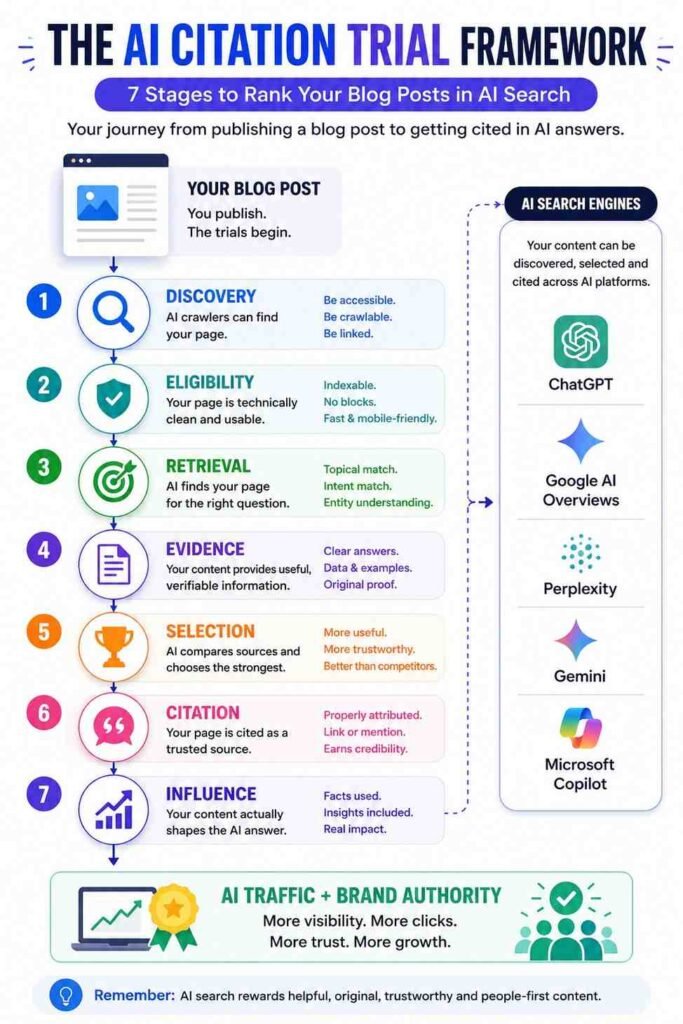
Think of AI search as a seven-step trial: discovery, access, match, proof, selection, citation, and influence. Miss one step, and a weaker page may win the mention.
This guide gives you a hands-on system for content, technical SEO, EEAT, source links, tracking, and recovery. Google also says strong SEO and useful, original content still support visibility in AI search.
To rank blog posts in AI search, make your page easy to find, answer real questions fast, show clear proof, share first-hand experience, earn trusted mentions, and track when AI tools find, cite, and use your work.
What Does “Ranking in AI Search” Actually Mean?
Ranking in AI search means more than appearing on a results page. Your blog post may earn a citation, shape an answer, or send a visitor.
Traditional Ranking Versus AI Visibility
In search, you compete for a place among blue links. The user sees your title, clicks it, and visits your page.
AI search works in more ways. Your page can appear as a cited source while the tool uses your facts in its answer.
Sometimes, the AI mentions your brand but gives no link. It may use your idea without making your page easy to find.
So, do not count citations alone. Track visits, sign-ups, sales, and enquiries that show value.
Google says its AI features still use Search ranking systems. Therefore, SEO remains the base for AI visibility.
The Seven-Stage AI Visibility Chain
Use this seven-stage test:
- Discovery: Can a crawler find your page?
- Eligibility: Can the engine index and use it?
- Retrieval: Does it match the user’s question?
- Evidence: Does it offer clear facts or useful steps?
- Selection: Is it better than found pages?
- Citation: Does the AI name or link to your page?
- Influence: Does your content shape the final answer?
One page may earn a citation but add one fact. Another may shape most of the answer with the same count.
One stop here, know how to begin a blog in AI dominating world.
That is why citation count and answer influence need separate checks. Measure both to see whether your post merely appears or truly achieves ranking in AI search.
Trial One — Prove That AI Search Can Discover Your Post
Before you try to rank blog posts in AI search, make sure search bots can reach your page. Even a great post stays hidden when your site blocks crawling or indexing.
Check Crawlability and Indexability
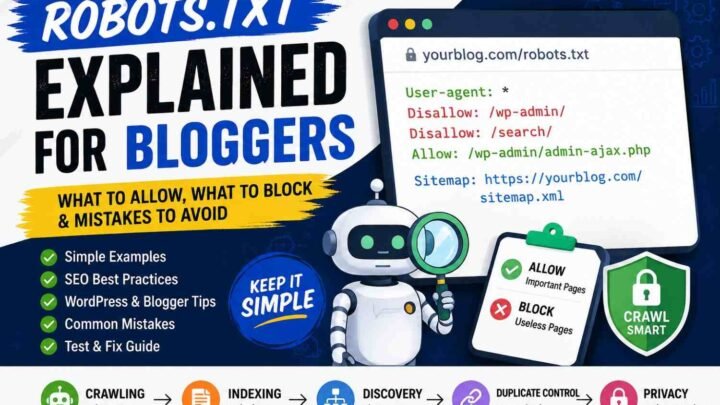
Start with robots.txt, but do not use it to remove a page from Google. Google says this file controls crawling, while a noindex rule controls indexing.
Check these points:
- Test the URL in Google Search Console.
- Remove any accidental
noindexrule. - Add the URL to your XML sitemap.
- Point the canonical tag to the correct page.
- Fix 404, 500, and redirect-loop errors.
- Confirm that the main text appears in the HTML.
- Add internal links from related posts.
Google can read JavaScript, but rendering adds more work. So, place your main answer in the first HTML when possible.
Do AI Engines Need Special Files?
You do not need an AI sitemap, special GEO schema, or llms.txt file for Google AI Overviews or AI Mode. Google says an indexed page needs no extra technical rule for these AI features.
The llms.txt file remains a proposed format. You may test it, but never use it instead of clean HTML, sound links, an XML sitemap, and normal SEO.
Also, check each AI crawler by name. Allow OAI-SearchBot for ChatGPT Search, while GPTBot serves a separate model-training role.
AI Search Discovery Audit
- [ ] URL is indexed.
- [ ] Canonical points to the right URL.
- [ ] Page opens without a login.
- [ ] Main text appears in HTML.
- [ ] Internal links reach the page.
- [ ] Sitemap lists the latest URL.
- [ ] Server returns
200 OK.
Run this audit after each major content update. It gives your post a fair chance to rank blog posts in AI search.
Trial Two — Match the Question AI Search Is Trying to Answer
Stop Targeting Only One Keyword
To rank blog posts in AI search, do not write for one fixed keyword. Start with one topic, then list each question a reader may ask.
One seed term can lead to many questions. Each question needs a clear answer and its own section.
- How do blog posts appear in AI answers?
- Why is my article not cited by ChatGPT?
- Can a new blog rank in AI Overviews?
- Does schema help AI visibility?
- Are backlinks still important for AI search?
- How can I track AI citations?
Google says people now ask longer and more complex questions in AI search. So, cover the full need, not the same keyword many times.
Build a Prompt-Intent Map
Use this map before you write:
| Prompt pattern | Search intent | Content to add |
|---|---|---|
| “What is…” | Definition | A clear 40–60-word answer |
| “How do I…” | Tutorial | Steps in order |
| “Why isn’t…” | Problem | Causes and fixes |
| “X vs Y” | Comparison | A fair table |
| “Best way…” | Choice | Advice with proof |
| “Does X work?” | Test | Result, limits, and verdict |
This map stops one thin answer from serving many needs. It also helps AI tools find the exact section that fits the prompt.
Optimise for Query Variations
Test the same question in five forms: casual, beginner, expert, comparison, and problem-based. Small wording changes can affect what an AI system finds and uses.
For example, test “How can my Hyderabad food blog enter AI Overviews?” and “Why does Google AI ignore my post?” This helps you rank blog posts in AI search for a full question set.
Trial Three: Build Answer Blocks AI Can Extract
To rank blog posts in AI search, make each key answer easy to find, read, and quote. Think of each section as a small evidence card that can stand on its own.
Use the Question–Answer–Evidence–Action Format
Start with a clear question that sounds like something a real person would ask. Then give the main answer at once, before you add more detail.
Use this four-step pattern:
- Question: Ask one clear and natural question.
- Answer: Give the result in one or two short lines.
- Evidence: Add a fact, test, expert source, screenshot, or real example.
- Action: Tell the reader what to do next.
For example, do not hide the answer under a long story. State the fix first; then show why it works and how the reader can use it.
Create Citation-Sized Passages
AI search tools often pull small parts from a page, not the full post. So, each key passage should make sense even when it appears alone.
Use:
- Clear definitions.
- Short answer paragraphs.
- Numbered steps.
- Named comparison tables.
- Direct pros and cons.
- Problem-and-fix tables.
- Original numbers.
- Labelled examples.
A 2026 study reviewed 602 prompts, 21,143 citations, and 18,151 web pages across ChatGPT, Google, Gemini, and Perplexity. It found that pages with clear definitions, numbers, comparisons, and steps had stronger influence on AI answers.
Avoid Fragment Traps
Do not write “this works” when the reader cannot see what “this” means. Name the tool, method, result, or subject each time.
Also, label every table and explain each number near its source. When you rank blog posts in AI search, clear context helps both people and search tools trust your answer.
Trial Four — Submit Evidence, Not Generic Advice
Generic advice will not make your blog post worth citing. You need proof that readers can check and use.
Create an Evidence Ladder
Rank your proof from weak to strong:
- Unsupported opinion.
- Repeated advice.
- Trusted source.
- Named expert quote.
- First-hand observation.
- Original screenshots or data.
- Repeatable test with clear steps.
Stronger proof builds EEAT and makes your page more useful. Google also advises site owners to publish unique, expert-led, people-first content instead of common material.
Run an AI Search Experiment
Choose 20 to 50 prompts linked to your topic. Test them in ChatGPT Search, Gemini, Perplexity, Google AI Overviews, and AI Mode.
Use three query forms: short, detailed, and problem-based. Record whether search starts, which domains appear, citation order, and whether the answer uses your facts.
ChatGPT Search may show inline citations, while Perplexity links answers to sources.
Track these points:
- Prompt, date, tool, and region.
- Search on or off.
- Cited domain and citation place.
- Your fact used or missed.
- Result before and after your update.
Google says AI search visibility still depends on core SEO and useful original content.
Publish What Failed
Share what failed, what you changed, and how long the test ran. Then repeat the test and report whether the gain appeared again.
Also state what remains unclear. Honest limits build more trust than a bold claim with no proof.
Key point: your AI search test has value only when another person can repeat it.
Trial Five — Establish E-E-A-T and Entity Credibility
AI search must know two things: you did the work, and trusted people know you. Google calls this experience, expertise, authority, and trust.
Prove experience
Show your work instead of saying, “I am an expert.” Add Search Console screenshots, dated tests, workflow images, results, and an update log.
For example, show a post that moved from position 38 to position 9 after you changed its answer blocks. Hide private data, state dates, list changes, and explain what failed.
Use this proof list:
- The goal and first result.
- The steps you took.
- The tools and dates.
- The final result.
- The mistake and fix.
Prove expertise
Add a clear author bio. State your role, years of work, skills, credentials, and links to projects or research.
Explain how you check facts, fix errors, and update old advice. Use a named reviewer only when that person checked the page.
Prove authority beyond your site
Your site can claim anything, so outside proof matters. Seek expert quotes, podcast talks, trade-site mentions, directory profiles, research citations, and trusted links.
Keep your name, photo, job title, organisation details, and bio the same everywhere. This helps AI systems connect your work to one author entity.
A 2025 study by Mahe Chen and three co-authors found that AI search favoured earned media and trusted third-party sources, though results changed by engine and query wording. So, publish proof, then earn real mentions from people you do not control.
Trial Six — Defeat the Competing Sources
Conduct a Citation-Gap Analysis
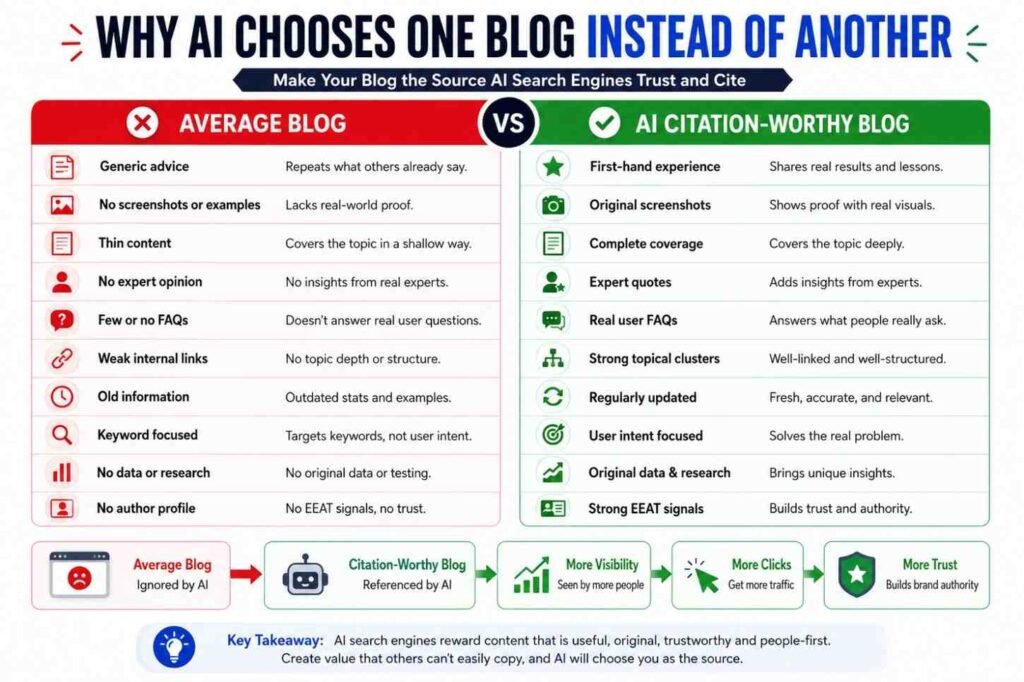
Do not copy the page that AI search cites. Study why it wins, then create a page that answers more useful questions.
Test 10 prompts in ChatGPT Search, Google AI Mode, Gemini, and Perplexity. Save each cited page and check:
- Questions answered.
- Trusted proof.
- Publish date.
- Author experience.
- Original data.
- Missing examples.
- Weak advice.
- Unanswered doubts.
Use one sheet with one row for each rival. Mark each point as “missing,” “weak,” or “strong,” so you can spot clear gaps.
Add Information Gain
Your goal is not a longer post; it is a better post. Google says unique, expert-led content should add value beyond common advice.
Add facts that rivals cannot copy fast:
- Share a clear framework.
- Test disputed AI SEO tips.
- Show exact prompts.
- Compare each AI engine.
- Report failed tests.
- Give templates.
- State time and results.
- Explain limits.
For example, test one updated article with 10 prompts for 30 days. Record when it appears, what gets cited, and which engine ignores it.
Put Relevance Before Design
Do not hide weak content behind boxes, icons, or long FAQ lists. Answer the exact query first, then add fresh dates, clear numbers, sources, and trust proof.
A May 2026 study ran 252,000 trials across six language models. It found that topical relevance strongly shaped the first citation, while formatting-only edits had little effect.
Trial Seven: Build Topical Authority Around the Post
Create a Supporting Content Cluster
Think of your main post as a railway station, not a lonely shop. Each cluster post brings readers and search systems back to one clear topic.
Create focused posts on ChatGPT citations, Google AI Overviews, Perplexity ranking, prompt research, EEAT, entity SEO, schema, AI tracking, content updates, audits, case studies, and AI search myths. Each page should answer one real question with simple steps, proof, and examples.
Do not publish all 15 posts at once just to look large. Start with the five questions your readers ask most, improve them with Search Console data, and add more only when you have useful insight.
Google says AI search still uses its core Search systems, so normal SEO remains important. It also tells site owners to make pages easy to find through internal links and to publish useful, original content.
Design a Simple Internal-Linking Map
Link every cluster post to your pillar guide: how to rank blog posts in AI search. Then link from the pillar to each cluster where that topic helps the reader.
Use clear anchors such as “track AI citations” or “improve EEAT for your blog.” Avoid using the same exact anchor everywhere; Google recommends short, relevant anchor text.
Also link related cluster posts when the next page solves the reader’s next problem. Run a monthly crawl and fix orphan pages, broken links, weak anchors, and pages with no internal links.
Key point: topical authority grows when each page has one clear job, solid proof, and a direct path to the rest of your content hub.
How to Optimise Separately for Google, ChatGPT, Perplexity and Gemini
Use one strong page, but test it through four different doors. Your passport stays the same: clear answers, real proof, easy access, and useful facts.
Google AI Overviews and AI Mode
Start with core SEO because Google says its normal Search rules still apply to AI Overviews and AI Mode. Make sure Google can crawl, index, understand, and link to your page; then add first-hand value that rival posts lack.
Use Google Search Console to check indexing, clicks, links, and page issues. Also, answer long and clear questions because AI search users often ask follow-up questions.
Check these points:
- Give the answer near the top.
- Add useful internal and trusted external links.
- Show real steps, tests, images, and results.
- Keep the page fast and easy to use.
ChatGPT Search
Do not test only one keyword. Ask the same question in five ways, record which pages ChatGPT cites, and find one useful fact that rival pages miss.
Allow OAI-SearchBot in your robots.txt so ChatGPT Search can find your public pages. Track visits from utm_source=chatgpt.com in your analytics.
Perplexity
Perplexity uses a fresh web index and gives sources with its answers. Use clear dates, named sources, direct replies, and exact numbers that readers can check.
Gemini
Test your page in both Gemini and Google Search because the answers may differ. Gemini can show related source links, while Deep Research uses Google Search by default.
Key Takeaway
Build one trusted page, then test it across all four tools. No method can promise a citation because AI systems, sources, and answers change often.
Schema Markup: What Helps and What Does Not
Schema markup gives search engines clear labels for your page, author, brand, video, and data. It can help Google understand your blog post, but it cannot make weak content rank.
Useful Schema Types
Use BlogPosting or Article for a blog post; add its title, author, image, and publish date. Google says Article schema may help it show better titles, images, and dates in Search.
Add Person for the writer and Organization for the site or business. Keep each name, profile, logo, and link the same across your content and schema.
Use BreadcrumbList to show the page path, such as Home: SEO: AI Search. Add VideoObject for a real video, and use Dataset only when you share original data.
Use FAQPage only when readers can see each question and answer. Use HowTo only for a true step-by-step task, not for a loose tips list.
Schema Myths
Schema is a label, not a magic ranking switch. Google also says you need no special AI schema to appear in its AI search features.
Your markup must match the content people can see. First fix crawling, indexing, useful content, proof, and trust; then check your code with Google’s Rich Results Test.
The 30-Day AI Citation Experiment
Treat this plan like a small science test: change one blog post, track each result, and keep clear proof. Your goal is not just to rank in AI search; you also want to learn why ChatGPT, Google AI Overviews, Gemini, or Perplexity cites one source over another.
Week 1: Record Your Starting Point
Choose 25 prompts that real readers may type, such as “how to rank blog posts in AI search” or “why is ChatGPT not citing my website.” Test each prompt three times, then record the cited pages, brands, dates, links, and answer order in one sheet.
Next, audit your page: check indexing, canonical tags, robots.txt, sitemap, mobile use, page speed, and internal links. Also, make sure OAI-SearchBot can reach your public content, since OpenAI says this access helps pages appear in ChatGPT search.
Week 2: Rebuild the Blog Post
Add a short answer below each key heading, then support it with proof, examples, screenshots, or fresh data. Remove long openings, weak claims, repeated tips, and sections that do not solve a real reader problem.
Also, study every cited rival page and note what your post lacks. Fill those citation gaps with clearer steps, better facts, first-hand lessons, and useful tables.
Week 3: Build Trust Outside Your Site
Ask one real expert for a useful quote, test result, or opposing view. Then share your original findings with trusted newsletters, bloggers, groups, and industry sites.
Update your author page, social profiles, company details, and past work. Keep the same name, role, topic, and proof across each place.
Week 4: Retest and Compare
Run the same 25 prompts three more times, including simple paraphrased versions. Record citations, brand mentions, source order, referral visits, and whether your facts shaped the final answer.
Compare the new results with Week 1: keep what worked, fix what failed, and log every change. Google also advises site owners to focus on useful, original content and sound SEO for AI features.
Why Blog Posts Fail to Rank in AI Search
Use this table as an AI citation clinic: find the fault, then fix it. A blog post may rank on Google but still miss ChatGPT, Gemini, Perplexity, or AI Overviews.
Google says AI search needs content that search systems can crawl, understand, and trust. Research also shows that AI tools may read many pages but cite only a few.
| Failure | Likely cause | Resolution |
|---|---|---|
| Page is never cited | AI tools cannot find or match it | Check robots.txt, noindex tags, canonicals, sitemaps, internal links, and topic fit |
| Competitors are cited | Their proof or authority is stronger | Add tests, screenshots, trusted sources, dates, and clear facts |
| Brand appears without a link | The engine knows your brand, but not this page | Match the exact query and make each answer clear on its own |
| Citations keep changing | AI answers can vary between searches | Run each prompt five times and test similar wording |
| Page ranks on Google, not AI | Google ranking does not ensure AI citation | Add short answers, steps, tables, examples, and sourced claims |
| AI cites old facts | Older pages still look more trusted | Add a visible update date and fresh evidence |
| Citations bring little traffic | Readers have no strong reason to click | Improve the title, promise, examples, and next step |
Start with 10 real user questions. Record the date, prompt, AI tool, cited pages, and facts taken from your post.
Then fix one fault at a time; do not rewrite the whole page without proof. In my view, clean formatting without strong evidence is decoration, not AI search optimisation.
Your goal is simple: make your page easy to find, trust, quote, and visit.
How to Measure AI-Search Performance
AI-search performance is not one fixed rank. You must track how often AI tools find, cite, mention, and use your blog post.
Build an AI Visibility Scorecard
Start with 20 real questions that your readers may ask. Test the same questions each week in Google AI Mode, ChatGPT, Gemini, and Perplexity.
Track these key points:
- Prompt coverage: How many target questions show your page or brand?
- Search activation rate: How often does the AI tool search the web?
- Retrieval frequency: How often does it find your page?
- Citation frequency: How often does it link to your page?
- First-citation share: How often does your link appear first?
- Answer influence: How much of the answer comes from your content?
- Brand mentions: How often does AI name your brand without a link?
- Competitor share: How often do rival sites appear instead?
- Referral sessions: How many people visit from AI search?
- Assisted conversions: How many AI visitors later join, buy, or contact you?
- Revenue influenced: How much income starts with an AI-search visit?
OpenAI adds utm_source=chatgpt.com to ChatGPT referral links, so you can track this traffic in Google Analytics. Google also launched separate Search Console reports for AI-feature impressions in June 2026.
Test More Than Once
Never trust one prompt test: AI answers can change across tools, days, wording, and repeat searches. A 2026 study found that one check gives a weak view, so measure each prompt several times.
Also, a citation does not always mean strong influence. Research across 602 prompts found that citation count and answer use can differ, so track both.
Review your scorecard every four weeks. Then improve pages that AI finds but does not cite, and protect pages that already drive visits, leads, or sales.
Frequently Asked Questions
1. Can a new blog rank in AI search?
Yes. Publish useful answers, show first-hand proof, and build trust around one clear topic.
2. How long does AI-search optimisation take?
There is no set time. Test changes for several weeks because crawling, selection, and citations vary.
3. Does ChatGPT crawl every website?
No. Keep pages public, allow OAI-SearchBot, and link your key pages clearly.
4. Are backlinks important for AI search?
Yes. Good backlinks support discovery and trust, but they cannot replace a useful answer.
5. Does schema improve AI citations?
Schema explains your page clearly. However, it never guarantees that an AI tool will cite you.
6. Is GEO different from SEO?
GEO targets AI answers; SEO covers wider search visibility. Still, both need helpful and crawlable content.
7. Can AI-generated articles rank in AI search?
Yes, when they add real value. Thin, copied, or mass-made AI pages may lose visibility.
8. Why does AI cite competitors instead of my blog?
Their page may answer the prompt better. Compare its proof, freshness, clarity, links, and topic depth.
9. How often should I update an AI-optimised post?
Update facts when they change. Review fast-moving posts every three to six months.
10. How do I track ChatGPT citations?
Repeat your target prompts and record cited URLs. Also track utm_source=chatgpt.com visits in analytics.
11. Does ranking first on Google guarantee an AI citation?
No. AI search may select several sources, even when your page ranks first.
12. Should every heading be a question?
No. Use question headings only when readers ask them; use steps and comparisons elsewhere.
13. Do AI engines prefer long-form content?
AI engines prefer complete answers, not empty length. Stop when you fully solve the reader’s need.
14. Can affiliate blogs appear in AI answers?
Yes. Publish honest tests, original photos, clear disclosures, and fair pros and cons.
15. Is llms.txt necessary?
No. It remains a proposed format, and Google says its AI Search does not use it.
Final Verdict: The AI Citation Case Checklist
Before you publish, test your post like a case. These seven checks show whether your page can rank in AI search and earn citations.
- Discovery: Can search engines and AI tools reach your page?
- Eligibility: Is the page indexable, safe, and free from crawl errors?
- Retrieval: Does the content match prompts and search intent?
- Evidence: Do you show proof, original examples, useful data, or first-hand lessons?
- Selection: Does your page answer the topic better than pages already shown?
- Citation: Can an AI tool lift one fact and name your page as the source?
- Influence: Does your content make the answer clearer and more useful?
Conclusion
Do not optimise merely to “look AI-friendly.” Build the most useful, provable, and easy-to-use answer on the topic.
AI visibility starts with SEO; however, citations come from relevance, proof, trust, and ideas that competing pages cannot copy.

Leave a Reply