Many bloggers now see one strange thing. Their pages still rank, impressions look fine, but clicks going down. This hurts. You work many days, update old post, wait for traffic, then Google shows AI answer before your link.
So, did AI Overviews destroy blogging income?
Not fully. Blogger income after AI Overviews ranges from almost nothing to six figures annually, but income now depends more on niche, audience ownership, commercial intent and monetisation diversity than raw Google traffic.
Some bloggers lost ad money. Some affiliate links get less clicks too. But others still grow by selling products, building email lists, making YouTube videos, running communities and getting people search their brand name.
In this post, we see who lost income, who still earn, what changed in traffic, and practical ways bloggers can recover.
Quick Answer: What Is the Real Income of Bloggers After AI Overviews?
The real income of bloggers after AI Overviews is not one clean number. It changes a lot. Some blogs earn almost nothing. Some make enough for rent. Few become a full business.
| Blog type | Possible monthly income |
|---|---|
| Beginner or low-traffic blog | £0–£300 |
| Growing niche blog | £300–£2,000 |
| Established authority blog | £2,000–£10,000 |
| Product-led or personal-brand blog | £5,000–£30,000+ |
| Large publisher or multi-channel business | Very different case to case |
These are only example ranges. Not promise. A blogger may work six months and still see £20. Another person with fewer readers may earn £2,000 because the visitors come ready to buy.
I saw this problem many time. Traffic looks good, but income feels empty. The reason often is wrong search intent. People come, read one answer, then leave.
Income depends on traffic quality, country of readers, ad RPM, affiliate payment, conversion rate, email-list size, products, consulting and brand trust.
Two blogs may get same traffic. One gets page views. Other gets buyers, email users and clients. That second blog usually earns more.
What Changed After Google Introduced AI Overviews?
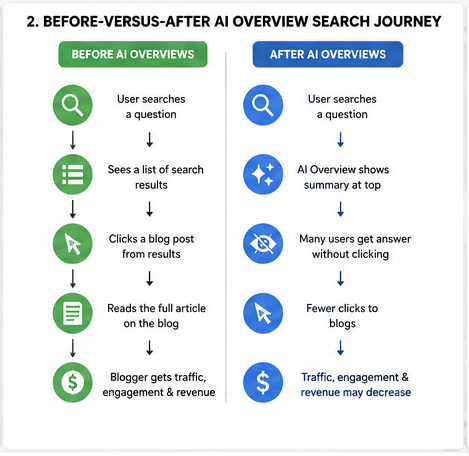
Before AI Overviews, search felt simple. A person ask one question. Google show links. They click one blog. Blogger gets visit, ad view, maybe sale. It was not always easy, but the road was clear.
Now the road changed.
A user types question, and Google AI Overviews gives a quick answer from many pages. Some people feel, “Okay, I got it,” and leave. No click comes. This is called zero-click search.
For bloggers, this can hurt. A page may still rank high, but organic CTR goes down. Simple “what is” posts often lose more clicks. I saw this kind of pain many writers talk about. Rank is there, traffic is not. Very confusing feeling.
Still, fewer clicks not always means bad clicks. Some visitors now come for proof, full steps, real story, or to buy something. These visits can be stronger.
So bloggers should not watch rank only. Track:
- clicks and CTR
- sales or leads
- revenue per visitor
- branded searches
- email sign-ups
- visits from AI tools
Now, visibility is not only position. Trust, citation, and brand name also matter.
4. Which Bloggers Are Losing the Most Income?
Not every blogger losing money same way. Some blogs get hit very hard because their whole work depend on easy Google clicks.
Ad-based information blogs face big trouble. Their posts answer simple things like meanings, short steps, basic facts, or small comparison. Now AI Search Overviews can show these answers on search page itself. Reader see answer there. No click. No page view. No ad money. It feel painful, mainly when old post was earning for many years.
Generic affiliate blogs also struggle. Many of them only copy product details. Same features, same words, same stock photos. No real testing. Reader cannot feel any real person used that item. Such review look empty.
Mass-made AI blogs face another issue. They publish too much, but every page sound similar. No story, no proof, no strong voice. People visit once and never return.
Google-only blogs also stand on weak ground. One CTR drop can hurt full month income.
The highest-risk blogs are not only small blogs. They are blogs giving information which AI can finish without making reader visit the original page.
5. Which Bloggers Are Still Earning Well?
Some bloggers still making good money after AI Search Overviews. Not because they publish more. They give something real.
First-hand blogs are strong. A travel writer show exact road, wrong hotel, missed bus, and what saved the trip. A software person share setup errors, screen steps, and fix that worked after five failed tries. AI can explain. But it was not standing there when the server broke at 2 a.m.
Expert websites also keep trust. Legal, health, finance, technical, and B2B readers do not want loose advice. They want a person who know the work, show proof, and explain risk without hiding hard parts.
Product-led blogs have another support. They sell useful things:
- templates
- courses
- tools
- software
- memberships
- paid groups
Traffic may fall, but old readers still come back.
Personal-brand writers also doing better. People type their name in search. They open email. They trust the voice, even when they disagree.
Community sites carry messy truth. Real users talk about failures, small wins, bad choices, and strange fixes. This lived knowledge is hard to copy.
Local and narrow blogs also survive. One city, one job type, one problem, one clear reader.
Bloggers who own expertise, audience relationships, or products are stronger than bloggers who only rent traffic from search engines.
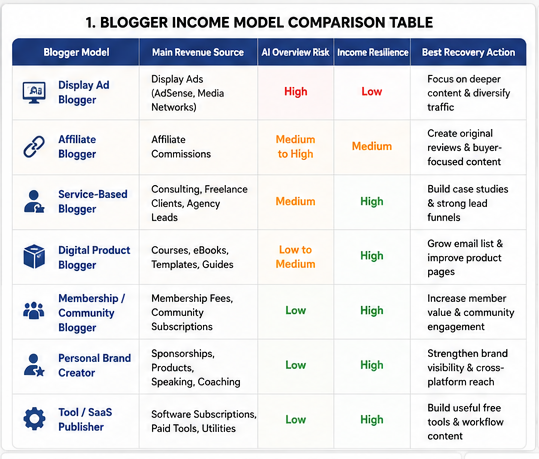
6. Real Blogger Income Models After AI Search
After AI search came, all bloggers not getting hurt same way. Some lose traffic fast. Some still earn good money. Main reason is not only content count now. The business model matter more.
| Blogger model | Main revenue source | AI Overview risk | Income resilience | Best recovery action |
|---|---|---|---|---|
| Display-ad blogger | Page views and ad clicks | High | Weak when traffic fall | Write deeper topics and bring traffic from many places |
| Affiliate blogger | Product commissions | Medium to high | Depends on buyer trust | Test products by own hand and write for real buyers |
| Service-based blogger | Consulting, freelance or agency leads | Low to medium | Strong when leads are good | Add real case studies and simple lead forms |
| Digital-product blogger | Templates, courses and guides | Lower | Good, because own product | Grow email list and improve product pages |
| Membership or community blogger | Monthly or yearly subscriptions | Lower | Strong when members stay | Help members get clear results and talk with them |
| Personal-brand creator | Sponsorships, products, speaking and consulting | Lower | Good when people know the name | Grow branded search and appear on many platforms |
| Tool or SaaS publisher | Software plans or paid tools | Lower | Strong if tool solves real pain | Give free useful tools and simple workflow guides |
I saw many bloggers keep posting five articles every week, but income still going down. They feel angry. Some think Google finished their work. But sometimes problem is simple: they only sell page views.
A display-ad blog need many visits. When AI Overview gives the answer on search page, visitor may not click. Income drops.
But a service blogger need maybe one good client, not ten thousand readers. A tool publisher also wins when one free calculator bring a paying user.
This is why real blogger income models after AI search depend on what happens after the click. Not only how many posts exist.
Better model gives more safety. Own audience, own product, own service. These things are hard, yes. Slow also. But they give blogger more control when search changes again.
Why Rankings Can Stay Stable While Income Falls
Your page still rank number three. Good news? Maybe not.
I saw this in my own blog. Ranking same. Impressions also looking fine. But money became less. At first, I blamed affiliate links. Then I looked deeper.
AI Overview was sitting above my result. Users got quick answer there. No click. Ads and shopping boxes also took more screen space, mainly on mobile phone. So ranking stayed, but attention gone.
Also, some visitors came only for free answer. They did not want product. My affiliate offer no longer matched their search need.
Check this path:
| Compare | What it may show |
|---|---|
| Impressions vs clicks | People see, but not visit |
| Clicks vs sessions | Tracking problem |
| Sessions vs sales | Weak visitor intent |
| Revenue by page | Pages losing money |
| Revenue by keyword | Wrong search intent |
Search visibility is no longer same as business visibility. Ranking report can smile while income quietly falling.
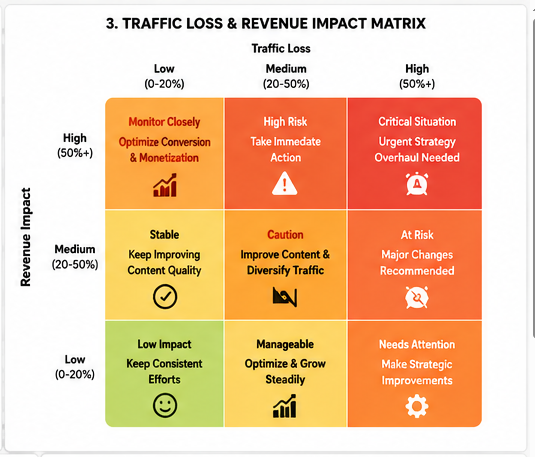
8. Are AI Overviews Affecting Every Niche Equally?
No. AI Overviews are not hitting every niche in same way.
Some topics get hurt fast. Basic meanings, small facts, easy health answers, first finance lessons, common travel facts, and simple tech guides. AI can give these answers in few lines. User read it, then leave. No click. This feel bad when blogger worked many hours.
Moderate-risk content still can get traffic. Software comparisons, recipes, product reviews, fixing guides, and long tutorials. But plain content may struggle. I once read ten review posts, all saying nearly same thing. No real photo. No testing. Nothing to trust.
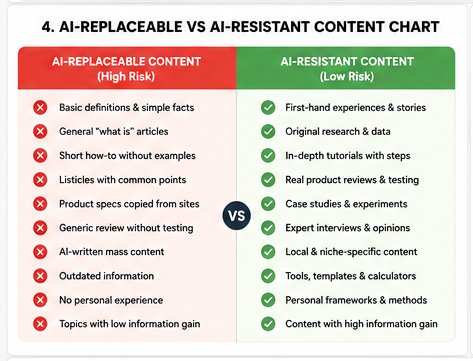
More resilient content gives something AI cannot easily copy:
- real product use
- local experience
- original survey or data
- expert case study
- difficult setup guide
- calculator or useful tool
- community stories
Still, no niche is fully safe.
Do not search for some magic AI-proof niche. Better create information gain. Show proof. Share mistakes. Explain what failed, what changed, and what finally worked. Useful depth can make reader stay, trust, and return.
What Content Can AI Overviews Not Easily Replace?
AI Overviews can give fast answer. But it cannot live your day. It never held the broken tool, lost money, tried again, and found what really work.
That is where strong content start.
Write from things you saw with own eyes. Show original research, survey data, personal test, before-and-after result, screenshots, photos, and real product testing. A reader trust more when proof sit there.
Once I followed a product guide that looked perfect. Nice words. No real photo. The method failed in ten minutes. Later, one small blogger showed the mistake with two phone pictures. That page helped more than twenty clean articles.
Useful content may include:
- expert interviews
- calculators and templates
- decision trees
- local field research
- failure stories
- recovery steps
- strong views with proof
- advice for one clear type of reader
Use this AI replacement test before publishing:
- Can AI answer it without my page?
- Do I have proof others not have?
- Must reader see examples or data?
- Did I really do this?
- Will it help someone choose or act?
When all five answer is no, the topic may be weak. Add proof. Add pain. Add the part that went wrong. That part often become the most useful one.
Real Failures Bloggers Experience and How They Recover
Many bloggers fail after AI Search Overviews, not because blogging fully dead. Mostly they keep doing old work, while search changed.
More posts, but same ideas
I also made this mistake before. Writing many articles felt like progress. But all posts saying almost same thing. Google sees no fresh value. Reader also leave fast.
Fix: Join weak posts together. Add real examples, screenshots, small tests, personal failure, and what worked after trying again.
Depending only on display ads
When traffic falls, ad money falls too. Simple. One blogger may have good page views today, then next month income become half. It feels scary.
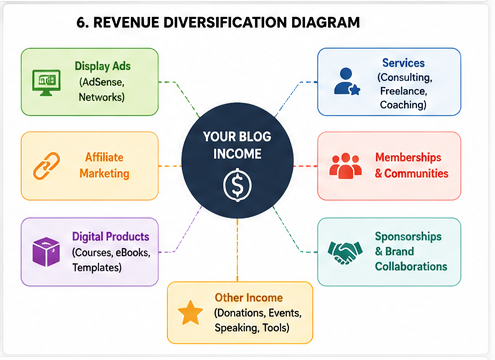
Fix: Add other income paths:
- useful affiliate products
- small digital guide
- paid template
- email offers
- service or coaching
Copying competitors with AI
AI can make fast article, but many articles then sound same. No soul. No proof. No reason to trust.
Fix: Put your own experience. Ask experts. Build your own method.
Chasing only big keywords
High-volume questions often get answered inside AI results.
Fix: Write narrow questions with clear problem and buying decision.
Forgetting readers
Google traffic is borrowed traffic.
Fix: Move readers into email list, social page, or private community. Then you not start from zero every day.
11. Practical Recovery Plan for Bloggers
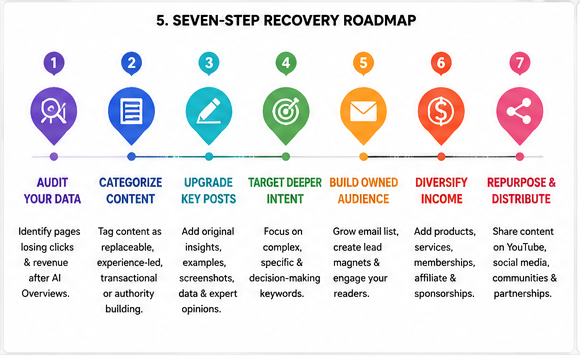
Traffic drop can feel very bad. One day blog is working. Next month, clicks fall, but ranking still look same. This happen more after AI Overview shows answer before your page.
Start with audit. Open Google Search Console and find pages where impressions stay, but clicks and CTR go down. Search those topics in Google too. See if AI summary taking big space.
Then sort every page.
| Content type | What it means |
|---|---|
| Replaceable | AI can answer it easy |
| Experience-led | You did it yourself |
| Transactional | Reader may buy |
| Authority-building | Shows your real knowledge |
| Conversion-focused | Brings leads or sales |
Do not delete weak posts fast. Improve them first. I had posts that looked dead, but after adding screenshots, real mistakes, small test results, and clear opinion, people stayed longer. The page felt alive again.
Go deeper with search need. “What is affiliate marketing?” is too wide. AI can finish it in few lines. Better topic is, “How much can a beginner earn from affiliate marketing with 10,000 monthly visitors?” This brings reader who need real answer.
Next, stop depending only on Google. Build newsletter. Give useful checklist, free tool, webinar, or small community. Even 300 loyal email readers may help more than random visitors.
Money also need more doors. Try digital products, consulting, services, sponsorships, memberships, or paid support.
Last step, reuse strong work. One research post can become YouTube video, LinkedIn post, email series, short clips, and downloadable guide.
The practical recovery plan for bloggers is not publish more. It is make each useful idea travel farther, help deeper, and earn in more than one way.
How to Optimise Content for AI Citations
Getting shown inside AI answers is not same like getting visitor. I learned this hard way. One page got mentioned, but clicks stayed small. Nice feeling first. Then little pain.
For better AI citations, answer the main question early. Do not hide it under long story. Use clear headings, same names for people, tools, brands, and topics. When one thing have three names, machine may get confused.
Add proof also. Real test. Real date. Real method. Not only big talk.
| Add this | Why it helps |
|---|---|
| Short answer box | Easy to understand |
| Table | Easy to compare |
| Original finding | Gives fresh value |
| Author details | Shows real knowledge |
| Internal links | Builds topic connection |
| Useful schema | Helps page meaning |
GEO and AEO can support SEO, but they do not replace it. Search ranking still matter.
Update old facts. Use trusted sources. Build brand mentions slowly.
Most important, give reason to click. Full data, tool, template, deeper steps, proof, or personal advice. AI may show small answer. Your page must hold the real help.
EEAT Proofs the Article Should Include
When talking about bloggers income, trust is big thing. Reader may feel doubt. I also feel same when one blog say, “I earn £10,000 every month,” but show nothing.
So article should give proof.
Add author bio. Tell how many years writing, what niche worked, what failed. Show real income examples, but hide private details. Revenue screenshots can help. Google Search Console and analytics images also show what really changed before and after AI Overviews.
Mention clear dates, traffic source, and money source.
| Proof | Why it matters |
|---|---|
| Income screenshot | Shows real earning |
| Traffic report | Shows where readers came |
| Method used | Helps others repeat it |
| Limits | Keeps claim honest |
One blogger result is not result for all. Niche, country, season, sample size and luck can change income. Big earners are seen more, failed blogs stay silent. This is survivor bias.
Also add expert quotes, original study links, update date, and affiliate note.
Truth may look small. Still, small truth is better than large fake promise.
The New Sustainable Blogging Income Formula
Blog traffic can look big, but money still small. I seen this many time. One post bring 10,000 readers, yet no one buy, join, or come back. It feel bad.
A better way is this:
Sustainable Blogging Income
Qualified attention × trust × conversion value × audience ownership × revenue diversity
Qualified attention means right people come with real problem.
Trust come from proof, honest words, mistakes, and true experience.
Conversion value is how much one reader may bring, not only page views.
Audience ownership means email list, direct readers, and your own community.
Revenue diversity means ads, products, service, affiliate, or membership.
High traffic is good. But traffic alone cannot feed a blog now. Loyal people, useful help, and more than one income door make blog strong.

Final Verdict: Is Blogging Still Profitable After AI Overviews?
Yes, blogging still profitable after AI Overviews. But old easy road is becoming narrow now.
Before, many bloggers write one simple answer, get Google visits, place ads, and earn. I also saw this method working. Then clicks became less. Ranking was still there, but money not coming same. It felt bad. Like shop is open, but people only looking from outside.
Still, blogging is not dead.
A blogger can grow by:
- sharing real work and mistakes
- writing for one clear group
- showing proof, photos, tests, and results
- building email readers
- selling service, tool, course, or product
- checking income, not only keyword rank
Generic facts are easy for search AI to show. Real experience is harder to copy.
AI Overviews may reduce value of replaceable information, but they increase value of original experience, trusted expertise, and useful products.
Frequently Asked Questions
How much do bloggers earn after AI Overviews?
There is no one income number. Some bloggers earn nothing, while some make full-time money. It depend on niche, visitor quality, products, ads, affiliate links, and loyal readers. A smaller blog with buying visitors may earn more than a large blog getting only question traffic.
Are bloggers losing money because of AI Overviews?
Yes, some bloggers are losing income. I seen sites still showing on Google, but clicks going down. This hurt blogs living mainly from display ads. When people get quick answer inside AI Overview, they may not open the blog at all.
Is blogging still worth starting?
Yes, but old way is getting risky. Do not build blog only for page views. Pick one clear audience and solve real problems. Share your own work, mistakes, photos, tests, and results. Build something readers remember, not another copied information site.
Which blogging niches are safest from AI?
No niche is fully safe. Still, local guides, expert advice, real reviews, personal journeys, tools, case studies, and buying-help content can stay stronger. AI can give a fast answer, but it cannot live your experience or test things like you did.
Can blogs receive traffic from AI search engines?
Yes, blogs can get visits from AI citations and source links. But traffic may be small or change often. Give readers reason to click, like full steps, proof, tables, templates, screenshots, or details which short AI answer cannot properly carry.
Should bloggers stop using SEO?
No. SEO still matter, but it cannot stand alone now. Use search optimisation with email, brand name, original research, social posts, and useful products. I would not throw SEO away. I would make it one road, not the whole journey.
How can bloggers replace lost Google traffic?
Start building traffic you partly control. Grow an email list. Make YouTube videos. Join useful communities. Work with other creators. Share practical posts on social sites. Create free tools or downloads. Google traffic can fall suddenly, but loyal readers can return by themselves.



Leave a Reply